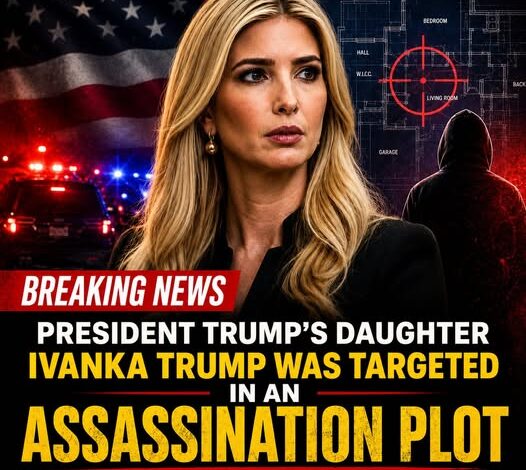
What makes stories like this so disturbing is not only the alleged plot itself, but the realization that modern geopolitical conflict no longer stays confined to battlefields, embassies, or military installations.
It travels quietly across borders.
Into neighborhoods.
Into family routines.
Into the private lives of people who wake up believing they stepped away from the center of political combat years earlier.
That is why the allegations surrounding threats tied to Ivanka Trump feel so unsettling to many Americans regardless of political affiliation.
Because the story forces an uncomfortable question:
How far does retaliation travel once nations begin treating individuals and families as symbolic targets?
At the center of the case sits the long shadow of the 2020 U.S. drone strike that killed Iranian General Qassem Soleimani near Baghdad International Airport. That strike did not simply eliminate one military figure. It reshaped an entire network of regional tensions, revenge narratives, intelligence priorities, and proxy relationships that continue reverberating years later.
For Iran and many aligned militias across the region, Soleimani was not viewed merely as a commander. He became a martyr figure — a symbol around which grief, nationalism, anti-American sentiment, and revenge rhetoric fused together. Since then, intelligence agencies across multiple countries have repeatedly warned about possible retaliatory threats aimed at current and former U.S. officials connected to decisions surrounding the strike.
What changes the emotional weight of this particular report is the suggestion that those threats may extend beyond political architects themselves and toward family members associated with them.
That shift matters psychologically because targeting relatives sends a very different message than targeting policymakers or military figures directly.
It says:
there is no true private life,
no safe distance from political conflict,
no guaranteed sanctuary behind resignation, relocation, or withdrawal from public office.
Ivanka Trump stepped away from frontline political life after her father’s presidency ended. Publicly, she attempted to reposition herself less as a political operative and more as a private citizen focused on family and business. Whether critics believed that distancing effort or not, the broader public perception gradually shifted. She appeared less frequently in campaign combat, less visibly involved in daily political warfare.
Yet cases like this suggest something darker about modern geopolitical conflict:
symbolic identities do not disappear simply because someone exits the spotlight.
To adversaries motivated by revenge or ideological messaging, family associations themselves can carry political meaning.
That reality creates a chilling emotional atmosphere around the allegations. Because suddenly the image changes from abstract foreign-policy conflict to something intensely domestic:
homes potentially monitored,
movements tracked,
private security assessments rewritten around invisible threats.
And if courts ultimately validate the accusations, the story becomes larger than one family entirely.
It becomes evidence of how international retaliation networks may attempt to penetrate ordinary American space itself.
That possibility unsettles people because Americans traditionally imagine geopolitical violence as something happening elsewhere:
overseas bases,
foreign capitals,
combat zones.
Not suburban routines.
Not school pickups.
Not private residences.
But intelligence professionals have long understood something the public often does not fully see:
modern asymmetrical conflict deliberately blurs those boundaries.
Proxy networks,
covert operatives,
cyber surveillance,
transnational intimidation,
and targeted plots increasingly operate through invisibility rather than conventional warfare.
Which brings attention to another important dimension of the story:
the invisible labor of security services.
Most successful counterterrorism and protective operations never become dramatic headlines because success often means interruption before violence occurs. Surveillance gets detected early. Communications are intercepted. Informants cooperate. Travel patterns raise alarms. Financial transactions trigger scrutiny.
The public sees only fragments afterward:
an indictment,
an arrest,
a brief statement from prosecutors.
What remains hidden is the constant preventative machinery operating beneath those announcements.
And that machinery exists precisely because intelligence agencies assume many threats never fully disappear after major geopolitical events.
The Soleimani strike fundamentally altered threat calculations for years. Security officials have repeatedly acknowledged concerns about retaliatory targeting tied not only to Donald Trump himself, but also to military leaders, former officials, diplomats, and associated figures connected symbolically to that decision.
If these allegations prove accurate, they reinforce how enduring those revenge frameworks remain.
Importantly, stories like this also reveal the emotional logic behind terror and intimidation strategies.
The goal is rarely only physical harm.
It is psychological destabilization.
Fear spreads outward through uncertainty:
Who is being watched?
Who else is vulnerable?
How many names appear on lists nobody sees?
How many plots never become public?
That uncertainty itself becomes part of the weapon.
Because once families feel unsafe in ordinary spaces, political conflict begins contaminating civilian emotional life far beyond government institutions.
And perhaps that is why these allegations resonate beyond partisan politics.
People may disagree fiercely about Donald Trump, his presidency, the Soleimani strike, or U.S. foreign policy generally. But most Americans still recognize a line separating political conflict from threats against family members and private households.
That line matters because democratic societies depend on some distinction between political disagreement and personal intimidation.
Without it, politics begins resembling clan warfare more than governance.
The alleged involvement of an Iraqi national reportedly connected to Iran-backed networks intensifies those fears because it reinforces broader anxieties about proxy operations functioning across borders with diffuse structures and shifting actors.
Modern geopolitical conflict increasingly relies on deniability and indirect networks:
aligned militias,
informal operatives,
loosely connected ideological actors,
regional intermediaries.
That ambiguity complicates both prevention and accountability.
And for ordinary citizens watching these stories unfold, it creates another unsettling realization:
many national-security battles now happen almost entirely out of public view.
Most people never hear about the threats disrupted quietly,
the surveillance operations conducted silently,
the names flagged internally,
or the investigations still unfolding behind sealed court documents.
They see only occasional glimpses when cases surface publicly.
But intelligence communities operate on the assumption that many more potential threats exist than the public ever learns about.
That reality can feel deeply uncomfortable because it suggests how much modern security depends on hidden systems functioning correctly without public visibility.
And perhaps that is ultimately what makes this story linger emotionally.
Not simply the celebrity name attached to it.
Not even the geopolitical backdrop alone.
But the recognition that political violence today increasingly works through invisibility:
through intimidation,
monitoring,
symbolism,
psychological pressure,
and the erosion of any clean boundary between public power and private life.
If the allegations are confirmed in court, the story will likely be remembered not merely as a threat against one prominent family member.
It will stand as another warning about the long afterlife of geopolitical conflict — how decisions made in war rooms and military briefings can echo years later through entirely different landscapes:
courtrooms,
security briefings,
suburban homes,
and frightened families trying to live ordinary lives under extraordinary shadows.
Because once nations enter cycles of revenge and symbolic retaliation, the consequences rarely remain contained to the original battlefield.
They spread outward quietly,
mapping relationships,
identities,
and vulnerabilities long after the world believes the headline itself has faded.