My Wife Abandoned Me with Our Blind Newborn Twins – 18 Years Later, She Returned with One Strict Demand

Eighteen years ago, my life split in two before the sun had fully risen.
I woke up expecting to hear the familiar sounds of a newborn household—the soft cries, the rustle of blankets, the exhaustion that comes with caring for twins. Instead, I found silence.
My wife was gone.
On the kitchen table sat a single note.
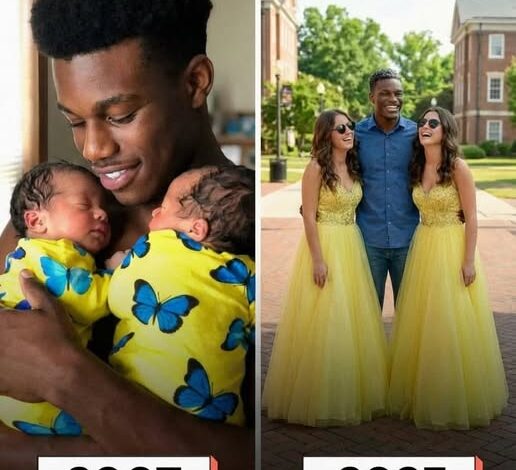
Beside it were our two newborn daughters.
Emma and Clara.
And a medical report confirming that both girls had been born blind.
For a long time, I stared at the paper in my hands, trying to make sense of what had happened. My wife hadn’t left an explanation that made sense. There were no promises to return, no timeline, no plan.
Just an apology.
And an exit.
I wish I could say I handled it with strength and certainty.
I didn’t.
I was terrified.
I was angry.
I was heartbroken.
Most of all, I was overwhelmed by the realization that two tiny human beings now depended entirely on me.
There wasn’t time to collapse.
There wasn’t time to grieve.
There were diapers to change, bottles to prepare, doctor appointments to attend, and two little girls who needed someone to show up every day.
So I did.
One day at a time.
One mistake at a time.
One victory at a time.
I taught myself braille before either of them could speak.
I spent nights studying raised dots under dim kitchen lights after they finally fell asleep.
I rearranged our tiny apartment so they could move through it safely. Every chair had a place. Every object had a purpose. Every room became a map they could memorize through touch and repetition.
What seemed impossible eventually became routine.
Not easy.
Never easy.
But possible.
As the years passed, we stopped thinking about what we lacked and started focusing on what we could build.
That was when sewing entered our lives.
It began with scraps of fabric.
Different textures fascinated the girls.
Silk felt different from cotton.
Velvet felt different from linen.
They explored materials with their fingertips the way other children explored colors.
Soon they wanted to create things.
At first, it was simple.
Small pouches.
Scarves.
Pillowcases.
Then came dresses.
Jackets.
Detailed patterns.
Designs that existed entirely in their minds before appearing beneath their hands.
What started as curiosity became talent.
And talent became passion.
Our apartment slowly filled with fabric rolls, sewing machines, sketches made in tactile formats, and unfinished projects draped across every available surface.
People often saw blindness as a limitation.
Emma and Clara saw it differently.
For them, touch revealed details most people overlooked.
They could feel symmetry.
Balance.
Texture.
Movement.
Emotion.
By the time they turned eighteen, they were creating gowns that left professional designers speechless.
I couldn’t have been prouder.
And for almost all those years, their mother remained a ghost.
A name that occasionally surfaced.
A question left unanswered.
A wound that gradually scarred over.
Then last week, she came back.
Without warning.
Without explanation.
Without shame.
I opened the door and barely recognized her.
She looked nothing like the woman who had left.
Designer clothes.
Expensive jewelry.
Perfect hair.
The confidence of someone accustomed to admiration.
Parked behind her was a luxury vehicle.
In her hands were garment bags containing stunning designer gowns.
And an envelope.
Thick.
Heavy.
Filled with money.
For a brief moment, I thought maybe she had come to apologize.
Maybe eighteen years had finally caught up with her.
Maybe she wanted to reconnect.
I was wrong.
She stepped inside and immediately began talking about opportunities.
Connections.
Success.
Influence.
Then she finally revealed why she was there.
The money, she explained, could help Emma and Clara.
The gowns could open doors.
She knew people in the industry.
She could elevate their careers.
But there was a condition.
A single condition.
They would need to publicly distance themselves from me.
Not completely.
Just enough.
Enough to reshape the story.
Enough to position her as the driving force behind their success.
Enough to make her look like the devoted mother who had sacrificed everything for her daughters.
She wanted interviews.
Public statements.
Social media posts.
Recognition.
Image rehabilitation.
What she wanted wasn’t reconciliation.
It was rebranding.
The room fell silent.
I looked at Emma.
Then Clara.
Neither spoke immediately.
Their mother smiled confidently, as though she believed the decision had already been made.
Money.
Connections.
Prestige.
Many people would have accepted.
Then Emma stood.
Clara followed.
Side by side.
Exactly the way they had stood together their entire lives.
And Emma spoke first.
“You left.”
The words were calm.
Not angry.
Not emotional.
Just true.
Their mother’s smile faded slightly.
“You weren’t there when we learned braille.”
Silence.
“You weren’t there when Dad worked double shifts.”
More silence.
“You weren’t there when we failed and had to start over.”
Clara stepped forward.
“You weren’t there for birthdays.”
“For graduations.”
“For surgeries.”
“For anything.”
Their mother attempted to interrupt.
They didn’t let her.
Emma shook her head.
“We don’t need gowns.”
Clara nodded.
“We don’t need money.”
Then together they delivered the words I will never forget.
“We needed a parent who stayed.”
The silence afterward felt enormous.
Their mother looked stunned.
As though the possibility of rejection had never occurred to her.
The envelope remained untouched.
The designer gowns remained unopened.
And for the first time in eighteen years, she had nothing to say.
She left shortly afterward.
The story should have ended there.
Instead, someone shared part of the encounter online.
Then another person shared it.
And another.
Within days, the story spread everywhere.
People weren’t interested because of the confrontation.
They were interested because two young women refused to sell their truth.
They refused to become props in someone else’s narrative.
They refused to trade loyalty for opportunity.
Public opinion shifted quickly.
Questions emerged.
Their mother’s carefully crafted image began to unravel.
Meanwhile, something unexpected happened.
Design schools reached out.
Industry professionals noticed their work.
Scholarship committees requested portfolios.
People finally saw what I had seen for years.
Not two blind girls overcoming obstacles.
Two extraordinarily talented artists.
Today, Emma and Clara are studying costume design through scholarships they earned entirely on their own merit.
Not because anyone felt sorry for them.
Because they are exceptional.
Every day, I watch them create.
Their fingers move confidently across fabric.
They discuss design concepts late into the night.
They argue over hems.
Celebrate completed projects.
Dream about futures they are building themselves.
And we’re still living in the same apartment.
Still sharing takeout.
Still stepping over fabric scraps scattered across the floor.
Still laughing until midnight.
Sometimes people ask whether I regret anything.
The truth is, I regret plenty.
I regret moments when I lost patience.
Times I doubted myself.
Days I feared I wasn’t enough.
But I never regret staying.
Because over eighteen years, I learned something simple.
People who leave often spend their lives chasing things they believe will complete them.
Money.
Status.
Recognition.
Approval.
People who stay build something different.
Trust.
Belonging.
Family.
Love.
The kind of things that cannot be bought back later.
Emma and Clara didn’t become strong because life was easy.
They became strong because they were loved consistently.
Without conditions.
Without transactions.
Without expectations.
And every time I watch them walk confidently toward a future they created with their own hands, I’m reminded of a truth that has carried us through everything:
The greatest gift a parent can give isn’t wealth, influence, or opportunity.
It’s staying.
Day after day.
Year after year.
When it’s difficult.
When it’s exhausting.
When nobody is watching.
Because in the end, love isn’t proven by what you offer when you return.
It’s proven by whether you were there all along.