For 300 people aboard Flight EK521, life was divided into two parts: the moments before the landing and everything that came after.
One minute they were preparing for what should have been a routine arrival. The next, they were staring into smoke, fire, and the terrifying possibility that they might never leave the aircraft alive.
No passenger who stepped onto that runway that day walked away unchanged.
The first sign that something was wrong came not through an announcement but through sensation. A violent jolt. A harsh scraping sound. The sickening vibration of metal grinding against concrete. The aircraft shuddered beneath them as it raced down the runway, no longer behaving as passengers expected a modern airliner to behave.
Then came the smoke.
Dark, choking, and impossible to ignore.
Inside the cabin, confusion spread almost instantly. People looked at one another, searching for reassurance that no one could provide. Children began crying. Some passengers gripped their armrests in silence while others reached instinctively for loved ones seated beside them.
The plane had stopped moving.
But the danger had only begun.
Outside, flames were beginning to consume the aircraft.
Inside, panic threatened to move faster than the fire itself.
In emergencies, human instinct often collides with survival. Some passengers reached for bags. Others searched for phones. A few seemed frozen in place, unable to process what was happening.
That is when the cabin crew became the difference between chaos and escape.
Training took over.
Fear had no time to negotiate.
Firm voices cut through the confusion.
“Leave everything.”
“Move now.”
“Go, go, go!”
The commands echoed through the cabin with an urgency that left no room for hesitation.
Crew members moved through smoke-filled aisles, directing terrified passengers toward exits. They repeated instructions again and again, forcing people to focus on the next step rather than the growing fear behind them.
Every second mattered.
A burning aircraft does not pause while passengers gather belongings.
It does not wait for panic to settle.
It does not grant extra time.
The crew understood that better than anyone.
Emergency exits swung open.
Inflatable slides deployed.
Heat rushed into the cabin.
Passengers began pouring out.
Some stumbled.
Some cried.
Some prayed.
Many moved on pure instinct.
The evacuation unfolded in minutes, but for those experiencing it, time seemed distorted. Every movement felt both frantic and painfully slow. Survivors would later remember fragments rather than a complete sequence of events—a crew member shouting instructions, the rush of hot air, the sight of smoke filling windows, the terrifying uncertainty of what was happening outside.
Then, suddenly, they were on the runway.
Alive.
Many could hardly believe it.
Families searched desperately for one another. Parents counted children. Friends embraced. Strangers held onto strangers.
Some passengers stood barefoot on the tarmac, staring back at the aircraft that had nearly become their grave.
Others simply collapsed in relief.
The sight before them felt unreal.
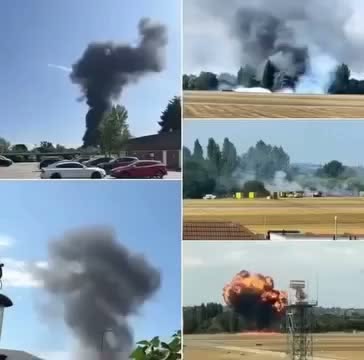
Flames engulfed sections of the plane.
Thick black smoke climbed into the sky.
The aircraft that had safely carried them for most of the journey now looked like something from a nightmare.
It was a moment suspended between catastrophe and miracle.
All 300 people aboard had escaped.
Yet while survivors gathered at a distance, another group of people was moving in the opposite direction.
Toward the fire.
Toward the danger.
Toward the uncertainty.
Firefighters rushed onto the scene knowing exactly what was at stake.
Where passengers saw a burning aircraft and fled, emergency responders saw a threat that still had to be contained.
Their mission was immediate.
Prevent further explosions.
Control the fire.
Protect lives.
They entered an environment filled with intense heat, smoke, fuel, and unpredictable hazards. Every step carried risk. Every second required courage.
For them, heroism was not a dramatic concept.
It was a job.
A responsibility.
A commitment to run toward danger when everyone else was trying to escape it.
During that battle, tragedy struck.
One firefighter lost his life while helping protect others.
His sacrifice forever changed the story of Flight EK521.
Without that loss, the incident might have been remembered solely as one of aviation’s most remarkable evacuations—a near-disaster where every passenger survived.
But his death introduced another reality.
Survival had come at a cost.
While families celebrated reunions and embraced loved ones, another family received devastating news.
Someone who had gone to work that day never came home.
That truth gives the story a weight that statistics alone cannot capture.
The successful evacuation remains extraordinary. The actions of the cabin crew undoubtedly saved lives. Yet the courage of the firefighter who died reminds us that rescue is often built upon personal sacrifice.
The people who escaped did so because others willingly stepped into danger.
In the days that followed, attention shifted toward understanding exactly what had happened.
Investigators began the painstaking work of reconstructing the event.
Every piece of evidence mattered.
Flight data would be analyzed.
Cockpit recordings would be reviewed.
Weather conditions examined.
Aircraft systems scrutinized.
Crew actions evaluated.
Experts would attempt to rebuild the final moments of the flight second by second, searching for answers hidden within thousands of technical details.
Aviation investigations are rarely about assigning quick blame.
They are about understanding.
Because every lesson learned from one incident has the potential to prevent another.
Yet while investigators focused on data, survivors faced a different challenge.
Memory.
Many would spend months—or years—replaying those moments.
The violent landing.
The smell of smoke.
The screams.
The uncertainty.
The desperate rush toward an exit.
Some would remember the stranger who helped them reach safety.
Others would remember the crew member whose voice cut through the panic.
Many would carry a complicated mixture of gratitude and fear.
Surviving a disaster often changes people in ways that are difficult to explain.
The body escapes.
The mind takes longer.
For the airline, the incident became a permanent chapter in an otherwise strong safety history.
Not because one event defines an organization, but because aviation is ultimately measured in human lives, not records.
Statistics can tell us how many people survived.
They can measure evacuation times.
They can count passengers and crew.
But numbers cannot explain what it feels like to stand on a runway watching flames consume the aircraft you escaped moments earlier.
Numbers cannot describe the relief of survival mixed with the guilt of knowing someone else was lost.
And numbers cannot measure the grief of a family whose loved one died protecting strangers.
That is why Flight EK521 remains more than an aviation incident.
It is a story of discipline under pressure.
A story of courage.
A story of ordinary people forced into extraordinary circumstances.
Most of all, it is a story about the fragile distance between life and disaster.
The smoke eventually cleared.
The fire was extinguished.
The runway reopened.
Investigators completed reports.
The world moved on.
But for those who lived through that day, time did not erase what happened.
Some memories become permanent.
The scrape of metal against concrete.
The heat of the flames.
The sound of shouted commands.
The sight of survival unfolding in real time.
And alongside those memories stands another image that must never be forgotten: a firefighter moving toward danger while everyone else moved away.
Three hundred people walked off that aircraft and continued their lives.
One rescuer did not.
And in the space between those two truths lies the lasting meaning of Flight EK521—a day marked by fear, bravery, survival, sacrifice, and the reminder that sometimes the greatest heroes are the ones whose names are remembered not for escaping danger, but for facing it.