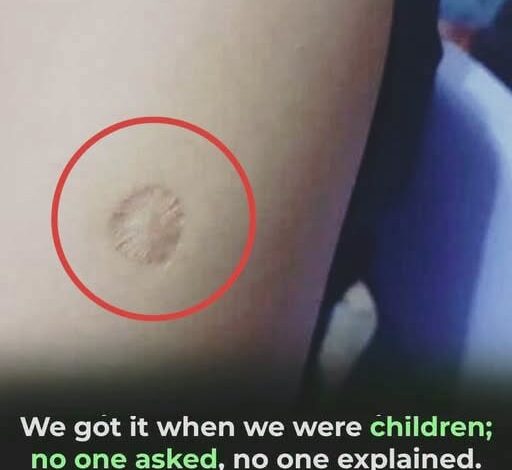
That small, circular mark on the upper arm of many older adults is more than an ordinary scar.
It is a lasting reminder of one of humanity’s greatest public health victories.
For much of history, smallpox was among the world’s most feared diseases. Caused by the variola virus, it spread rapidly from person to person, bringing high fever, exhaustion, and a painful rash that developed into fluid-filled blisters covering much of the body. Those who survived were often left with permanent scars, and many lost their eyesight or suffered other lifelong complications.
For countless others, there was no recovery at all.
Smallpox claimed hundreds of millions of lives over the centuries, devastating families and entire communities. Outbreaks could sweep through towns with terrifying speed, leaving few untouched and creating fear wherever the disease appeared.
The fight against smallpox required an extraordinary international effort.
Health workers traveled across cities, villages, and remote communities carrying vaccine supplies wherever they could. Clinics, schools, and temporary vaccination centers became gathering places where millions of people rolled up their sleeves in hopes of protecting themselves and those around them.
Unlike many modern vaccines delivered with a standard syringe, the smallpox vaccine was commonly administered using a bifurcated (two-pronged) needle. Healthcare workers dipped the needle into the vaccine solution and made a series of quick, shallow punctures in the skin.
A few days later, a small blister typically formed at the vaccination site.
As the blister healed, it often left behind a distinctive round scar that remained visible for life. That familiar mark became a quiet sign that someone had received protection against one of history’s deadliest infectious diseases.
The global vaccination campaign expanded year after year.
Governments, healthcare professionals, researchers, and international organizations worked together to identify outbreaks, vaccinate exposed communities, and stop the virus from spreading further. Through careful surveillance and widespread immunization, the number of cases steadily declined.
Then came a milestone few people had once believed possible.
In 1980, after years of coordinated international effort led by the World Health Organization (WHO), smallpox was officially declared eradicated worldwide.
It remains the only human infectious disease to have been completely eradicated through vaccination.
With the virus no longer circulating naturally, routine smallpox vaccination programs were discontinued in most countries. As new generations grew up without needing the vaccine, the familiar circular scar gradually became less common.
Today, seeing that mark often means looking at someone who lived during a very different era of public health.
For many older adults, the scar carries memories of school vaccination days, neighborhood clinics, or family stories about a disease younger generations have never had to fear.
For younger people, it offers a glimpse into history.
It reminds us that diseases once considered unstoppable can, through scientific research, international cooperation, and sustained public health efforts, be brought under control—and, in rare cases, eliminated entirely.
The scar itself is small.
Its meaning is enormous.
It represents generations of healthcare workers who traveled great distances to deliver vaccines, scientists who dedicated their lives to understanding infectious disease, and communities willing to participate in one of the largest public health campaigns ever undertaken.
Most importantly, it stands as a quiet reminder of what humanity can accomplish when nations work toward a common goal. That small circle on someone’s arm isn’t simply evidence of a vaccination given decades ago—it is a living piece of history, marking the moment when one of the world’s most devastating diseases was finally defeated.