John Wayne’s Final Oscar Appearance: Hollywood’s Emotional Farewell to a Legend
Few figures have left a larger imprint on American cinema than John Wayne.
For more than five decades, Wayne embodied the image of the classic Hollywood hero. Through Westerns, war films, and adventure stories, he became a symbol of strength, resilience, and determination. By the late 1970s, he was more than a movie star—he was a cultural icon whose influence extended far beyond the screen.
Yet one of the most memorable moments of his life came not during a film performance, but during a brief appearance at the 51st Academy Awards in 1979.
It would become one of Hollywood’s most emotional farewells.
A Career That Defined an Era
Born Marion Robert Morrison in 1907, John Wayne rose from modest beginnings in Hollywood to become one of the most recognizable actors in cinematic history.
His breakthrough role in Stagecoach (1939) transformed him into a leading man, and films such as Red River, The Quiet Man, Rio Bravo, and The Searchers cemented his reputation as the face of the American Western.
Across nearly 200 films, Wayne created characters who represented courage, independence, and moral conviction. Audiences around the world came to associate his deep voice, commanding presence, and distinctive walk with a uniquely American style of storytelling.
By the time he reached his seventies, Wayne had become one of the most respected figures in the entertainment industry.
The Health Battles Behind the Legend
Behind the public image, however, Wayne was fighting serious health challenges.
In 1964, he underwent surgery for lung cancer. Years later, he faced additional medical complications, including heart problems that required major surgery. Although he continued making public appearances when possible, his physical condition declined significantly during the final years of his life.
In early 1979, his health worsened further following another major medical procedure.
Friends and colleagues understood that each public appearance carried increasing difficulty. Even so, when longtime friend Bob Hope invited him to participate in the Academy Awards ceremony that spring, Wayne accepted.
The Night Hollywood Stood Together
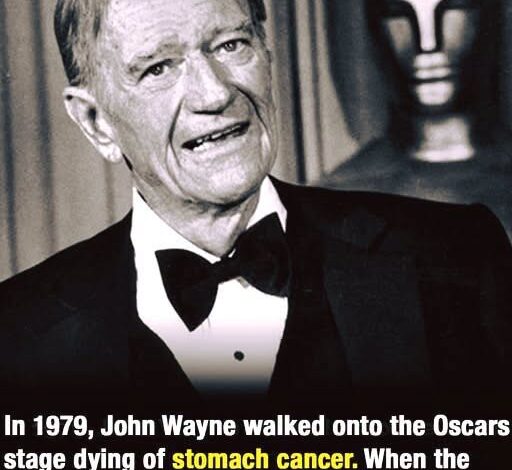
On April 9, 1979, Wayne arrived at the Dorothy Chandler Pavilion in Los Angeles for the Academy Awards.
The moment he walked onto the stage, the audience rose to its feet.
Actors.
Directors.
Producers.
Writers.
Industry veterans and rising stars alike stood in a prolonged standing ovation that seemed to acknowledge far more than a successful career. The applause reflected admiration, gratitude, and an understanding that many in the room might be seeing Wayne publicly for the final time.
Those who watched that night noticed how much he had changed physically.
He appeared thinner and noticeably weaker than audiences remembered from his most famous films. Yet despite his frailty, he retained the quiet confidence and dignity that had defined his screen persona for decades.
The applause continued.
And Wayne smiled.
A Brief but Powerful Speech
When the ovation finally subsided, Wayne addressed the audience in his characteristic style—simple, direct, and sincere.
Rather than delivering a lengthy speech, he offered words of appreciation for the support he had received throughout his career. His remarks reflected gratitude and humility, qualities that resonated deeply with those in attendance.
The audience response demonstrated how much affection Hollywood still held for him.
It was not merely respect for an actor.
It was respect for a man who had become part of cinema’s history.
Presenting Best Picture
Wayne’s role that evening was to help present the Academy Award for Best Picture.
The honor ultimately went to The Deer Hunter, one of the most acclaimed films of the year. Although Wayne’s participation lasted only a short time, his presence became one of the ceremony’s defining moments.
Many viewers remember little about the awards themselves.
They remember John Wayne standing on that stage.
The Final Months
Following the Academy Awards, Wayne’s health continued to decline.
Despite ongoing medical treatment and efforts to explore new options, his condition worsened over the following weeks. Yet those close to him often noted his determination and optimism, qualities that had characterized much of his life.
Even as illness limited his activities, his legacy continued to expand.
His films remained widely viewed, and younger generations were discovering the performances that had made him famous.
A Legacy Beyond Film
While Wayne will always be remembered for his contributions to cinema, part of his legacy extends into medical research and cancer treatment.
After his death, his family helped establish the John Wayne Cancer Institute, an organization dedicated to advancing cancer research and patient care. The institute became one of the most significant ways his influence continued beyond Hollywood.
It reflected the challenges he had faced personally and transformed them into a mission aimed at helping others.
The End of an Era
John Wayne died on June 11, 1979, at the age of 72.
News of his passing prompted tributes from around the world. Actors, filmmakers, political leaders, and fans reflected on a career that had helped shape American cinema throughout much of the twentieth century.
Yet among the many images associated with Wayne, one continues to stand out.
Not a scene from a Western.
Not a dramatic film moment.
But a frail yet determined actor standing before his peers as an entire room rose in appreciation.
Why the Moment Still Matters
More than four decades later, Wayne’s final Academy Awards appearance remains one of the most emotional moments in Oscar history.
It was a rare occasion when Hollywood paused to honor one of its giants while he was still there to witness it.
The standing ovation represented more than admiration for his films. It acknowledged a lifetime of work, perseverance through illness, and a connection with audiences that endured for generations.
For many, the moment serves as a reminder that legends are not defined only by their greatest performances.
Sometimes they are defined by how they face their final chapter.
John Wayne’s appearance at the 1979 Academy Awards was brief.
But it became one of the most unforgettable moments of his life—a final bow from a man whose influence on film history continues to endure long after the applause faded.