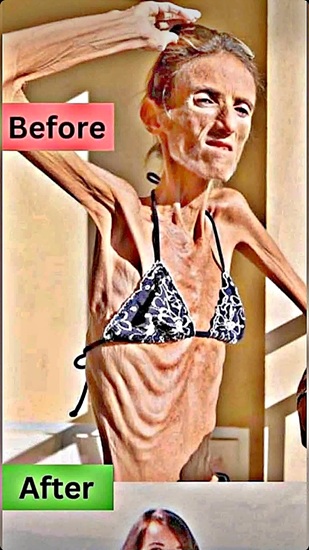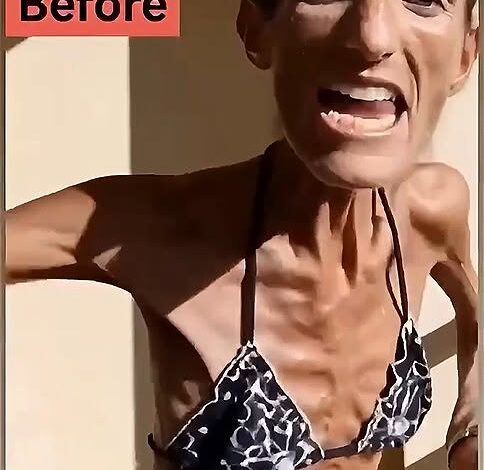
When people see a photograph of someone who has experienced extreme weight loss, their first reaction is often shock.
The image can be difficult to process.
Sharp bones protrude beneath thin skin. Clothing hangs loosely from a body that once looked entirely different. The person’s face appears older, more fragile, almost unrecognizable.
In a world obsessed with before-and-after transformations, such images spread quickly across social media. They attract attention, spark speculation, and often generate countless assumptions about what happened.
But behind every dramatic weight-loss story lies something far more important than the photograph itself.
A human being.
A struggle.
And often, a battle that few people fully understand.
Severe weight loss is not a condition in itself.
It is usually a symptom.
A warning sign that something deeper is happening inside the body or mind.
For some individuals, the cause may be a serious illness.
Cancer, gastrointestinal diseases, autoimmune disorders, chronic infections, and hormonal imbalances can all interfere with the body’s ability to absorb nutrients or maintain a healthy weight.
For others, mental health conditions may play a significant role.
Eating disorders, depression, anxiety, and other psychological challenges can profoundly affect a person’s relationship with food, nutrition, and self-care.
Regardless of the cause, the effects often extend far beyond physical appearance.
The human body is remarkably resilient.
Yet it depends on a steady supply of nutrients to function properly.
When that supply becomes inadequate for an extended period, the consequences can be widespread.
Muscle tissue begins to break down.
Energy reserves become depleted.
Strength gradually fades.
Tasks that once felt effortless suddenly become exhausting.
Something as simple as climbing stairs, carrying groceries, or standing for long periods can become overwhelming.
The body enters survival mode.
Every available resource is redirected toward maintaining essential functions.
Even then, challenges continue to emerge.
The immune system may weaken, making infections more common.
Bones can become fragile.
Healing slows.
Concentration becomes difficult.
Fatigue settles into daily life.
Many people who experience severe malnutrition describe a constant feeling of exhaustion, as though their bodies are running on empty no matter how much they rest.
Others struggle with dizziness, sensitivity to cold temperatures, or a persistent mental fog that makes everyday decisions feel unusually difficult.
These symptoms affect far more than physical health.
They affect confidence.
Relationships.
Independence.
Quality of life.
And for many people, the emotional burden can be just as challenging as the physical one.
Recovery begins with understanding the cause.
This is why medical evaluation is so important.
Doctors often use a combination of blood tests, imaging studies, nutritional assessments, and detailed medical histories to identify what may be contributing to the weight loss.
The process can sometimes be lengthy.
But finding the underlying cause is often the first critical step toward healing.
Once a diagnosis is established, treatment plans vary widely depending on the individual’s needs.
Some people require medications.
Others may need surgery.
Some benefit from nutritional rehabilitation programs.
Others require specialized mental health support.
In many cases, recovery involves multiple healthcare professionals working together.
Physicians.
Dietitians.
Therapists.
Rehabilitation specialists.
Family members.
Support networks.
Healing rarely happens in isolation.
One of the most misunderstood aspects of recovery is nutrition itself.
Many people assume that regaining lost weight is simply a matter of eating more food.
In reality, the process is often far more complex.
When someone has been severely undernourished for a prolonged period, the body adapts to survival conditions.
Suddenly increasing food intake without proper medical guidance can sometimes create serious complications.
For this reason, healthcare professionals often recommend a gradual approach.
Calories are increased carefully.
Protein intake is monitored.
Vitamin and mineral deficiencies are addressed.
Progress is evaluated consistently.
The goal is not simply weight gain.
The goal is rebuilding health safely.
As nutrition improves, remarkable changes often begin to occur.
Energy slowly returns.
Muscles regain strength.
Concentration improves.
The body begins repairing itself.
But recovery is rarely a straight line.
There are setbacks.
Frustrations.
Moments of doubt.
And periods when progress feels painfully slow.
This is especially true because healing is not purely physical.
Many individuals face significant emotional challenges during recovery.
Fear of relapse.
Anxiety about health.
Changes in body image.
Lingering psychological effects from illness or trauma.
These experiences can create obstacles that are invisible to others.
A person may appear healthier on the outside while still fighting difficult battles internally.
This is why emotional support plays such an important role.
Family members who offer patience.
Friends who provide encouragement.
Counselors who help navigate complex emotions.
Support groups where people share similar experiences.
These connections often become essential sources of strength.
Recovery teaches patience in ways few experiences can.
Popular culture often celebrates dramatic transformations.
Before-and-after photographs suggest rapid change.
Quick victories.
Instant success.
Reality is rarely so simple.
Meaningful recovery often unfolds over months or even years.
Progress may be measured in small milestones rather than dramatic breakthroughs.
Walking farther without fatigue.
Sleeping better.
Regaining an appetite.
Returning to work.
Participating in favorite activities again.
These moments may seem ordinary to outsiders.
To someone recovering from severe illness or malnutrition, they can feel extraordinary.
Social media has complicated public understanding of these journeys.
Images circulate rapidly, often without context or verification.
A dramatic transformation photograph may be presented as evidence of one condition when the actual story is entirely different.
Medical treatment.
Lifestyle changes.
Recovery from an eating disorder.
Management of a chronic illness.
Without reliable information, assumptions can quickly become misinformation.
This is why healthcare professionals consistently emphasize the importance of evidence-based sources.
Photographs can tell part of a story.
They cannot tell the whole story.
Understanding requires context.
Facts.
Medical expertise.
Compassion.
Perhaps the most inspiring aspect of recovery is the human body’s capacity to heal.
Despite immense challenges, many people successfully rebuild their strength, restore their health, and reclaim their lives.
Modern medicine, nutritional science, rehabilitation programs, and mental health support have dramatically improved outcomes for countless individuals.
Recovery may not always be easy.
It may not always be fast.
But it is often possible.
Every recovery journey is unique.
No two stories are exactly alike.
Yet many share common themes.
Perseverance.
Support.
Hope.
And the determination to keep moving forward even when progress feels slow.
These stories remind us of something important.
The human body is remarkable.
But the human spirit can be equally extraordinary.
When people receive proper medical care, accurate information, and meaningful support, recovery becomes more than a possibility.
It becomes a path forward.
A path marked not by perfection, but by persistence.
Not by dramatic headlines, but by daily victories.
And not by how far someone has fallen, but by their courage to keep rising.
Because behind every recovery story is more than a physical transformation.
There is a person rebuilding strength, reclaiming confidence, and proving that healing—while often difficult—is one of the most powerful forms of resilience the human experience can offer.