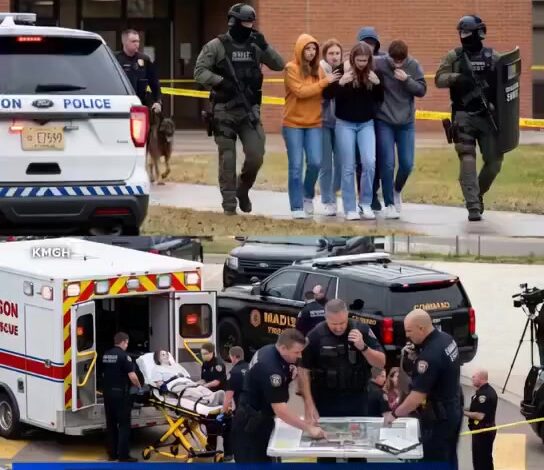
The balloons were still tied to the mailbox when the sirens arrived.
Bright red and yellow ribbons twisted in the evening wind while police lights washed over the neighborhood in pulses of blue and crimson. Hours earlier, children had raced across that same front yard clutching juice boxes and paper crowns, their sneakers pounding against dry grass while adults laughed from folding chairs beneath rented shade tents.
It had been an ordinary birthday party.
That detail haunted people most afterward.
Not a nightclub.
Not a dangerous street corner.
Not somewhere already associated with fear.
A child’s celebration.
Cake.
Music.
Plastic tablecloths fluttering against picnic tables.
The kind of gathering parents create specifically to make children feel safe.
Then suddenly, nothing felt safe anymore.
By the time first responders forced their way through the chaos inside the house, the celebration had collapsed into something almost unrecognizable. Frosting smeared across overturned paper plates. Half-filled juice cups tipped sideways beneath chairs. Wrapping paper clung wetly to the floor where people had stepped through spilled drinks and panic without noticing.
Near the kitchen doorway sat a birthday cake partially sliced through the middle.
One side remained decorated carefully with bright icing balloons and a child’s name written in uneven blue letters.
The other side had collapsed inward under its own weight.
That image stayed with firefighters later.
The cake somehow made everything feel unbearably real.
Because tragedy always lands harder against evidence of ordinary joy interrupted too quickly.
Tiny shoes remained lined neatly beside the front hallway wall where parents had asked children to leave them before running through the house.
One shoe sat upside down.
Another missing entirely.
Inside the living room, officers moved carefully between crying relatives trying desperately to account for everyone present. Parents clutched children so tightly that paramedics sometimes had to separate them gently just long enough to examine injuries properly.
A mother screamed every time someone tried taking her son from her arms for evaluation.
One little girl sat silently beneath a dining table refusing to come out even after officers promised she was safe.
A father wandered room to room repeating his daughter’s name despite already holding her hand.
Shock rearranges human behavior strangely.
Some people become frantic.
Others terrifyingly calm.
Outside, neighbors gathered in clusters beneath porch lights speaking in hushed voices that kept collapsing into silence.
“What happened?”
“Was it random?”
“Did someone know the family?”
No one seemed certain.
People watched stretchers disappear into ambulances while helicopters circled overhead and reporters began arriving faster than facts could.
Children from nearby houses stood barefoot on front lawns clutching blankets around their shoulders despite the warm night air.
Parents pulled them back repeatedly.
Stay close.
Not tonight.
Not now.
The neighborhood itself seemed stunned.
Stockton had seen violence before. Residents understood headlines, police tape, candlelight vigils. But something about this shattered people differently because birthdays belong emotionally to innocence. They represent continuity, family, ordinary hope.
The idea that terror could enter a room filled with children and birthday candles fractured something larger than physical safety.
It fractured assumption.
As detectives worked through surveillance footage overnight, investigators moved carefully around details too painful to release publicly yet impossible to ignore privately. Witness statements overlapped chaotically:
confusion,
noise,
people running,
children crying,
adults trying to shield bodies smaller than their own.
Every interview carried the same underlying disbelief.
It wasn’t supposed to happen here.
That sentence echoed across the city for days afterward.
But increasingly, Americans no longer know where “here” actually exists anymore.
Schools.
Churches.
Movie theaters.
Grocery stores.
Birthday parties.
Spaces once protected psychologically by innocence now feel conditional instead of secure. Parents learn emergency exits instinctively. Children practice lockdown drills before multiplication tables fully settle into memory.
And after each new tragedy, communities confront the same unbearable realization:
normal life now carries calculations previous generations never imagined making routinely.
How quickly can we leave?
Where are the exits?
Who would protect the children first?
Stockton felt that shift immediately.
By morning, pastors opened church doors early for grieving families who could not bear sitting alone with television coverage replaying overhead. Community centers organized trauma counselors before investigators even finished processing evidence. Volunteers arrived carrying bottled water, blankets, casseroles, anything tangible enough to offer against grief too large for language.
Because when violence tears through ordinary spaces, people instinctively begin searching for ways to rebuild meaning before fear hardens permanently.
Vigils formed quickly across the city.
Candles flickered beneath handwritten signs and photographs while strangers embraced one another despite never having met before. Children drew pictures in chalk outside schools:
balloons,
hearts,
sunshine,
names.
Adults cried harder looking at those drawings than they did watching official press conferences.
Perhaps because children still attempt to repair the world through innocence long after adults stop believing repair is possible.
The birthday child survived physically.
But survival after trauma is complicated.
Experts understand that children often remember catastrophe in fragments rather than coherent timelines:
sirens,
shouting,
someone pulling them suddenly toward the floor,
cake frosting drying against their hands while adults screamed nearby.
Years from now, long after headlines disappear, that child may still pause unexpectedly at the smell of vanilla icing or the sound of helicopters overhead without fully understanding why.
Trauma embeds itself quietly sometimes.
Not always through memory alone.
Through atmosphere.
Through nervous systems learning fear before language fully catches up.
And somewhere inside Stockton now, countless parents hold their children a little longer at bedtime because the illusion of guaranteed safety cracked visibly in front of them all.
That may be the deepest wound events like this leave behind.
Not only grief.
Hyperawareness.
The terrible understanding that ordinary joy can become emergency with almost no warning at all.
Still, even amid devastation, small acts of humanity persisted stubbornly through the darkness.
Neighbors opened homes to displaced relatives.
Restaurants delivered free meals to first responders.
Teachers volunteered for grief support sessions before schools reopened.
Communities do this after catastrophe.
They build temporary shelters out of tenderness because tenderness is often the only available resistance against despair.
And perhaps that is what Stockton will remember most clearly years from now.
Not only the flashing lights.
Not only the ambulances disappearing into the night.
But also the way people showed up afterward:
quietly,
imperfectly,
desperately trying to hold one another together after innocence shattered in a room still smelling faintly of birthday cake and candles.
The child whose celebration began in laughter will grow older carrying a story no birthday should contain.
A story retold softly across years by adults who still struggle explaining how joy and horror occupied the same house within the span of a single evening.
And somewhere beneath the grief, Stockton itself will continue wrestling with the same impossible question echoing through neighborhoods across the country:
how do people keep building ordinary life for their children once even the safest moments begin feeling fragile?