Psychotherapist issues chilling prediction that Donald Trump will ‘kill more people than Hitler’

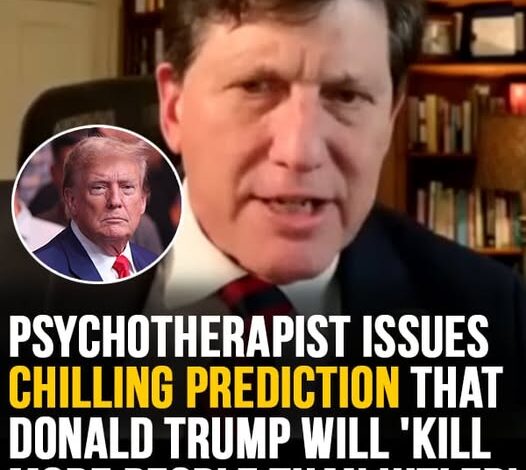
Psychotherapist Dr. John Gartner has spent years arguing that Donald Trump represents something far more dangerous than ordinary political extremism or ego. As founder of the Duty To Warn movement, Gartner believes mental health professionals have an ethical obligation to speak publicly when they perceive a leader as psychologically unstable and potentially dangerous. But his latest warnings move beyond controversy into territory many Americans find deeply unsettling.
Because Gartner is no longer merely describing narcissism.
He is describing what he believes is psychological deterioration unfolding in real time around one of the most powerful political figures on Earth.
Drawing from Trump’s speeches, interviews, social media posts, and increasingly grandiose public rhetoric, Gartner argues that the former president’s behavior reflects not simply confidence or theatrical self-promotion, but a dangerous fusion of cognitive decline, paranoia, and delusions of historical greatness. He points specifically to Trump comparing himself to figures like Jesus, Napoleon, Caesar, and Alexander the Great — not as isolated moments of exaggeration, but as signs of escalating grandiosity untethered from reality.
For Gartner, the issue is not style.
It is capacity.
And when that capacity belongs to someone who could command the U.S. military and nuclear arsenal, he believes the stakes become existential.
That fear sits underneath his most explosive statement: the claim that Trump could “kill more people than Hitler.” The line shocked even many critics of Trump because of its scale and emotional force. Gartner insists he is not predicting genocide in a literal historical sense, but warning about the catastrophic potential of a psychologically unstable leader controlling modern weapons systems, military power, and global influence.
To supporters of Trump, the comments sound hysterical, politically motivated, and profoundly irresponsible.
To Gartner and those who agree with him, silence feels even more dangerous.
That divide reflects a growing fracture not only in politics, but inside the mental health profession itself.
For decades, the American Psychiatric Association’s “Goldwater Rule” discouraged professionals from publicly diagnosing political figures they have not personally examined. The guideline emerged after psychiatrists publicly speculated about presidential candidate Barry Goldwater’s mental health during the 1964 election, an episode later viewed by many in the profession as unethical and politically corrosive.
Critics of Gartner argue the rule exists precisely to prevent psychiatry from becoming a partisan weapon.
They warn that diagnosing public figures remotely risks reducing complex political disagreements into medical accusations. Once mental health language becomes political ammunition, opponents argue, nearly every controversial leader could eventually be framed as psychologically unfit by ideological enemies claiming clinical authority.
From that perspective, Gartner’s rhetoric crosses a dangerous line.
Not only because of the claims themselves, but because of what happens if psychiatric speculation replaces democratic judgment in public life.
Yet Gartner rejects the idea that neutrality is ethically sufficient when he believes the risks are this severe.
He argues the Goldwater Rule was never intended to silence professionals witnessing what they interpret as visible psychological collapse in a leader capable of catastrophic decisions. In his view, Trump’s rhetoric, impulsivity, fixation on loyalty, conspiracy thinking, and increasingly apocalyptic language create patterns too alarming to ignore quietly.
And perhaps what unsettles many Americans most is not necessarily whether Gartner is correct.
It is the impossibility of proving the question cleanly either way.
Because political leadership has always existed in an uncomfortable space between performance and psychology. Presidents are expected to project strength, certainty, dominance, and historical significance almost by design. Trump, especially, built his political identity around exaggeration, spectacle, and personal mythology long before entering office. Supporters often interpret his grandiose statements not literally, but strategically — as branding, trolling, confidence, or media manipulation rather than delusion.
Critics see the exact same behavior and interpret something far darker.
That split reveals how deeply modern politics depends on perception rather than shared reality.
The same speech sounds charismatic to one audience and alarming to another.
The same behavior appears strong to some and unstable to others.
And once political identities harden emotionally, evidence itself becomes difficult to evaluate neutrally.
Still, Gartner’s warnings resonate because they tap into broader anxieties many Americans already carry privately about aging leaders, concentrated power, and psychological fitness in the nuclear era. Presidents are not ordinary executives. They oversee military systems capable of destruction on a scale previous generations could barely imagine. Every decision involving war, retaliation, diplomacy, or emergency powers depends heavily on judgment under pressure.
That reality makes questions about temperament impossible to dismiss entirely.
Even people uncomfortable with Gartner’s methods often admit the underlying issue matters: how should democracies evaluate psychological fitness for leaders whose decisions can affect millions of lives?
There are no easy answers.
Medical certainty itself becomes slippery when filtered through politics, media clips, partisan outrage, and public performance. Dementia, narcissism, cognitive decline, and personality disorders are serious clinical subjects — not hashtags or campaign slogans. Yet modern political culture increasingly compresses them into viral accusations, memes, and televised speculation where nuance disappears almost immediately.
The result is an atmosphere where genuine concern and partisan weaponization become difficult to separate cleanly.
And perhaps that is why Gartner’s comments provoke such intense reactions across the political spectrum.
Not only because they are provocative —
but because they force people to confront questions many would rather avoid.
What responsibilities do mental health professionals have when they believe a leader is dangerous?
When does public warning become political activism?
Can psychological instability even be evaluated honestly inside a media ecosystem driven by outrage and tribal loyalty?
And perhaps most hauntingly of all:
what happens if warnings dismissed as hysteria eventually prove partially true?
That final question lingers precisely because history contains examples of societies underestimating dangerous leaders until consequences became irreversible. Gartner invokes those fears deliberately, believing complacency itself poses risk. Critics counter that comparing political opponents to history’s worst tyrants inflames paranoia rather than protecting democracy.
Both sides claim to fear catastrophe.
They simply imagine different kinds.
And somewhere between those competing fears sits the American voter, forced to navigate a political landscape where psychology, power, celebrity, media spectacle, and existential anxiety now blur together almost completely.
The debate surrounding Trump’s mental fitness may never reach consensus.
There may never be one definitive moment proving either side fully right.
But the controversy itself reveals something significant about modern democracy:
Americans no longer argue only about policy.
They argue about reality, stability, perception, and whether the people seeking power can be trusted psychologically to hold it at all.
That uncertainty may be the most unsettling part of the entire conversation.
Not the diagnosis.
Not the rhetoric.
Not even the warnings themselves.
But the realization that millions of people are staring at the same public figure and seeing fundamentally different versions of sanity, danger, and leadership — while the stakes remain unimaginably high for everyone watching.