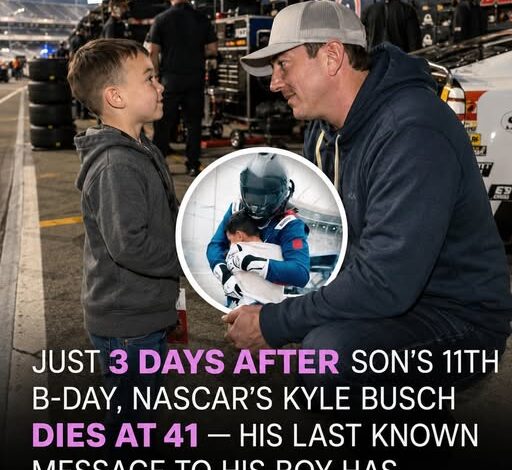
For a few frantic hours, the internet behaved as though Kyle Busch were gone.
Headlines spread faster than facts.
Screenshots multiplied without sources.
Social media timelines filled with shock, heartbreak, tribute photos, and disbelief before anyone paused long enough to ask the most important question:
Was any of it actually true?
It wasn’t.
Kyle Busch was alive.
But by the time reality caught up, something revealing had already happened. Thousands of people experienced genuine grief over a death that never occurred. Fans replayed memories of races, interviews, rivalries, family moments. Some cried. Others texted friends immediately. NASCAR communities spiraled collectively through fear before official clarification finally slowed the panic.
That emotional reaction matters.
Because it exposes something deeper than misinformation alone.
False celebrity death reports succeed precisely because the connection people feel is real.
Sports fans especially build long emotional histories around public figures. Over years, athletes stop feeling like distant strangers and begin occupying a strangely intimate place in people’s lives. Fans watch victories, breakdowns, marriages, injuries, rivalries, comebacks. They follow careers through divorces, parenthood, scandals, championships, aging.
Eventually the relationship becomes emotionally layered even if entirely one-sided.
Kyle Busch represents that kind of figure for many NASCAR fans.
To supporters, he is fiercely competitive, unapologetic, relentless behind the wheel. To critics, he has often embodied arrogance, volatility, and confrontation. But even people who dislike Busch professionally usually recognize his significance to the sport itself.
He is impossible to ignore.
Over time, audiences also watched him evolve publicly beyond racing alone:
husband,
father,
mentor,
family man balancing intensity with visible devotion to the people closest to him.
That visibility creates attachment.
And attachment creates vulnerability.
The moment false reports targeted Busch’s life, they triggered years of accumulated emotional investment instantly. Fans did not react only to a name in a headline. They reacted to memories attached to that name:
Sunday races with parents,
childhood heroes,
heated arguments about NASCAR standings,
moments shared across generations of viewers.
Bad actors understand this psychology extremely well.
Modern misinformation rarely spreads through logic first.
It spreads through emotion.
Fear travels quickly.
Shock travels faster.
Grief travels fastest of all.
A false death report bypasses skepticism because emotional systems activate before rational systems fully engage. People share first because they want connection, warning, collective mourning. Verification becomes secondary once panic takes hold.
Social media accelerates that process brutally.
Platforms reward immediacy over accuracy. Algorithms amplify engagement, not truth. The more emotionally charged a claim becomes, the more visibility it gains. And once enough people repeat something publicly, familiarity itself begins masquerading as evidence.
“I saw everyone talking about it” becomes mistaken for confirmation.
That dynamic makes celebrity death hoaxes uniquely damaging.
Not only because they frighten fans.
Because real families often discover the rumors simultaneously with the public.
Imagine waking up to messages of condolence while still very much alive.
Imagine children seeing headlines announcing a parent’s death before school.
Imagine spouses fielding calls from terrified relatives trying to determine whether tragedy has actually occurred.
For public figures, privacy during crisis barely exists already. False reports weaponize that vulnerability further.
In Busch’s case, the emotional whiplash revealed something unsettling about modern media culture: many people now consume “breaking news” less as verified information than emotional experience. Headlines become adrenaline events. Outrage, grief, panic, and shock circulate faster than correction ever can.
And corrections rarely travel with equal force.
By the time truth arrives quietly hours later, the emotional damage often remains.
Still, there is another side to the story too.
Because moments like this also create opportunities for reflection.
The false report surrounding Busch became a reminder of how desperately modern culture needs patience again. Not passive ignorance. Deliberate pause.
The simple discipline of asking:
Where did this information come from?
Has anyone confirmed it officially?
Am I reacting to evidence or momentum?
Those questions sound small.
But collectively, they matter enormously.
Every person who resists sharing unverified tragedy slows the machinery of panic slightly. Every pause creates space for truth to catch up. In an environment engineered for instant reaction, restraint becomes a form of responsibility.
That responsibility matters most during moments of genuine loss.
Because false alarms distort collective grief itself. They blur emotional trust between audiences and information systems. Over time, repeated hoaxes condition people toward skepticism even when tragedy eventually becomes real.
And real grief deserves better than that.
It deserves clarity.
Accuracy.
Care.
When an actual death occurs, families should not compete with rumor cycles or internet performance. Fans should not need to wonder whether mourning itself has become another manipulation.
Perhaps that is the deepest damage misinformation causes:
it corrodes trust emotionally long before people recognize the erosion intellectually.
And yet, strangely, the Busch episode also revealed something hopeful beneath the chaos.
People cared.
Deeply.
Fans responded emotionally because connection still exists in sports culture despite cynicism surrounding celebrity. Communities formed instantly around concern for another human being. Rivalries disappeared temporarily beneath shared fear. People who spent years criticizing Busch still expressed relief once the truth emerged.
That humanity matters too.
It reminds us that emotional investment itself is not the problem.
Care is not weakness.
Connection is not foolishness.
The danger lies in how quickly those emotions can be manipulated when speed outruns verification.
Kyle Busch’s false death became a modern cautionary tale precisely because it felt believable enough to wound people emotionally before facts intervened.
And maybe the lesson is not simply “don’t trust the internet.”
Maybe it is something more demanding:
slow down.
Pause before amplifying panic.
Wait before participating in grief.
Treat breaking news with enough skepticism to protect both the living and the dead.
Because someday genuine tragedy will come for someone people truly love publicly.
And when it does, our collective response should be grounded in truth rather than conditioned chaos.
Until then, every small act of patience matters.
Not only for public figures like Kyle Busch and their families —
but for the fragile integrity of shared reality itself.