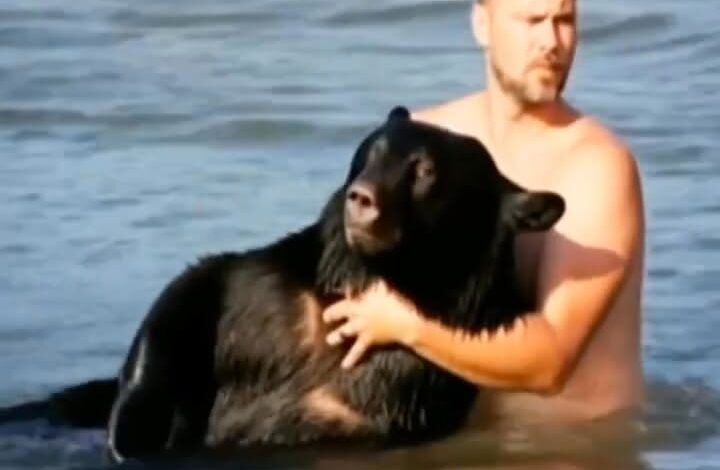
One wrong move. One split-second decision. One massive black bear drifting toward death in open water.
What began as a routine wildlife call on Florida’s Gulf Coast quickly transformed into a rescue that few people who witnessed it would ever forget.
In 2008, residents near Alligator Point spotted an unexpected visitor wandering dangerously close to homes—a fully grown black bear weighing nearly 400 pounds. While Florida is no stranger to encounters between humans and wildlife, the sheer size of the animal immediately raised concerns throughout the neighborhood.
Calls flooded into local authorities.
People worried about their safety. Wildlife officials worried about the bear.
The Florida Fish and Wildlife Conservation Commission responded quickly. Their mission was straightforward: remove the bear safely, protect nearby residents, and relocate the animal before the situation escalated.
At first, everything seemed under control.
Experienced wildlife officers assessed the scene and decided to use a tranquilizer dart, a standard tool for safely capturing and relocating large animals. The procedure had been used countless times before and generally worked without incident.
The dart struck its target.
For a brief moment, it appeared the operation would end quietly.
Then everything went wrong.
Startled by the impact, the bear reacted instantly. Instead of slowing down, it exploded into motion.
Witnesses watched in disbelief as the enormous animal charged away from the officers and headed directly toward the shoreline.
Within seconds, the bear plunged into the ocean.
What had been a controlled wildlife operation suddenly became a race against time.
At first, the bear swam strongly. But the tranquilizer was already beginning to take effect.
The powerful animal started losing coordination.
Its strokes became uneven.
Its movements slowed.
Those onshore quickly realized the danger.
A sedated bear cannot swim effectively.
As the medication continued working through its system, the animal’s chances of staying afloat diminished by the second.
The situation had transformed from a relocation effort into a life-or-death emergency.
Standing nearby was FWC biologist Adam Warwick.
He didn’t have time for lengthy discussions or carefully planned strategies.
He saw the bear struggling.
He saw it beginning to sink.
And he knew that if nobody acted immediately, the animal would drown.
Years later, Warwick would describe the decision as instinctive.
There was no grand plan.
No heroic speech.
Just a realization that every second mattered.
Without hesitation, he entered the water.
The risks were enormous.
This wasn’t a small animal in distress. It was a 400-pound black bear under the unpredictable effects of sedation. At any moment, it could panic, lash out, or regain enough strength to become extremely dangerous.
Most people would have stayed on shore.
Warwick didn’t.
Driven by equal parts training, responsibility, and adrenaline, he swam toward the struggling animal.
The scene was extraordinary.
The bear, clearly exhausted and disoriented, seemed to recognize that Warwick wasn’t a threat.
Instead of reacting aggressively, it allowed him to come alongside.
Even so, the task was far from easy.
The animal was losing its ability to keep its head above water.
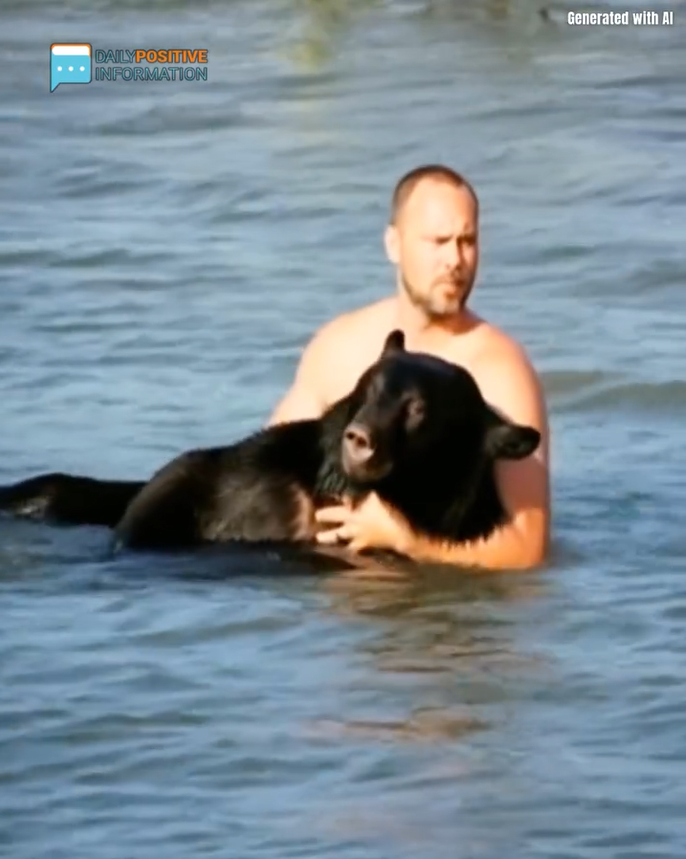
Warwick carefully positioned himself next to the bear and began guiding it toward safety.
Wave after wave pushed against them.
Every movement required effort.
The bear drifted lower.
Warwick adjusted.
The bear struggled.
Warwick kept moving.
For what felt like an eternity, he fought to keep the massive animal afloat while slowly steering it toward shallower water.
Those watching from shore could only hope the rescue would succeed.
The margin for error was almost nonexistent.
A single mistake could have cost either of them their lives.
But gradually, yard by yard, they made progress.
Eventually, the water became shallow enough for the bear to regain footing.
The exhausted animal reached land.
So did Warwick.
Remarkably, despite the danger and physical strain, the biologist escaped with only a minor scratch.
For everyone involved, it felt almost unbelievable.
The crisis wasn’t over yet, however.
The bear still needed to be transported safely before the sedative wore off completely.
Additional wildlife officers immediately moved into action.
Working together, they improvised a practical solution.
Using available equipment, including a tractor with a front-end bucket, the team carefully lifted and secured the exhausted bear.
The operation required patience and precision.
Nobody wanted to risk injuring the animal after coming so close to losing it.
Once safely contained, the bear was loaded for transport.
Its destination was Osceola National Forest, a vast protected area offering everything the animal needed to thrive—food, water, shelter, and distance from residential communities.
Warwick accompanied the relocation effort, ensuring the animal’s condition remained stable throughout the journey.
By the time the bear was released into its new environment, the dramatic rescue had already become the subject of conversation among wildlife officers across the state.
What could have ended as a tragedy had become a remarkable success story.
The incident also highlighted a growing challenge facing Florida and many other regions across North America.
As human development expands into natural habitats, encounters between people and wildlife become increasingly common.
Bears searching for food may wander into neighborhoods.
Residents may unknowingly attract wildlife through unsecured trash, pet food, or other sources.
Each interaction creates risks for both humans and animals.
That’s why wildlife professionals like Warwick play such a critical role.
Their job involves far more than relocating animals.
They must make rapid decisions under pressure, assess unpredictable situations, and balance public safety with animal welfare.
Sometimes those decisions carry significant personal risk.
Warwick has consistently downplayed his actions.
Rather than focusing on individual heroism, he has emphasized the teamwork involved and the broader mission of protecting Florida’s wildlife.
Yet those who witnessed the rescue understand just how extraordinary his response truly was.
Most people never face a choice between personal safety and saving the life of a struggling wild animal.
Warwick did.
And when that moment arrived, he acted.
The bear’s successful return to the wild became more than a rescue story.
It became a reminder of what conservation looks like in practice.
It isn’t always conducted in laboratories or discussed in policy meetings.
Sometimes conservation happens in the middle of a crisis.
Sometimes it involves muddy boots, split-second decisions, and a willingness to enter dangerous situations for the sake of preserving life.
Today, the rescued bear is long gone from public attention, living the life nature intended.
But the story continues to inspire wildlife professionals, conservationists, and animal lovers alike.
It serves as proof that expertise matters.
Preparation matters.
Courage matters.
Most importantly, it demonstrates that even when circumstances spiral out of control, one person’s quick thinking can make the difference between disaster and survival.
On that day near Alligator Point, a frightened bear entered the water facing almost certain death.
Because one biologist refused to stand by and watch, it got a second chance.