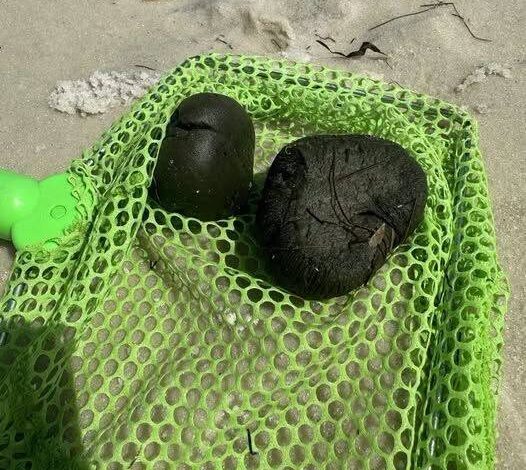
At first glance, they look almost too strange to be natural.
Scattered across the shoreline are dozens of dark, rounded balls that resemble something dropped from another world—or, as many beachgoers jokingly describe them, “sea turds.” Children immediately want to pick them up. Adults pause, wondering whether they’re looking at pollution, animal waste, or some unusual marine creature.
The real explanation is far more fascinating.
These unusual objects are commonly known as mudballs—naturally formed clumps of fine sediment that develop beneath the waters of places such as Pensacola Bay and other coastal environments with soft, clay-rich bottoms.
Their story begins underwater.
Along muddy banks and shallow estuaries, currents, waves, and changing tides gradually loosen pieces of compacted sediment. Once freed, these clumps begin rolling slowly across the bay floor. As they tumble, the motion compresses the mud while gently smoothing away rough edges.
The process is surprisingly similar to the way river stones become rounded over time.
With enough movement, the mud gradually forms remarkably smooth spheres or rounded lumps that range in color from dark green to nearly black. They often feel firm on the outside while remaining slightly soft or spongy when gently squeezed.
Finding one can feel like discovering a natural curiosity.
Despite their unusual appearance, these mudballs are generally harmless. Most are simply compacted sediment mixed with naturally occurring organic material. Freshly formed mudballs are often nearly odorless, though those containing more decaying organic matter may develop a mild earthy or marsh-like smell as they dry.
They are not sewage.
They are not manufactured waste.
They are simply one of nature’s quieter geological processes at work.
For children especially, they offer an unexpected opportunity for discovery.
One mysterious object can lead to all kinds of questions.
Why does mud roll into a ball?
How do tides move underwater?
Why is the mud darker in some places than others?
What other things are constantly changing beneath the surface where we can’t see them?
Those questions are the beginning of science.
Not because someone hands over the answers.
Because curiosity takes over.
Parents often find themselves kneeling in the sand alongside their children, turning an ordinary beach walk into an impromptu lesson about coastal ecosystems, sediment, erosion, and the hidden forces that shape shorelines every day.
The mudball itself may eventually crumble back into the beach.
The memory usually lasts much longer.
Years later, people rarely remember every shell they collected or every wave they chased.
They remember the strange little sphere that nobody could identify.
The excitement of carrying it back to the towel.
The laughter that came with inventing wild explanations before learning the real one.
Those are the moments that quietly turn a day at the beach into a lifelong memory.
Nature has a remarkable way of hiding its most interesting stories inside the most ordinary-looking objects.
A smooth stone.
A piece of sea glass.
A perfectly rounded mudball.
Each reminds us that the world is constantly shaping itself through patient, invisible processes we rarely notice until something unexpected washes ashore.
So the next time you spot one of these curious little spheres along the beach, don’t dismiss it as something strange or unpleasant.
Pick it up gently.
Take a closer look.
Ask a few questions.
You may discover that what first appeared to be an odd curiosity is actually a small, beautifully simple lesson in how tides, currents, and time quietly sculpt the natural world—one rolling mudball at a time.