Yesterday morning, while sorting laundry by the window, I noticed something that made my heart skip a beat

I almost destroyed them before I understood what they were.
That is the part I remember most clearly.
I was standing beside the window with a shirt stretched between my hands, halfway through an ordinary chore, when something on the fabric caught the light.
At first, I thought it was dirt.
Then I looked closer.
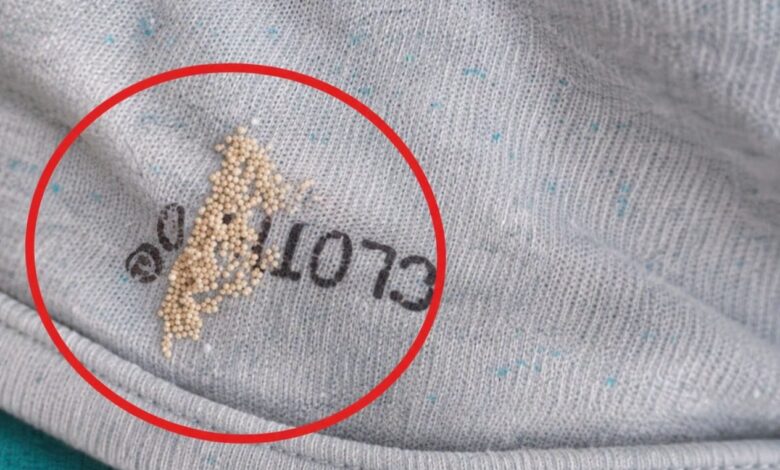
A small cluster of tiny round beads clung to the shirt, gathered together with such precision that they couldn’t possibly have landed there by accident.
My stomach tightened.
“What on earth is that?”
I brought the fabric closer to the window.
The little spheres were pale green, almost translucent in the daylight. They were incredibly small, but unmistakably three-dimensional, each one attached firmly to the material.
Eggs.
The word arrived immediately.
And with it came panic.
Bedbugs.
That was my first thought.
Then moths.
Then some other insect I couldn’t identify but was suddenly certain would destroy every piece of clothing I owned.
Within seconds, my imagination had moved far beyond the shirt in my hands.
I pictured opening drawers and finding insects crawling through everything.
I imagined mattresses being dragged outside.
Closets emptied.
Bags of clothing thrown away.
Chemical treatments.
Exterminators.
Days spent washing, vacuuming, scrubbing, inspecting.
The whole house seemed contaminated in my mind before I had even established what I was looking at.
I held the shirt farther away from my body.
That seems funny now.
At the time, it felt necessary.
I checked the sleeve.
Nothing.
The collar.
Nothing.
The other side.
Nothing.
Just that single strange cluster.
I considered scraping it off immediately.
My fingernail moved toward the fabric.
Then stopped.
Something wasn’t right.
Not frighteningly wrong.
Beautifully wrong.
The eggs were too orderly.
They weren’t hidden deep inside a seam or tucked into some dark fold.
They were sitting openly on the fabric.
And their color was extraordinary.
Not brown.
Not dirty white.
Not the ugly, unsettling shade I had unconsciously expected from something I had already classified as an infestation.
They were a soft, living green.
I leaned toward the window again.
Sunlight passed across them.
For the first time, fear loosened its grip enough for curiosity to enter.
I stopped asking:
How do I get rid of these?
And started asking:
What are these?
That small change transformed everything.
I studied the arrangement.
The tiny shapes seemed almost architectural, placed close together in a delicate pattern.
Whatever had left them there had done so intentionally.
The shirt had not been damaged.
There were no holes.
No webbing.
No obvious evidence that anything had been feeding on it.
Nothing else in the laundry seemed affected.
My catastrophic theory was beginning to collapse.
I thought about where the shirt had been.
Outside.
In the open air.
Accessible not only to pests but to all the ordinary creatures moving through the garden unnoticed.
Bees.
Flies.
Moths.
Butterflies.
Butterflies.
I froze.
Suddenly, the pale green color made sense.
The careful placement made sense.
The fact that the eggs were exposed rather than buried inside the fabric made sense.
I looked again, and the object in my hands seemed to change without changing at all.
Butterfly eggs.
The phrase felt almost absurd after the horror story I had constructed moments earlier.
I had been preparing for an infestation.
Instead, I was holding a nursery.
My first reaction was relief.
The second was embarrassment.
Then something much quieter arrived.
Awe.
I stood by the window staring at those tiny eggs and thought about what must have happened.
At some point, while the shirt was outside, a butterfly had landed on it.
Perhaps I had been inside making coffee.
Answering a message.
Cleaning the kitchen.
Thinking about bills.
Doing any of the hundreds of ordinary things that make up a day.
Meanwhile, outside, something delicate had settled onto a piece of my laundry.
It had paused there long enough to leave behind the beginning of another generation.
Then it had flown away.
I had missed the entire event.
That realization moved me more than I expected.
We like to imagine that meaningful moments announce themselves.
A dramatic sunset.
A birth.
A wedding.
A storm.
Something large enough to make us stop whatever we’re doing and pay attention.
But this had happened silently.
No announcement.
No audience.
No reason I should have noticed.
Life had simply continued doing what life does.
And it had chosen my shirt.
I laughed.
Of all places.
Not a perfect green leaf.
Not some picturesque wildflower.
Laundry.
A shirt I had probably worn dozens of times without thinking about it.
There was something wonderful about that.
The ordinary object in my hands had become temporarily precious because another living thing had treated it as a safe place.
My instinct to destroy the eggs disappeared.
Instead, I became afraid of hurting them.
Minutes earlier, I had been ready to scrape them off.
Now I was holding the shirt as carefully as if the fabric itself might bruise.
That reversal stayed with me.
Nothing about the eggs had changed.
They were the same size.
The same color.
Attached to the same piece of cloth.
Only my understanding had changed.
When I believed they were dangerous, I wanted them gone.
When I understood what they might represent, I wanted to protect them.
How much of fear works exactly that way?
We encounter something unfamiliar.
We don’t understand it.
So our minds fill the empty space with danger.
Unknown becomes threatening.
Strange becomes hostile.
Unidentified becomes something to eliminate.
Fear is fast.
Understanding is slower.
If I had followed my first impulse, there would have been no lesson.
Scrape.
Wash.
Forget.
Instead, hesitation gave curiosity enough time to catch up.
I gently set the shirt aside.
It felt ridiculous to treat laundry with such ceremony, but I couldn’t bring myself to disturb the cluster.
I kept looking at it.
Those eggs were astonishingly small.
Each contained almost nothing visible to me, yet inside something was happening.
Cells dividing.
Structures forming.
A process older than every house, road, machine, and city around me continuing quietly on a scrap of fabric.
There is something humbling about being reminded that nature does not recognize our categories.
To me, the shirt was clothing.
To the butterfly, apparently, it had been a surface.
A possible beginning.
Humans divide the world into objects according to their purpose.
Shirt.
Table.
Fence.
Window.
Garden.
Nature ignores those labels.
A bird sees a roof as somewhere to perch.
A spider sees the corner of a window as architecture.
A seed sees a crack in concrete as enough soil to try.
A butterfly sees hanging fabric and makes a decision I will never fully understand.
Life improvises.
Constantly.
Most of the time, we don’t notice.
That may have been the real gift hidden in those eggs.
They made me notice.
For the rest of the day, ordinary things looked slightly different.
I saw movement around plants I normally walked past.
I noticed insects hovering near flowers.
I looked more carefully at leaves.
I realized how much activity had always been happening around me without requiring my attention.
The world was crowded with beginnings.
I had simply been too busy to see them.
That thought followed me back inside.
How many things do we miss because we have already decided they’re ordinary?
Laundry is laundry.
A windowsill is a windowsill.
A garden is background scenery.
We move through routines efficiently because efficiency allows us not to look closely.
Wash.
Dry.
Fold.
Put away.
Repeat.
There is comfort in routine.
But routine can also make the miraculous invisible.
Not miraculous in the supernatural sense.
Miraculous because of improbability.
Because something fragile exists at all.
Because a creature weighing almost nothing can find a place, leave behind eggs smaller than beads, and continue a cycle that has been unfolding for millions of years.
And because I happened to notice before my hand destroyed it.
I kept thinking about that fingernail hovering above the cluster.
One second.
That was probably all that separated discovery from destruction.
It made me uncomfortable.
Not because removing insect eggs from clothing would make someone cruel. There are perfectly reasonable situations in which that is exactly what should be done.
What bothered me was how confidently I had reacted before knowing what I was seeing.
I had built an entire disaster from a handful of green dots.
Bedbugs.
Moths.
Fumigation.
Ruined clothes.
A contaminated house.
None of those things existed.
Fear had written the story first and asked for evidence later.
I recognized that habit.
Not only with insects.
With everything.
A strange noise in the house becomes an expensive repair.
An unanswered message becomes anger.
A delayed phone call becomes bad news.
An unfamiliar symptom becomes the worst diagnosis imaginable.
A person’s unusual expression becomes judgment.
Our minds dislike empty spaces.
When information is missing, imagination volunteers.
And imagination, when frightened, is rarely optimistic.
Those eggs became a small reminder to wait.
Look again.
Ask another question.
Let curiosity stand beside fear before deciding which one deserves control.
Sometimes danger is real.
Sometimes immediate action is necessary.
But sometimes the frightening thing is frightening only because we haven’t identified it yet.
I left the shirt alone.
Every time I passed it, I checked the tiny cluster.
The garment itself became almost irrelevant.
I wasn’t seeing something I needed to wear anymore.
I was seeing a temporary shelter.
I wondered what might emerge.
What color it might eventually become.
Whether something so tiny could really transform into the winged creature I was imagining.
Transformation is such an overused metaphor that we sometimes forget how astonishing the literal version is.
An egg.
A caterpillar.
A chrysalis.
A butterfly.
If someone invented that sequence for a fantasy story, it would seem excessive.
Nature does it routinely.
That was the strangest part.
To me, the eggs were an event.
To nature, they were Tuesday.
Perhaps wonder is often just ordinary reality viewed with enough attention.
The more I thought about it, the less embarrassed I felt about my initial panic.
In fact, the panic made the later awe sharper.
I had moved from wanting to destroy something to wanting to protect it.
From disgust to fascination.
From certainty to curiosity.
All because I looked twice.
There was a lesson in that I didn’t want to lose.
So I began treating the memory almost like a mental checkpoint.
Whenever something unfamiliar immediately frightens me, I try to remember the shirt.
Not to tell myself everything is harmless.
That would be foolish.
But to ask:
Do I know what this is?
Or have I merely decided what it is?
There is enormous distance between those questions.
Fear often hides inside that distance.
So does discovery.
The shirt eventually became more than clothing to me.
It represented interruption.
A tiny break in routine.
A moment when the world asked me to stop moving automatically.
I had been doing laundry.
Nothing important.
Nothing memorable.
Then suddenly I was standing beside a window holding evidence that an entire life cycle had brushed against mine without permission or announcement.
That is what I love most about the memory now.
I didn’t go searching for wonder.
Wonder attached itself to my laundry.
It appeared in the middle of something mundane and almost got scrubbed away because I was too frightened to recognize it.
Maybe that is why the smallest discoveries can stay with us.
Grand experiences arrive already labeled as meaningful.
We prepare ourselves to appreciate them.
The ordinary ones test whether we’re paying attention.
A strange pattern on a leaf.
A bird building a nest somewhere inconvenient.
A flower growing through pavement.
Tiny green eggs on a shirt.
They don’t demand reverence.
They simply exist.
We decide whether to notice.
That day, almost accidentally, I did.
I stood there with the fabric trembling slightly in my hands and watched panic become curiosity, curiosity become understanding, and understanding become something close to gratitude.
I had started the moment thinking:
How do I get rid of this?
I ended it thinking:
How do I keep from hurting it?
Nothing in the room had changed.
The same window.
The same daylight.
The same unfinished chores waiting for me.
But the world felt slightly larger.
Less predictable.
More alive.
I set the shirt aside gently and returned to what I had been doing.
Eventually, the laundry still needed folding.
The floor still needed cleaning.
Dinner still had to be made.
Ordinary life resumed because ordinary life always does.
But now something extraordinary was sitting quietly within it.
A handful of pale green beginnings.
No bigger than beads.
Almost invisible unless you stopped to look.
And that became the lesson I carried forward.
Not everything unfamiliar is an invasion.
Not everything strange needs to be destroyed.
Not every interruption is a problem waiting to be solved.
Sometimes life enters our routines in forms we don’t immediately recognize.
Sometimes fear speaks first.
Sometimes wonder gets the second word.
And sometimes, if we’re patient enough to look twice, the thing that made us recoil becomes the very thing we’re grateful we didn’t brush away.