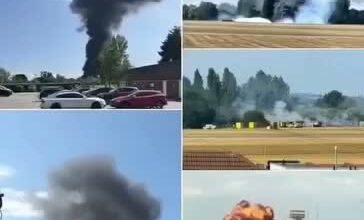
No one could later agree on the exact moment when panic gave way to something quieter. It wasn’t hope, and it certainly wasn’t acceptance. It was a strange, exhausted stillness that settled over the neighborhood once the sirens faded into the background and the thick clouds of smoke began to drift away. After hours of terror, people simply ran out of fear. What remained was the unbearable task of looking at what the disaster had left behind.
As the haze slowly lifted, the destruction revealed itself with cruel clarity.
Entire homes stood open to the street, their front walls torn away as though someone had peeled them back by hand. Bedrooms, kitchens, family photographs, children’s drawings taped to refrigerators, and half-finished dinners sat exposed beneath the gray morning sky. The ordinary details of private lives—things that had never been meant for strangers’ eyes—were suddenly visible to everyone passing through.
It felt deeply unsettling.
Not because possessions had been destroyed.
Because intimacy itself had been stripped away.
Cars that only hours earlier had carried people to work, school, or the grocery store now rested twisted and blackened along the roadside. Windows had melted into jagged edges. Metal frames sagged under impossible heat, some vehicles fused to the pavement as though they had become part of the road itself.
Nothing looked familiar anymore.
Among the wreckage stood one image that many witnesses would remember long after everything else had blurred together.
A single shoe.
It remained perfectly upright in the middle of the street, untouched amid the chaos. There were no footprints leading toward it. None leading away. It stood alone against a backdrop of shattered glass and scattered debris, transforming an ordinary object into something almost impossible to forget.
People moved through the neighborhood as though the world itself had grown heavier.
Every step seemed deliberate.
Every movement cautious.
It wasn’t simply exhaustion.
It was the fragile awareness that one unexpected sound or one painful discovery might break whatever strength they had managed to hold together.
Neighbors called out names again and again, their voices echoing through streets that no longer resembled the places they had known for years. At first, those calls were urgent and hopeful.
Then they became quieter.
Voices grew hoarse from repetition.
Eventually, some people stopped shouting altogether.
They continued forming familiar names with trembling lips, but no sound emerged. The words remained trapped somewhere between memory and disbelief, too painful to release yet impossible to let go.
For a fortunate few, the waiting finally ended.
A familiar voice answered.
Someone emerged from behind emergency vehicles or stepped carefully through the rubble, and moments later two people found each other in embraces so tight they seemed almost desperate. Tears replaced words. Relief arrived alongside overwhelming disbelief that either of them had survived at all.
Those reunions became small miracles inside an otherwise devastating landscape.
Not everyone received one.
Many families continued searching long after hope had begun slipping away. They clung to every rumor, every unconfirmed report, every whispered possibility that someone had been taken to another hospital or evacuated before official records were completed.
Questions lingered where certainty refused to exist.
Some would never receive the answers they desperately sought.
No investigation could fully explain every missing moment.
No report could restore the conversations interrupted forever.
No apology could reach backward through time and change what had already happened.
As emergency crews completed their work and media attention gradually shifted elsewhere, another challenge quietly began.
Survival.
The cameras captured dramatic rescues and collapsing buildings.
They rarely remained for the paperwork.
Kitchen tables that once hosted family dinners became temporary offices covered with insurance documents, assistance applications, identification forms, contractor estimates, and endless lists of everything that had disappeared overnight.
People learned a new vocabulary almost immediately.
Claims.
Assessments.
Temporary housing.
Replacement costs.
Disaster assistance.
Each form required them to describe lives that no longer existed.
Every signature forced them to calculate the value of memories that had never been meant to carry price tags.
Officials stood before microphones promising investigations, accountability, and comprehensive reviews. Experts reconstructed timelines, identifying failures, missed opportunities, communication breakdowns, and procedural mistakes. Charts were presented. Reports were published. Recommendations were announced with solemn determination.
Those efforts mattered.
But for the people who had breathed that smoke and walked through those ruined streets, they could never tell the entire story.
Because the deepest wound was not administrative.
It was emotional.
Many survivors admitted they had always believed disaster belonged somewhere else. Serious emergencies happened on television, in distant cities, to strangers whose names disappeared from headlines a week later.
Home was supposed to mean safety.
That belief vanished in a single day.
They discovered that security is often something we build from routine rather than certainty. We lock our doors, check smoke alarms, wave to neighbors, and convince ourselves tomorrow will resemble yesterday because imagining anything else would make ordinary life impossible.
After the disaster, that illusion never fully returned.
Even so, something remarkable began unfolding.
Neighbors who had barely spoken before shared tools, meals, and spare bedrooms. Volunteers arrived carrying bottled water, blankets, clothing, and quiet determination. Children drew hopeful pictures for families they had never met. Strangers spent weekends helping rebuild homes that were not their own.
Compassion slowly began filling spaces where destruction had once stood.
Months later, new walls rose where shattered ones had fallen. Fresh paint covered blackened surfaces. Windows reflected sunlight instead of smoke. Gardens were replanted. Front porches welcomed conversation once again.
Yet beneath every repair remained invisible scars.
Certain smells still transported people back to that day.
Certain sounds still caused hearts to race.
Certain anniversaries remained almost impossible to endure.
Healing, they learned, was never the same as forgetting.
And perhaps it was never meant to be.
Those who chose to remain did not rebuild because they believed tragedy could never return. Life had already taught them that certainty is fragile. They rebuilt because abandoning the place where love, laughter, and loss had all existed together felt like surrendering more than buildings. Every restored doorway honored the people who had once walked through it. Every repaired home became an act of quiet defiance against despair. The scorch marks hidden beneath fresh paint were never truly erased, nor were the memories carried by those who survived. But each sunrise over streets slowly coming back to life testified to a simple, enduring truth: remembering is not only something we do in silence or at memorials. Sometimes the greatest tribute is choosing to live, to rebuild, and to keep creating new memories in the very place where the old ones were almost lost forever.