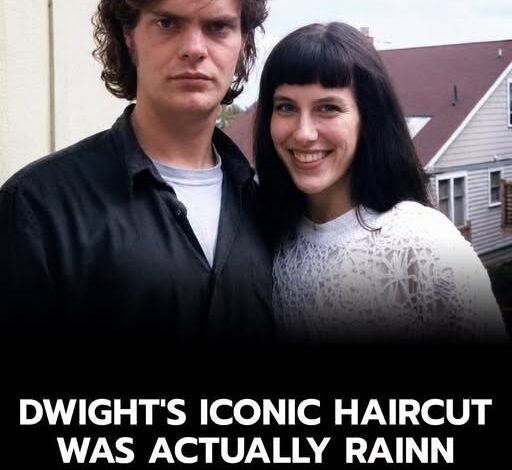
Long before Dwight Schrute became one of television’s most unforgettable characters, he existed in a much less glamorous form: a teenage haircut from the 1980s.
Most fans assume iconic characters are built from elaborate creative decisions, carefully crafted from scratch by writers, actors, and producers. But sometimes the details that make a character feel real come from something far more personal. In Dwight’s case, one of his most recognizable features—the severe center part, the flat shape, the complete absence of style masquerading as professionalism—came directly from Rainn Wilson’s own past.
When Wilson landed the role on The Office, he didn’t invent Dwight out of thin air. Instead, he dug through old memories and found pieces of himself he had never completely left behind. The intensity. The social awkwardness. The absolute certainty. And yes, the haircut.
That perfectly parted look was inspired by the hairstyle Wilson actually wore as a teenager during the 1980s.
The revelation somehow makes Dwight even funnier.
But more importantly, it makes him more human.
For years, fans have struggled to explain why Dwight feels different from so many sitcom oddballs. On paper, he should have been a one-note joke. He was obsessed with beet farming. He treated office policies like military doctrine. He carried survival gear, practiced martial arts with alarming seriousness, and approached paper sales as though civilization depended on it.
Yet Dwight never felt like a cartoon.
He felt familiar.
Almost everyone has known a Dwight at some point. Maybe it was a classmate who followed every rule with religious devotion. Maybe it was the coworker who cared too much about authority. Maybe it was the kid who desperately wanted respect but had no idea how to earn it socially.
That authenticity did not happen by accident.
Wilson understood something essential about the character from the beginning: Dwight could never know he was funny.
Many comedic characters are built around self-awareness. They crack jokes, wink at the audience, or seem conscious of their own absurdity. Dwight did none of those things. He believed every word he said. He approached every situation with complete sincerity. Whether he was discussing agricultural practices, emergency preparedness, office hierarchy, or personal honor, his commitment never wavered.
That commitment became the foundation of the character.
The haircut played a surprisingly important role in that process.
Before Dwight ever opened his mouth, viewers already understood something about him. The severe center part suggested a man who valued practicality over appearance. The rigid shape hinted at someone who followed rules even when no one else cared. The style looked outdated, unfashionable, and oddly confident all at once.
It told a story before the dialogue ever began.
The moment Dwight walked into a scene, audiences instinctively understood they were looking at someone who took himself very seriously—even if nobody around him did.
That visual shorthand became part of the magic.
Because beneath the strange appearance and bizarre behavior was a surprisingly vulnerable person.
Wilson never approached Dwight as a joke to be mocked. Instead, he treated him as someone worthy of protection. Underneath the awkward conversations, stiff posture, and endless need for validation was a man searching for purpose. Dwight wanted respect. He wanted loyalty. He wanted recognition. More than anything, he wanted to matter.
The problem was that he rarely knew how to express those desires in a normal way.
So he hid behind systems.
Rules made sense.
Authority made sense.
Structure made sense.
People, on the other hand, were confusing.
Emotions were unpredictable.
Relationships were messy.
Dwight’s obsession with order became a form of armor, protecting him from situations he did not fully understand. The more uncomfortable he felt, the tighter he clung to certainty. The more vulnerable he became, the harder he tried to appear confident.
That emotional truth transformed him from a source of comedy into something much more enduring.
As The Office evolved, so did audience perception of Dwight. What began as laughter slowly turned into affection. Viewers started seeing past the eccentricities. They noticed his loyalty to Michael. They recognized his dedication to the people he cared about. They saw moments of courage, heartbreak, and unexpected kindness hiding beneath the rigid exterior.
Suddenly, the strange guy sitting at the neighboring desk became one of the emotional centers of the entire series.
That transformation is remarkably rare in television.
Many comedy characters remain frozen in place, repeating the same jokes season after season. Dwight grew. He changed. He revealed layers nobody expected during those early episodes.
By the show’s final seasons, fans were no longer laughing at him simply because he was weird.
They were rooting for him.
They wanted him to succeed.
They wanted him to find happiness.
And when he finally achieved many of the things he had always wanted—respect, leadership, love—it felt earned.
Perhaps that is why Dwight remains so beloved years after The Office ended.
He represents something deeply recognizable.
Not perfection.
Not coolness.
Not effortless confidence.
He represents every person who has ever felt awkward in a room full of people who seemed to understand social rules better than they did. Every person who cared too much. Every person who tried too hard. Every person who built protective walls because vulnerability felt dangerous.
Dwight is exaggerated, certainly. But exaggeration works best when it grows from something true.
Wilson understood that.
By drawing from his own teenage experiences, he gave Dwight a foundation that felt authentic beneath all the absurdity. The haircut became a symbol of that authenticity. What could have been a simple visual gag instead became part of a larger portrait of someone struggling to find where he belonged.
Years later, fans can still recognize Dwight instantly from a silhouette alone.
The wire-rimmed glasses.
The mustard-colored shirt.
The rigid posture.
The unmistakable center-parted haircut.
And, of course, the expression of a man who genuinely believes he is prepared for every conceivable emergency except ordinary human interaction.
Those details have become television history.
But the reason Dwight endured was never the glasses, the clothes, or even the jokes.
It was the humanity hidden beneath them.
Rainn Wilson gave the character his voice, his physicality, his intensity, and his awkward confidence. Yet the most important thing he gave Dwight may have been something much smaller: a genuine piece of himself.
A forgotten teenage haircut.
An old memory.
A trace of youthful discomfort that could have remained an embarrassment but instead became part of one of comedy’s most beloved characters.
That is why Dwight Schrute still resonates today.
He was never just a collection of punchlines.
He was built from truth.
And somewhere beneath that famously severe 1980s haircut was the quality that made audiences love him from the beginning: he was ridiculous, undeniably strange, and wonderfully human.