The Star Quarterback Asked My Daughter with Down Syndrome to Prom – But When I Found What He’d Hidden in His Tuxedo, He Whispered, ‘Stay Quiet for Her Sake’

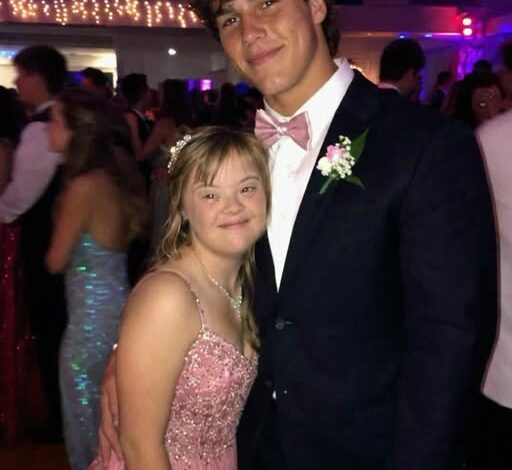
No one expected the school assembly to change anyone’s life.
Students filed into the gymnasium the way they always did, chatting with friends, checking their phones one last time, and waiting impatiently for another presentation they assumed would be forgotten before the final bell rang.
Teachers stood along the walls.
Parents filled a section of folding chairs near the back.
The principal stepped to the microphone and welcomed everyone, explaining that a student had asked to share something important with the school community.
Most people expected a speech.
Instead, they witnessed something they would never forget.
Steven walked slowly onto the stage carrying a small laptop and a projector remote.
He wasn’t known for seeking attention.
He wasn’t one of the loudest students or the most popular.
If anything, he preferred staying in the background.
As he reached the center of the stage, the gym gradually grew quiet.
He looked toward the audience.
Then toward someone sitting several rows back.
Rosie.
She immediately lowered her eyes.
Few people noticed the brief exchange.
Steven took a slow breath.
“I’m not here because I want attention,” he began.
“I’m here because someone deserves to be seen.”
The lights dimmed.
The first photograph appeared on the large projection screen behind him.
It showed Rosie sitting alone at lunch.
Most students barely glanced at the image.
It looked ordinary.
Then another photograph appeared.
Rosie walking through a hallway while several students laughed behind her.
Then another.
A torn backpack lying on the floor.
A notebook covered with cruel writing.
Bruises hidden beneath the sleeve of a sweatshirt.
A lunch tray abandoned on a cafeteria table after someone had dumped its contents across the floor.
With every photograph, the room became quieter.
No dramatic music played.
No emotional narration filled the silence.
Steven simply allowed each image to remain on the screen long enough for everyone to truly look.
Then he spoke.
“This wasn’t one bad day.”
Another photograph.
“This wasn’t one misunderstanding.”
Another.
“This happened for months.”
Another.
“Sometimes every single day.”
Each image felt less like a presentation and more like undeniable evidence.
Students who had laughed at passing jokes now stared at the floor.
Teachers exchanged uneasy glances.
Parents shifted uncomfortably in their seats.
Steven never raised his voice.
He never accused specific people.
He never demanded sympathy.
Instead, he calmly described moments most adults had never noticed.
The jokes whispered just quietly enough to escape teachers’ attention.
The backpacks deliberately bumped in crowded hallways.
The cruel messages written online after school.
The empty seats that mysteriously surrounded Rosie every lunchtime.
The names.
The rumors.
The laughter.
None of it had seemed significant on its own.
Together, it revealed something heartbreaking.
An entire pattern of isolation.
As the presentation continued, Steven explained something that left the gym in complete silence.
“Everyone keeps asking how bullying gets so bad.”
He paused.
“It gets that bad because it rarely happens in front of everyone.”
Another slide appeared.
“It happens when everyone thinks someone else will notice.”
Another.
“When everyone assumes someone else will step in.”
Another.
“When silence becomes normal.”
No one interrupted.
No one argued.
There was nothing left to argue with.
The photographs spoke more clearly than any speech ever could.
Rosie remained seated, tears quietly streaming down her face.
For years, she had carried experiences that many people doubted, dismissed, or simply failed to see.
Now they were impossible to ignore.
The images didn’t exaggerate.
They didn’t manipulate.
They simply documented reality.
Steven explained that he had begun quietly saving photographs, screenshots, and notes after realizing no one seemed to understand how often Rosie was being targeted.
He wasn’t trying to embarrass anyone.
He wasn’t seeking revenge.
He simply wanted people to stop calling it “drama.”
Because what Rosie had experienced wasn’t drama.
It was loneliness.
Humiliation.
Fear.
And the exhausting feeling of walking into school every morning wondering what would happen next.
The presentation ended with one final photograph.
Rosie smiling.
Not because someone had complimented her.
Not because everything had suddenly become easier.
She was smiling because Steven had sat beside her at lunch the day before.
Nothing more.
One empty seat filled.
One conversation.
One act of kindness.
Beneath the picture appeared a single sentence.
“No one should have to survive school alone.”
The lights came back on.
No applause followed.
The silence felt too heavy for clapping.
Some students wiped away tears.
Others stared motionlessly toward the stage.
Several teachers quietly covered their mouths.
Parents looked at one another with expressions that mixed heartbreak, regret, and disbelief.
The principal slowly approached the microphone but struggled to find words.
For perhaps the first time, everyone understood that this wasn’t simply about bullying.
It was about everything that had allowed it to continue.
The warnings people overlooked.
The excuses made too easily.
The moments adults assumed children were “just being kids.”
Sometimes the deepest harm isn’t caused only by cruelty.
It’s caused by everyone convincing themselves someone else will stop it.
Steven closed the laptop.
Without looking toward the audience, he stepped off the stage.
He walked directly across the gym floor until he reached Rosie.
She looked up at him through tears.
“I’m sorry,” she whispered.
Steven gently shook his head.
“You never have to apologize for what someone else did.”
For a moment, neither of them spoke.
Then he smiled.
The same quiet smile she had seen every day when he saved a seat beside her in the cafeteria.
“I’m still here.”
Rosie stood.
Without hesitation, she wrapped her arms around him.
Around them, the gym remained completely silent.
Some moments simply leave no room for applause.
Only reflection.
Only truth.
In the weeks that followed, the school began reviewing its reporting procedures, strengthening anti-bullying programs, and encouraging students to speak up sooner when they witnessed someone being isolated or mistreated.
Policies mattered.
Training mattered.
But perhaps the most important change happened in the hallways.
Students who had once walked past Rosie without noticing began saying hello.
Others invited her to sit with them.
Small gestures replaced quiet indifference.
Not because one presentation erased years of pain.
But because people finally understood what silence had been costing someone else.
Rosie’s scars did not disappear overnight.
Healing never works that way.
Trust would take time.
Confidence would return slowly.
Some memories would always remain.
Yet one thing had changed forever.
She no longer carried those memories alone.
Looking back, her mother realized the most powerful part of Steven’s presentation wasn’t the photographs or the evidence.
It was the choice behind them.
One student deciding another person’s pain mattered enough to remember.
Enough to speak.
Enough to stand in front of an entire school and say what so many others had ignored.
The world would never become completely free of cruelty.
There would always be people willing to mock, exclude, or hurt others.
But there would also be people like Steven.
People willing to notice.
People willing to stay.
People willing to quietly say the words every lonely person hopes someone will someday mean.
“I see you.”
“And I’m not going anywhere.”