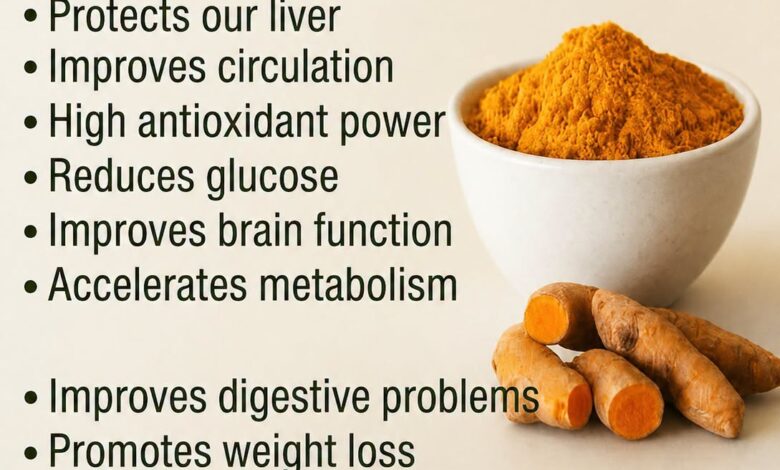
Turmeric tea has been called almost everything.
An inflammation fighter.
A heart protector.
A memory booster.
A detox drink.
An immune tonic.
And, in the wildest corners of the internet, something close to a cure-all.
The truth is less spectacular.
But it is also more useful.
Turmeric tea can be a pleasant, caffeine-free drink with compounds that scientists genuinely find interesting. What it cannot do is carry the enormous medical promises often attached to it online.
Understanding the difference begins with curcumin.
Curcumin is one of the best-known active compounds in turmeric, responsible for much of its distinctive golden color. Laboratory research has found antioxidant and anti-inflammatory activity associated with curcumin, which helps explain why turmeric has attracted so much scientific attention.
That sounds impressive.
But there is an enormous distance between saying a substance demonstrates an effect under research conditions and saying a cup of tea will prevent or treat disease in a human being.
That distance is where many wellness claims fall apart.
Imagine a researcher studying a concentrated curcumin preparation at a carefully controlled dose.
Now compare that with simmering a spoonful of turmeric in water.
Those are not equivalent exposures.
Turmeric itself contains only a fraction of curcumin, and curcumin is not particularly well absorbed by the body. Supplements used in studies may contain concentrated extracts or formulations specifically designed to increase absorption.
Your kitchen mug does not automatically reproduce those conditions.
This doesn’t make turmeric tea worthless.
It simply means the evidence has to be interpreted honestly.
For some people, the most reasonable potential benefit is also one of the least dramatic: joint comfort.
Because inflammation plays a role in conditions such as osteoarthritis, researchers have investigated turmeric and curcumin preparations for symptoms including pain and stiffness. Some studies have reported promising results.
But again, much of that research concerns extracts or supplements—not ordinary tea.
So if someone says, “Turmeric has been studied for joint discomfort,” that’s reasonable.
If someone says, “Drink turmeric tea every morning and your arthritis will disappear,” that’s a very different claim.
The first acknowledges evidence and uncertainty.
The second sells certainty that science has not earned.
The same caution becomes even more important when people start talking about Alzheimer’s disease.
You’ll sometimes see claims that turmeric prevents dementia because curcumin has antioxidant or anti-inflammatory properties.
It sounds plausible.
The brain is affected by complex inflammatory and oxidative processes.
Curcumin has interesting biological properties.
Therefore, turmeric tea prevents Alzheimer’s.
But that final leap is enormous.
Alzheimer’s disease is not caused by one simple inflammatory switch that can be turned off with a spice.
It involves complicated interactions among aging, genetics, brain biology, vascular health and other factors researchers are still working to understand.
A cup of turmeric tea should not be presented as proven protection against it.
The same problem appears with heart-health claims.
Turmeric compounds have been studied in relation to markers connected with cardiovascular health.
Interesting?
Absolutely.
Proof that drinking turmeric tea protects you from heart attacks?
No.
Heart disease risk is influenced by factors including blood pressure, cholesterol, smoking, diabetes, physical activity, diet, genetics and age.
No single beverage replaces attention to those fundamentals.
This is an important rule for interpreting nutrition headlines:
A change in a biological marker is not automatically proof of disease prevention.
And evidence involving concentrated extracts is not automatically evidence for tea.
The distinction sounds boring.
It’s also the difference between science and marketing.
Cancer claims require even greater caution.
Curcumin has been studied extensively in laboratories, including research involving cancer cells and biological pathways related to tumor development.
But cells in a laboratory dish are not a human body.
Many substances can affect cells under experimental conditions without becoming effective cancer treatments.
Cancer is not one disease, either.
It is a vast group of diseases with different mutations, behaviors and treatments.
Someone undergoing cancer treatment should never be encouraged to replace evidence-based care with turmeric tea—or any other food, herb or supplement—because of laboratory findings.
“Promising research” and “proven treatment” are worlds apart.
Then there is the popular word detox.
This is where turmeric tea acquires almost mystical powers.
Drink it and supposedly toxins disappear.
Your liver gets “cleansed.”
Your body resets.
Your system flushes itself clean.
But your body already has extraordinarily sophisticated systems for processing and eliminating waste.
Your liver, kidneys, lungs and gastrointestinal tract work continuously.
They do not need a golden beverage to switch them on.
Hydration and nutritious dietary habits support normal health.
That is very different from claiming a particular tea “removes toxins.”
Whenever somebody makes that claim, ask one simple question:
Which toxin?
If there is no clear answer, the claim probably belongs to advertising rather than medicine.
So after removing all the exaggerated promises, what is left?
Quite a lot, actually.
Turmeric tea can still be enjoyable.
It can be warm.
Comforting.
Aromatic.
Caffeine-free, depending on what else is added.
For someone trying to replace a sugary evening drink or an extra caffeinated beverage, it may be a perfectly sensible alternative.
And rituals matter more than wellness culture sometimes realizes.
There is something genuinely valuable about preparing a warm drink at the end of a stressful day.
Boiling the water.
Adding turmeric.
Perhaps ginger.
Sitting down for ten quiet minutes.
Not because the drink is secretly repairing every organ in your body.
Because you have created a small moment of deliberate care.
Health is built partly from those repeated behaviors.
A cup of tea can become associated with slowing down.
It can replace another habit that wasn’t serving you.
It can encourage hydration.
It can simply taste good.
Those benefits don’t need exaggeration.
In fact, one of the strangest features of modern wellness culture is the assumption that food must perform medical miracles before we’re allowed to value it.
Blueberries don’t need to cure cancer to be nutritious.
Walking doesn’t need to guarantee you’ll live to 100 to be worthwhile.
Turmeric tea doesn’t need to prevent Alzheimer’s disease to deserve a place in your kitchen.
Sometimes “pleasant and potentially beneficial” is enough.
There are also practical ways people modify turmeric drinks.
Black pepper is frequently paired with turmeric because piperine, a compound in pepper, can substantially affect curcumin absorption.
Fat can also influence absorption because curcumin is fat-soluble.
This is why turmeric appears traditionally in meals containing oils and other ingredients rather than exclusively as a watery drink.
But increased absorption is not automatically better for everyone.
This is where the wellness conversation often forgets something crucial:
Natural substances can still have biological effects.
And biological effects can interact with medical conditions and medications.
Turmeric used normally as a culinary spice is generally different from taking large quantities of concentrated curcumin supplements.
Higher-dose products may cause gastrointestinal problems in some people.
They may also be inappropriate in certain medical situations or interact with medications.
Anyone considering concentrated turmeric or curcumin supplements—particularly someone taking prescription medicines, managing a medical condition, preparing for surgery, or dealing with gallbladder or bleeding-related concerns—should discuss the idea with a qualified healthcare professional.
Tea is not automatically dangerous.
Supplements are not automatically dangerous.
The point is that “natural” does not mean “incapable of causing harm.”
Hemlock is natural.
So is poison ivy.
Nature is not a safety certification.
There is another psychological danger worth discussing.
Miracle-health claims can create guilt.
Someone develops arthritis despite drinking turmeric every morning.
Did they fail?
Someone’s parent develops dementia despite following every supposed brain-health trick.
Did the family not try hard enough?
Someone with cancer uses an alternative remedy because they were promised hope, then feels responsible when the disease progresses.
This is where misinformation becomes cruel.
It converts uncertainty into personal responsibility.
Medicine cannot promise that every disease can be prevented.
A person can exercise, eat well, avoid smoking, attend medical appointments and still become seriously ill.
Healthy behavior can influence risk.
It cannot abolish vulnerability.
Evidence-based wellness should empower people without pretending they can control everything.
That means appreciating turmeric for what it realistically offers.
If you enjoy turmeric tea, drink it.
Make it because the warmth relaxes you.
Add ginger because you like the flavor.
Use lemon if that appeals to you.
Enjoy the ritual.
Let it be one small part of a broader pattern that includes nutritious food, regular movement, adequate sleep, preventive healthcare and appropriate medical treatment.
Just don’t ask one cup to carry the weight of your entire future.
No tea can do that.
And be suspicious whenever someone needs you to believe otherwise.
Health misinformation often follows the same formula.
Take a real scientific observation.
Remove the limitations.
Upgrade “may” to “does.”
Replace “associated with” with “prevents.”
Ignore differences in dose and formulation.
Then attach a frightening disease to the headline.
Suddenly:
“Researchers are studying curcumin.”
becomes:
“Doctors don’t want you to know this turmeric trick prevents dementia.”
The first statement invites curiosity.
The second sells certainty.
Good health information should survive questions.
What was actually studied?
Was it turmeric, isolated curcumin or a specialized supplement?
Was the research performed in humans?
How many participants were involved?
How long did the study last?
What outcome was measured?
Has the finding been reproduced?
Was the effect clinically meaningful?
Were there adverse effects?
Those questions aren’t negativity.
They’re how we protect ourselves from being impressed by evidence that doesn’t actually support the claim being made.
Turmeric deserves that fairness too.
Exaggerated promises ultimately hurt potentially useful foods and compounds because they force people into an unnecessary choice:
Miracle or fraud.
Reality usually lives between them.
Turmeric is neither magic nor meaningless.
It is a spice containing biologically interesting compounds.
Curcumin remains an active area of research.
Some evidence around certain uses is promising.
Many sweeping disease-prevention claims remain unsupported or far ahead of what research can confidently establish.
And ordinary turmeric tea is not equivalent to the concentrated formulations used in many studies.
That’s the whole story.
Less exciting than a miracle cure.
Far more trustworthy.
So make the golden cup if you enjoy it.
Wrap your hands around it on a cold evening.
Let the steam rise.
Take a few minutes away from your phone.
Drink slowly.
But let the tea be tea.
Your medicine should remain medicine.
Your doctor should remain your doctor.
And hope should be built on evidence strong enough to carry it.
Because taking care of yourself doesn’t require believing every extraordinary promise.
Sometimes it begins with something much simpler:
Enjoy what helps.
Question what sounds miraculous.
And never confuse a comforting ritual with a cure.