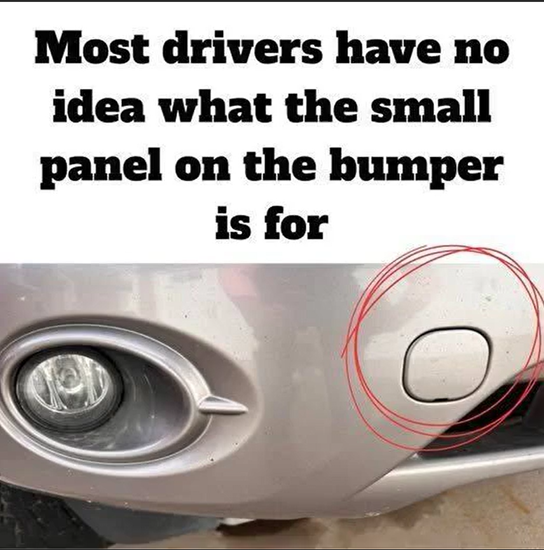
Most drivers have noticed it at least once.
A tiny square or rectangular panel tucked neatly into the front or rear bumper of their car.
It’s so subtle that many people never give it a second thought.
Some assume it’s part of the design.
Others think it hides a sensor or electrical component.
Many never notice it at all.
Yet behind that small plastic cover lies one of the most important emergency features built into modern vehicles.
And chances are, you’ll never appreciate it until the day you desperately need it.
Imagine this.
It’s late at night.
Rain is falling heavily.
Your car suddenly loses power on a quiet road miles from home.
Or perhaps you’ve slid into a muddy ditch after a storm.
Maybe your vehicle becomes trapped in deep snow during winter.
In moments like these, panic often arrives before solutions.
But hidden behind that tiny bumper panel is a feature specifically designed for situations exactly like these.
The tow hook socket.
Small.
Unassuming.
Easy to overlook.
Yet capable of preventing thousands of dollars in damage and turning a stressful emergency into a manageable inconvenience.
Most modern vehicles are designed with appearance in mind.
Manufacturers spend countless hours refining body lines, reducing visual clutter, and creating sleek, aerodynamic profiles.
Exposed metal hooks would interrupt those clean lines.
So engineers found a clever solution.
They concealed the towing point behind a removable cover that blends seamlessly into the bumper.
The result is both practical and elegant.
Drivers get a clean-looking vehicle while retaining immediate access to a critical safety feature.
Few people realize how much engineering is hidden behind that simple panel.
Behind the cover sits a reinforced threaded socket connected directly to the vehicle’s structure.
Unlike the bumper itself—which is largely designed to absorb minor impacts and improve appearance—the tow hook socket is built specifically to withstand tremendous force.
Its purpose is straightforward.
To provide a safe, manufacturer-approved attachment point whenever a vehicle needs to be pulled, recovered, or repositioned.
Without it, towing becomes significantly more dangerous.
Many inexperienced drivers make a costly mistake during emergencies.
They attach ropes or chains to bumpers, suspension components, or whatever metal part appears strong enough.
Unfortunately, those shortcuts often end badly.
Plastic bumpers crack.
Suspension parts bend.
Frames become damaged.
Repair costs quickly exceed what the original problem would have cost.
The tow hook socket eliminates those risks.
It gives tow operators a secure connection point specifically engineered for the job.
What makes this feature even more interesting is how many owners don’t realize they already possess the second half of the system.
The actual tow hook.
Most vehicles include one from the factory.
It’s usually hidden in the trunk.
Sometimes near the spare tire.
Sometimes inside a tool compartment.
Sometimes tucked away beneath floor panels few owners ever open.
The hook itself is surprisingly simple.
A heavy-duty metal rod with a threaded end designed to screw directly into the socket behind the bumper cover.
Though compact, it is engineered to handle significant loads.
When properly installed, it becomes one of the strongest external connection points on the entire vehicle.
Some cars include tow hook sockets on both the front and rear bumpers.
Others feature only one.
The exact configuration depends on the manufacturer and model.
That’s why experts always recommend familiarizing yourself with your vehicle before an emergency occurs.
Finding the tow hook during a stressful roadside situation is far easier when you already know where it’s stored.
Using the system is relatively simple.
First, locate the bumper panel.
Most covers can be removed by gently prying them open using your fingers or a small flat tool.
Once removed, the threaded socket becomes visible.
Next, retrieve the tow hook from the vehicle’s storage compartment.
The hook screws directly into the socket, turning clockwise until fully secured.
Afterward, a tow strap, rope, or recovery device can be attached safely.
While the process sounds straightforward, proper installation matters.
A loosely attached hook can fail under tension.
An improperly aligned tow line can place unnecessary stress on the vehicle.
This is why professional towing operators follow strict procedures and manufacturers provide detailed instructions within owner’s manuals.
The importance of tow hooks becomes even more obvious in off-road environments.
Anyone who has driven through mud, sand, snow, or rocky terrain understands how quickly conditions can change.
A vehicle that seems perfectly capable one moment can become completely immobilized the next.
Off-road enthusiasts often consider recovery equipment as essential as fuel.
Many specialized vehicles feature reinforced tow points or heavy-duty recovery mounts designed to handle even greater forces.
In these situations, the tow hook isn’t merely convenient.
It’s indispensable.
Without it, recovering a stuck vehicle can become dangerous for both the vehicle and the people attempting the recovery.
Tow hooks also play a critical role in motorsports.
When race cars break down on a track, officials need a fast, safe way to remove them.
Every second matters.
Clearly marked towing points allow recovery crews to act quickly while minimizing damage to expensive vehicles.
Even high-performance sports cars often feature specially designed tow hook sockets for transport purposes.
The importance of maintenance is another detail many drivers overlook.
Like any mechanical component, tow hooks require occasional attention.
Experts recommend inspecting both the hook and socket periodically.
Rust.
Corrosion.
Thread damage.
Debris buildup.
Any of these issues can compromise performance when the system is needed most.
Keeping the bumper cover in place helps protect the socket from dirt, moisture, and road grime.
Checking the owner’s manual ensures you understand your vehicle’s specific towing limitations.
And perhaps most importantly, drivers should recognize that tow hooks are intended primarily for controlled, low-speed towing and recovery situations.
For long-distance transport, flatbed trucks remain the safest option.
The history of tow hooks reveals how much vehicle design has evolved over the decades.
Early automobiles often featured exposed towing loops or welded hooks permanently attached to their frames.
They were effective but unattractive.
Rust accumulated easily.
Appearance suffered.
Modern hidden sockets solved those problems while improving overall design.
Today’s systems combine aesthetics, functionality, and safety in ways early automotive engineers could only imagine.
What’s remarkable is how little attention this feature receives compared to flashier automotive technology.
People talk endlessly about horsepower.
Touchscreens.
Driver-assistance systems.
Luxury interiors.
Yet a simple tow hook socket may save a vehicle from severe damage during one of its most vulnerable moments.
That tiny panel embodies a fundamental principle of good engineering.
The best features aren’t always the most visible.
Sometimes the most valuable innovations are the ones you barely notice until you need them.
The next time you walk around your vehicle, take a moment to locate that small bumper cover.
Open your trunk and find the tow hook.
Read the relevant section of your owner’s manual.
A few minutes of preparation today could save hours of frustration tomorrow.
Because emergencies rarely announce themselves in advance.
Breakdowns happen unexpectedly.
Road conditions change suddenly.
Accidents occur without warning.
And when they do, that tiny hidden panel may become the most important feature on your entire vehicle.
What looks like an insignificant piece of plastic actually conceals a carefully engineered solution designed to protect your car, simplify recovery, and help you navigate stressful situations safely.
It’s a reminder that in automotive design—as in life—the smallest details often carry the greatest importance.
And sometimes, the difference between a minor inconvenience and a costly disaster is hidden in plain sight, quietly waiting behind a little square cover on your bumper.