The first thing most people noticed about Richard Huff wasn’t his smile.
It wasn’t the way he laughed with his children or how he instinctively reached for his wife’s hand when they walked together.
It wasn’t his kindness, his patience, or the warmth that filled a room whenever he entered.
No.
People noticed the tattoos.
Hundreds of them.
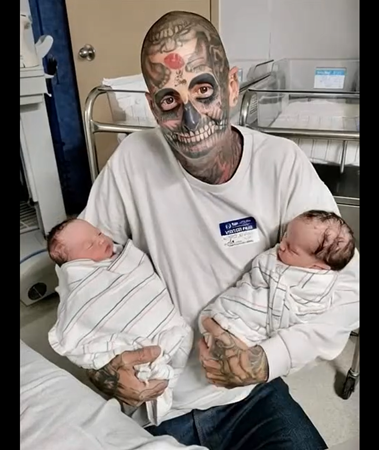
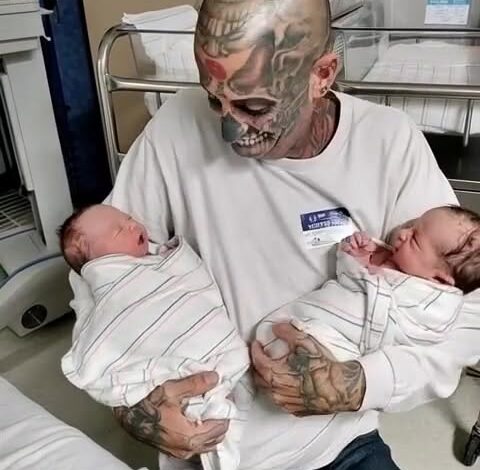
The artwork stretched across his arms, chest, neck, hands, and face, covering nearly every visible inch of skin. Strangers stared. Some whispered. Others openly judged.
Many decided who he was before he ever spoke a word.
Richard had grown used to it.
At fifty-one years old, he understood how quickly people formed opinions based on appearance alone. He had experienced the uncomfortable glances in grocery stores, the suspicious looks at school events, and the harsh comments that appeared beneath photos of him online.
Some labeled him dangerous.
Others called him irresponsible.
The cruelest critics questioned whether a man who looked like him could possibly be a good father.
They couldn’t have been more wrong.
Beneath the layers of ink was a man whose world revolved around his family.
A husband.
A father.
A protector.
A person whose story challenged nearly every stereotype society attached to people who looked different.
Richard often described himself with a laugh as an “ink addict.”
It wasn’t meant as a joke.
Tattoos had become a lifelong passion, a deeply personal form of self-expression that started years earlier and gradually transformed into something much larger.
Each piece carried meaning.
Each design represented a chapter of his life.
Some tattoos commemorated important milestones. Others honored loved ones. Several were dedicated entirely to his children, celebrating the people he valued most in the world.
To Richard, his body wasn’t simply covered in artwork.
It was covered in memories.
The tattoos told stories of victories, struggles, relationships, and lessons learned.
While many people viewed face tattoos as shocking or rebellious, Richard saw them differently.
To him, they represented honesty.
They reflected who he was without filters or pretenses.
“I’ve always believed people should be comfortable being themselves,” he once explained. “The tattoos are part of my story. They’re not the whole story, but they’re part of it.”
Unfortunately, not everyone cared enough to learn the rest.
Over the years, social media became both a platform and a battlefield.
Photos of Richard with his family often attracted thousands of comments. Many were supportive, but others were openly hostile.
People who had never met him questioned his parenting.
Complete strangers made assumptions about his character.
Some suggested his appearance alone made him a poor role model.
At first, the negativity was frustrating.
Then it became exhausting.
Eventually, Richard stopped trying to convince everyone.
Instead, he focused on what mattered.
Living his life.
Being present for his children.
Letting his actions speak louder than opinions.
And those actions painted a very different picture.
Most mornings began before sunrise.
Richard helped prepare breakfasts, packed lunches, and made sure everyone was ready for school. He attended parent-teacher conferences, school concerts, soccer games, and science fairs.
He volunteered whenever he could.
He listened when his children needed advice.
And he showed up.
Again and again.
Because, in his mind, that was what being a parent meant.
Not appearances.
Not perfection.
Just showing up consistently.
His wife, Marita Huff, understood this better than anyone.
Ironically, when they first met, she had some of the same concerns many strangers expressed online.
Richard’s appearance intimidated her.
The tattoos.
The facial ink.
The intense first impression.
She worried about what kind of person might exist beneath all that artwork.
Then she got to know him.
And everything changed.
“I was nervous at first,” Marita admitted in interviews. “I think a lot of people would be. But after spending time with him, I realized he had one of the biggest hearts of anyone I’d ever met.”
What she discovered was a man who treated people with kindness.
A man who valued family above everything.
A man whose appearance never reflected the gentleness of his character.
As their relationship deepened, Richard became an important part of her children’s lives.
Marita brought three children into the relationship, creating a blended family that required patience, trust, and commitment.
Richard embraced the responsibility without hesitation.
He didn’t try to replace anyone.
Instead, he focused on being dependable.
Being supportive.
Being there whenever they needed him.
At first, the children weren’t entirely sure what to think.
Like many people, they noticed the tattoos before anything else.
But children often see truths adults miss.
It didn’t take long for them to recognize who Richard really was.
They saw the man who helped with homework after long workdays.
The man who cheered the loudest during sports games.
The man who sat beside them during difficult moments and celebrated their victories as if they were his own.
Before long, the tattoos became irrelevant.
What mattered was how he treated them.
One child later described him simply.
“He makes us feel important.”
To Richard, there was no greater compliment.
As his story gained attention online, something unexpected happened.
Support began pouring in.
Parents from around the world shared similar experiences.
Tattooed mothers and fathers spoke about facing unfair judgments.
Others admitted they had once made assumptions about heavily tattooed people before realizing how wrong they had been.
The conversation grew beyond Richard himself.
It became a discussion about bias.
About how quickly society judges based on appearances.
About how often people mistake difference for danger.
Many pointed out an uncomfortable truth.
A person can wear a suit and be cruel.
A person can have tattoos and be loving.
Character isn’t visible on skin.
It’s revealed through behavior.
Richard became a living example of that reality.
Yet despite the growing support, he never viewed himself as an activist.
He wasn’t trying to change the world.
He was simply trying to live authentically.
To raise his children.
To love his wife.
To be himself.
The tattoos remained an important part of his identity, but they were never the most important part.
For Richard, the artwork served as a permanent record of experiences and relationships.
Some tattoos honored his marriage.
Others reflected personal struggles he had overcome.
The most meaningful pieces, however, were those dedicated to his children.
Whenever people asked about them, his entire demeanor changed.
His face softened.
His voice warmed.
Because behind every tattoo honoring his family was a story he loved telling.
A memory he never wanted to forget.
As years passed, Richard continued adding to his collection, gradually covering more of his body with meaningful artwork.
But while the tattoos multiplied, the values guiding his life remained unchanged.
Family first.
Always.
Today, Richard and Marita continue building a life centered on love, respect, and acceptance.
They understand that criticism will never disappear completely.
There will always be people who judge quickly.
People who see the ink before they see the man.
But they no longer allow those opinions to define them.
Their happiness doesn’t depend on public approval.
It depends on the strength of the family they have built together.
And that family is thriving.
Perhaps that is the greatest lesson Richard Huff offers the world.
Not that tattoos should be admired.
Not that everyone should embrace the same lifestyle.
But that human beings are far more complex than appearances suggest.
A face covered in ink cannot reveal kindness.
A tattoo cannot measure integrity.
And no amount of body art can determine someone’s ability to love.
The people who take the time to know Richard discover something powerful.
They discover a father who shows up.
A husband who remains devoted.
A man who refuses to hide who he is simply to make others comfortable.
The tattoos may tell pieces of his story.
But they are not the story itself.
That story is written in the lives he has touched, the family he has nurtured, and the example he sets every day.
Because when all the assumptions fade away and the stereotypes disappear, what remains is something far more meaningful than ink.
A life built on love.