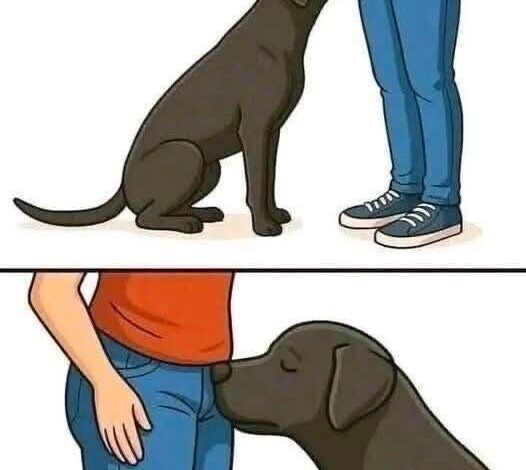
To your dog, the world is written in scent. While humans rely primarily on vision to understand their surroundings, dogs gather most of their information through their extraordinary sense of smell. Every encounter is an opportunity to collect details that are invisible to us, and that includes the people they know and love. What may feel like an awkward or embarrassing sniff to you is, for your dog, simply a natural way of asking, “Is everything the same, or has something changed?”
Your body is constantly releasing chemical signals, many of which are completely undetectable to human senses. Sweat, breath, skin, and other areas naturally produce odors that vary throughout the day. Hormonal fluctuations, stress, diet, exercise, medications, and even minor changes in your body’s chemistry can subtly alter your scent. While these differences may seem insignificant to you, a dog’s highly sensitive nose can detect them with remarkable precision.
This is why dogs often greet familiar people with enthusiastic sniffing, even if they’ve seen them only a few hours earlier. They’re not simply recognizing you—they’re gathering fresh information. In many ways, it’s their equivalent of reading today’s news. A quick sniff tells them where you’ve been, how you’re feeling, and whether anything about your scent profile has changed since your last interaction.
Most of the time, those changes are completely normal. A different meal, a workout, emotional stress, or a new soap can all create scents your dog finds interesting. Curiosity alone doesn’t indicate that something is wrong. Dogs are naturally driven to investigate new smells because doing so is deeply rooted in how they understand the world around them.
Occasionally, however, a dog’s unusual interest in one specific area may be worth paying closer attention to—particularly if the behavior is persistent and represents a noticeable change from what is typical for your pet. Some research and anecdotal reports suggest that dogs can sometimes detect scent changes associated with certain medical conditions, including infections, skin problems, or other physiological changes. While this area continues to be studied, there are documented cases in which trained dogs have identified specific illnesses by detecting subtle chemical differences in human scent.
That does not mean a dog can diagnose disease, nor should unusual sniffing be interpreted as proof that something is medically wrong. There are countless harmless explanations for a change in your scent, and dogs may focus on an area simply because it smells different for perfectly ordinary reasons. Still, if your pet suddenly becomes unusually fixated on one particular part of your body, it can be reasonable to consider whether anything else has changed.
The key is to observe the bigger picture rather than relying on your dog’s behavior alone. If persistent sniffing is accompanied by symptoms such as pain, unusual discharge, swelling, changes in your skin, unexplained fatigue, or other health concerns, it may be worth discussing those symptoms with a healthcare professional. Your dog’s curiosity should not replace medical evaluation, but it can occasionally serve as an additional reason to pay attention to changes you might otherwise overlook.
At the same time, it’s perfectly appropriate to establish boundaries with your pet. Even though sniffing is instinctive and serves an important purpose in canine communication, you don’t have to allow behavior that makes you or your guests uncomfortable. Calmly redirect your dog toward a toy, another activity, or a more appropriate greeting, and reward the behavior you want to encourage. Positive reinforcement helps your dog learn acceptable ways to interact without punishing a behavior that is entirely natural from their perspective.
Understanding why dogs sniff can also strengthen the bond you share. Rather than viewing the behavior as rude or embarrassing, it becomes easier to recognize it as a form of communication rooted in trust, curiosity, and remarkable sensory ability. Your dog isn’t trying to invade your privacy—they’re simply using the most powerful tool they have to understand the person standing in front of them.
In the end, your dog’s nose is an extraordinary instrument, capable of detecting scents and chemical changes that humans could never perceive on their own. Most of the time, their interest reflects nothing more than curiosity and normal canine behavior. But if their attention suddenly becomes unusually focused and coincides with symptoms or noticeable changes in your health, it’s worth listening to what your body may be telling you. Trust your instincts, seek medical advice when appropriate, and remember that while your dog isn’t a doctor, their remarkable sense of smell may sometimes encourage you to notice what you otherwise might have missed.