Most people walk past it without a second thought.
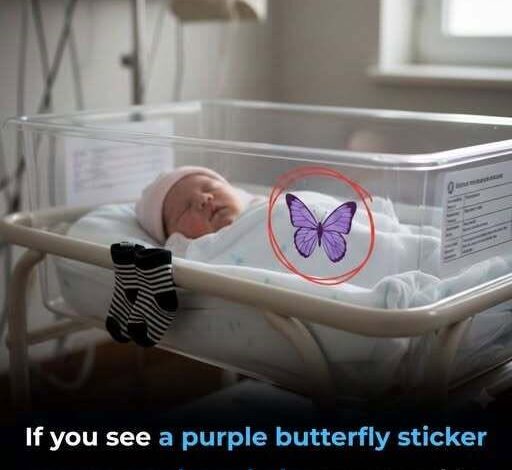
A small purple butterfly sticker rests quietly on the side of a neonatal incubator, surrounded by the steady rhythm of monitors, the hum of medical equipment, and the careful movements of nurses tending to fragile newborns. To an outsider, it might seem like a simple decoration—a gentle splash of color in a place filled with clinical routines and anxious waiting.
But for the families who know its meaning, that tiny butterfly represents a heartbreak so profound that words often fail to carry it.
It is not there to decorate.
It is there to speak.
Because sometimes grief is too heavy to explain over and over again.
The purple butterfly is a silent message that the baby lying inside that incubator was not meant to arrive alone. It tells a story of a multiple birth in which one or more siblings did not survive. It is a symbol of love, loss, and remembrance. Most importantly, it protects grieving parents from having to relive their tragedy every time someone unknowingly asks a question or makes an innocent comment.
Behind this powerful symbol is the story of a mother named Millie Smith and a little girl named Skye.
Like many expectant parents, Millie and her partner, Lewis Cann, were overwhelmed with excitement when they learned they were having twins. More than that—they were expecting identical twin girls.
The future seemed full of possibilities.
They imagined birthday parties with matching cakes, bedtime stories shared between sisters, laughter echoing through their home, and the special bond that twins often share throughout their lives. Every dream they had for their growing family suddenly doubled.
Then came a routine medical scan.
A day that should have been ordinary became one they would never forget.
The atmosphere in the examination room changed almost instantly. The smiles faded. The conversation became cautious. The joy they had carried into the appointment collided with devastating news.
One of their daughters had been diagnosed with anencephaly, a severe condition that prevents parts of the brain and skull from developing properly. Doctors explained that she would not survive long after birth.
In a single moment, the future Millie and Lewis had imagined shattered.
Yet even in the face of unimaginable heartbreak, they made a decision rooted in love. They would continue the pregnancy and cherish both of their daughters for every moment they could.
They named the girls Skye and Callie.
The name Skye carried special significance. It reflected the place where they knew she would eventually go—a beautiful tribute to a life destined to be painfully brief. Callie represented hope, the daughter they prayed would continue the journey forward.
As the months passed, Millie carried both joy and grief at the same time. She celebrated her daughters while preparing for a goodbye no parent should ever have to anticipate.
When complications led to an emergency C-section at just 30 weeks, the emotions became almost impossible to describe.
The delivery room was filled with urgency.
Doctors moved quickly.
Machines beeped.
Everyone focused on bringing the babies safely into the world.
Then something extraordinary happened.
Both girls cried.
For Millie and Lewis, that sound felt like a miracle.
Doctors had not expected Skye to survive long enough to make a sound. Yet there she was, announcing her arrival to the world alongside her sister.
For a brief moment, both daughters were alive.
For a brief moment, the family was complete.
Those moments became priceless.
Millie and Lewis were given three precious hours with Skye.
Three hours to hold her tiny body.
Three hours to kiss her forehead.
Three hours to study every detail of her face and memorize every feature they would never get to watch grow older.
Three hours to love her openly and completely.
And then, surrounded by her parents, Skye passed away.
No amount of time would ever have been enough.
But those three hours became memories they would carry forever.
After Skye’s death, the world did what it always does.
It kept moving.
The neonatal unit continued its daily routines. Nurses cared for babies. Families celebrated milestones. New parents worried, hoped, and waited.
Meanwhile, Callie remained in her incubator, fighting to grow stronger each day.
Millie found herself living in two realities at once.
She was grieving one daughter while caring for another.
She was mourning a death while celebrating a life.
Most of the hospital staff understood her situation. They knew the pain she carried every time she walked through the neonatal ward.
But other parents didn’t know.
How could they?
To them, Millie appeared to be the mother of a single baby.
They couldn’t see the daughter who should have been beside Callie.
They couldn’t see the loss hidden behind her smile.
And so the comments began.
Not cruel comments.
Not intentional ones.
Just ordinary observations made by exhausted parents trying to make conversation.
“At least you only have one baby to look after.”
“I can’t imagine handling twins.”
“You’re lucky you don’t have two newborns right now.”
The people saying these things had no idea what they were doing.
They didn’t know they were speaking directly into a wound that was still bleeding.
Each comment forced Millie into an impossible choice.
She could explain that she had actually given birth to twins and that one of them had died.
Or she could remain silent and carry the pain alone.
Often, she chose silence.
Often, she walked away in tears.
The other parent usually never knew what had happened.
Over time, Millie realized something important.
Families experiencing this unique kind of loss needed protection.
They needed a way for others to understand their situation without forcing them to repeatedly explain the most devastating event of their lives.
They needed a symbol.
Something simple.
Something gentle.
Something visible.
And from that realization, the purple butterfly was born.
The idea was beautifully simple.
A small purple butterfly sticker would be placed on the incubator of a surviving baby whose sibling had passed away.
The butterfly represented the child who had flown away too soon.
Purple was chosen because it felt universal, appropriate for any baby regardless of gender.
The sticker asked for something very simple from everyone who saw it:
Compassion.
Understanding.
Gentleness.
It quietly reminded people that the baby before them was part of a larger story.
A story that included both life and loss.
A story that deserved care.
What began as one mother’s response to personal grief soon grew into something much larger. Millie established the Skye High Foundation, dedicated to supporting families affected by the loss of a baby from a multiple birth.
Today, the purple butterfly symbol is recognized in hospitals around the world.
Its impact reaches far beyond neonatal wards.
It reminds healthcare workers, visitors, and families that grief and joy can exist side by side.
A parent can celebrate one child’s survival while mourning another child’s absence.
A family can feel immense gratitude and overwhelming heartbreak in the same moment.
Both emotions can be true.
For Millie, the butterfly also ensures something deeply important.
Skye is never forgotten.
Her life mattered.
Her brief time on earth mattered.
Her memory continues to touch thousands of families she never had the chance to meet.
Every purple butterfly placed beside an incubator tells the world that a child was loved, even if their time was measured in hours rather than years.
The next time you see one, pause for a moment.
Remember that it is not a decoration.
It is a story.
A tribute.
A quiet request for kindness.
It represents parents carrying both love and loss in the same heart.
It reminds us to speak gently because we rarely know what someone else is carrying.
Most of all, it reminds us that every life matters—even those that stay only briefly.
The purple butterfly may be small enough to fit in the palm of your hand, but its message is enormous.
It transforms silence into understanding.
It turns grief into compassion.
And through it, Skye’s legacy continues to wrap grieving families in something they need most during their darkest moments: the reassurance that they are not alone.