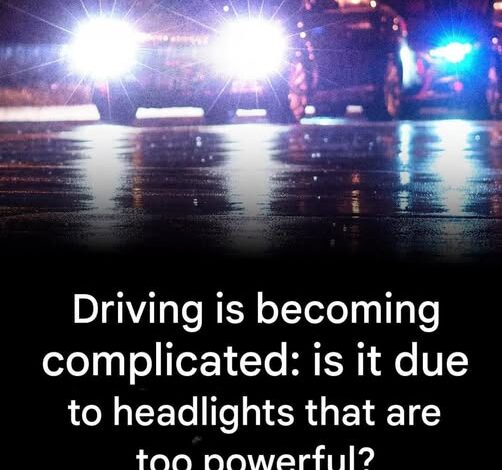
Modern LED headlights were created with good intentions: brighter roads, sharper visibility, faster reaction times, and safer nighttime driving. On paper, the technology makes perfect sense. LEDs consume less energy, last longer than traditional halogen bulbs, and cast a cleaner, wider beam that helps drivers spot hazards earlier. Deer at the edge of the road, pedestrians in dark clothing, sudden curves, heavy rain — all become easier to detect beneath that intense white light.
Yet for many drivers, especially during long nighttime trips, those same headlights feel less like protection and more like assault.
People describe being temporarily blinded on dark highways, squinting through rainstorms while oncoming SUVs flood their windshield with harsh blue-white glare. Others talk about gripping the steering wheel tighter as their vision washes out for a few frightening seconds, unable to clearly see lane markings or road edges until the vehicle finally passes. Some older drivers avoid nighttime travel altogether now because modern headlights leave them anxious, exhausted, or physically uncomfortable.
And importantly, much of that frustration is real.
The problem is not simply brightness alone.
It is the combination of intensity, color temperature, beam concentration, and vehicle height all colliding at once.
Traditional halogen headlights emitted warmer, softer yellow light. LEDs, by contrast, often produce a much cooler color temperature — closer to daylight in appearance. While that cooler white light improves contrast and visibility for the driver using it, the human eye can interpret it very differently when viewed directly from another vehicle.
Cooler blue-white light scatters more aggressively inside the eye, particularly during rain, fog, or nighttime driving when pupils are already dilated. For tired eyes, aging eyes, or anyone dealing with astigmatism or light sensitivity, the glare can become overwhelming very quickly.
And vehicle design has made the issue worse.
Modern roads are now filled with taller SUVs, trucks, and crossovers whose headlights sit higher than older sedans. Even properly aligned beams can strike directly at eye level for drivers in lower vehicles. When headlights are poorly adjusted — tilted even slightly upward — the effect intensifies dramatically.
That momentary blindness many people experience is not imagined weakness or overreaction.
It is a physiological response.
When intense light floods the eye suddenly, the retina becomes temporarily oversaturated. Vision blurs. Contrast drops. Recovery takes precious seconds after the vehicle passes. During those seconds, drivers often instinctively slow down because the brain no longer fully trusts what the eyes are seeing.
Rain amplifies everything further.
Wet roads reflect light upward like mirrors. Windshields collect microscopic smudges, streaks, and film that scatter glare across the driver’s field of vision. Fatigue worsens eye strain. Suddenly an ordinary nighttime drive can begin feeling stressful, disorienting, or even dangerous despite technically improved lighting technology.
Still, experts emphasize something important:
this problem is manageable.
Drivers are not helpless against glare, even though modern lighting has changed dramatically.
One of the simplest but most overlooked solutions is proper headlight alignment. Many vehicles leave factory settings slightly imperfect, and bumps, suspension changes, or heavy cargo can gradually tilt beams higher over time. Misaligned headlights may improve visibility for the driver using them while unintentionally blinding everyone else on the road.
Having alignment checked professionally can significantly reduce glare for other drivers without sacrificing safety.
Many newer vehicles also include manual beam-level adjustment settings specifically designed for situations where extra weight in the trunk or rear seats changes the vehicle’s angle. Most people never touch these controls because they either do not know they exist or underestimate how much improper load balance affects headlight direction.
But small adjustments matter enormously at night.
Windshield cleanliness matters too — more than many realize.
A windshield can appear visually clean during daylight while still carrying thin layers of oil residue, smoke film, fingerprints, dust, or cleaning streaks that become invisible glare amplifiers after dark. Light hitting those imperfections scatters unpredictably across the glass, reducing contrast and increasing eye fatigue.
Cleaning both the outside and inside of the windshield thoroughly can dramatically improve nighttime visibility.
The same applies to eyeglasses.
Tiny scratches or smudges often intensify glare significantly after sunset.
Experts also recommend a subtle but effective behavioral adjustment:
avoid staring directly into oncoming headlights.
Instead, drivers should shift their gaze slightly toward the right edge of their lane while using peripheral vision to maintain awareness of approaching traffic. This technique reduces direct retinal exposure to glare while still preserving road control and spatial orientation.
It sounds simple because it is simple.
But it works.
Many experienced nighttime drivers use this instinctively without even realizing it.
Meanwhile, automotive technology itself is slowly evolving toward solutions as manufacturers recognize growing public frustration surrounding glare. Adaptive headlights capable of automatically adjusting beam shape, intensity, and direction are becoming increasingly common in newer vehicles. Some systems can detect oncoming traffic and selectively dim portions of the beam while maintaining illumination elsewhere. Others adjust dynamically around curves, hills, and surrounding vehicles to reduce direct eye-level exposure.
In theory, these smarter systems could eventually preserve the visibility advantages of LEDs while minimizing the discomfort they currently create for other drivers.
That future matters because nighttime driving is not merely technical.
It is emotional too.
People need to feel safe behind the wheel.
When glare repeatedly creates anxiety, hesitation, or fear, driving itself becomes mentally exhausting. Long commutes feel heavier. Rainstorms become stressful. Older drivers begin restricting movement after sunset altogether, losing independence not because they cannot drive, but because modern roads increasingly feel hostile to their vision.
And perhaps that is why conversations about headlights have become surprisingly emotional.
Because beneath the complaints about brightness sits something deeper:
people longing for roads that feel calmer,
more cooperative,
less physically aggressive.
The irony is that everyone involved is usually trying to stay safe simultaneously.
Drivers using bright LEDs often love the visibility they provide.
Drivers facing those same lights often feel attacked by them.
Both experiences are real.
The challenge now is balancing technological progress with human comfort — creating systems that illuminate roads clearly without overwhelming the eyes of everyone approaching from the opposite direction.
Until then, small practical choices remain powerful:
cleaner windshields,
properly aligned beams,
smarter driving habits,
thoughtful adjustments when vehicles are loaded heavily.
Tiny actions.
Real difference.
Because safer roads are not built through brightness alone.
They are built through visibility balanced with consideration —
through technology designed not only to help us see farther,
but to help us share the darkness without blinding one another along the way.