The Head Cheerleader Asked The Overweight Grieving Outcast To Prom And 20 Years Later They Met Again In The Most Shocking Way

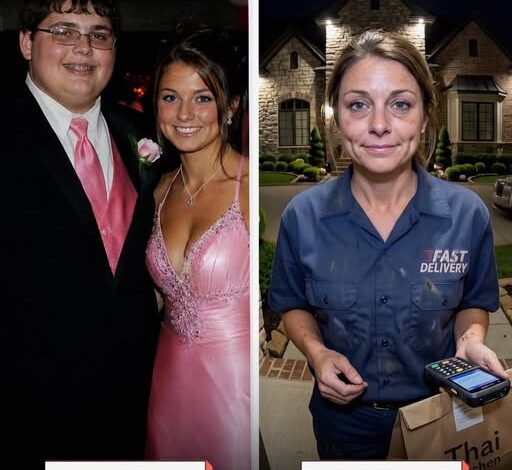
For twenty years, I told myself I had moved on.
That’s what success is supposed to do, isn’t it? Sand down the sharp edges of old pain. Replace humiliating memories with polished achievements. Build enough distance between who you were and who you became that the frightened version of yourself eventually fades into someone almost unrecognizable.
And for a while, I believed it had worked.
I had the career people envied.
The downtown office with glass walls and city views.
The expensive watches.
The house so quiet it sometimes echoed.
I knew exactly how to look successful.
What I never learned was how to stop feeling like the boy everyone once laughed at.
Back in high school, I was an easy target.
Too awkward.
Too quiet.
Too eager to disappear before anyone noticed me standing there.
I wore oversized sweaters year-round because I hated how thin I looked. My stutter worsened whenever teachers called on me unexpectedly, which only made classmates imitate me louder afterward. There are humiliations people eventually outgrow, and then there are humiliations that settle permanently into your nervous system.
Mine lived there for years.
The cafeteria.
The locker room.
The way entire conversations stopped when I walked near certain groups.
Teenagers can smell insecurity the way sharks smell blood.
And nobody smelled weaker than me.
Except somehow… she didn’t treat me like prey.
Her name was Clara.
The first time she ever spoke to me, I genuinely thought she was joking.
She sat beside me in chemistry class wearing a pale blue dress under her oversized winter coat because she’d forgotten there was a school dance after classes ended that evening. Everyone else looked polished and loud and socially fluent. Clara somehow looked elegant without trying.
“You’re good at this stuff, right?” she asked while pointing at the equations on the board.
I stared at her too long before answering.
“At… chemistry?”
She smiled softly.
“At pretending you don’t know you’re smart.”
Nobody had ever spoken to me like that before.
Not with pity.
Not with mockery.
With certainty.
That was the terrifying thing about Clara: she saw people directly. No hesitation. No social calculation. She looked at you like your best parts were obvious even if you couldn’t see them yourself.
And somehow, impossibly, she kept choosing me publicly.
She sat with me at lunch once after watching someone dump milk across my tray.
Held my hand in a fluorescent hallway while my whole body shook after a panic attack.
Walked beside me after school while people whispered behind us.
I remember asking her once:
“Why do you even talk to me?”
She looked genuinely confused.
“Because I like you.”
As if it were the simplest thing in the world.
For someone like Clara, maybe it was.
For someone like me, it changed everything.
She became the first person who made me believe I might not be fundamentally broken.
But life has a cruel habit of separating people right when they begin understanding what they mean to each other.
Her father lost his job senior year. Suddenly Clara disappeared from dances, clubs, after-school activities. She started working evenings at a diner while trying to keep her grades high enough for scholarships. Exhaustion replaced the easy brightness she carried before.
Then one day she was simply gone.
Transferred schools.
Family relocated.
No goodbye.
I spent months checking social media that barely existed yet, asking mutual acquaintances if they’d heard anything, carrying around a yearbook photo of her tucked inside my wallet long after graduation.
Eventually life moved forward anyway.
Or at least it pretended to.
College.
Business school.
Work.
I discovered something important early:
pain can become fuel if you point it in the right direction.
Every insult became motivation.
Every humiliation became ambition.
I built my entire adult life like armor.
By forty, I had everything younger me once thought would guarantee happiness:
money,
respect,
control,
distance from the frightened boy people mocked.
Yet some nights I still dreamed about fluorescent hallways and pale blue dresses.
Then, twenty-two years later, I saw her again.
It was raining hard that night.
The kind of cold rain that turns streets reflective and lonely. I’d just left a client dinner downtown when I noticed a delivery driver struggling with two paper bags outside a restaurant across the street.
At first, I almost kept walking.
Then she turned slightly beneath the streetlight.
And the entire world stopped.
Older, yes.
Thinner.
Exhausted in ways beauty magazines never photograph.
But unmistakably Clara.
She wore a soaked delivery jacket several sizes too large while balancing takeout containers against her chest. Rain had plastered strands of hair against her face. Her shoes looked worn through at the soles.
For several seconds I couldn’t move.
Because the person standing in front of me was not supposed to exist inside this version of my life.
Clara belonged to memory.
To longing.
To unfinished sentences.
Not to rainstorms and food delivery apps.
She glanced up briefly while adjusting the bags.
Her eyes passed over me without recognition.
That hurt more than it should have.
“Clara?”
She froze immediately.
Nobody else in the world still said her name like that.
Slowly, cautiously, she looked closer.
Then her expression shifted.
“Oh my God.”
We stood there in the rain staring at each other while traffic hissed past nearby.
“You’re…” she whispered softly.
“Ethan.”
She laughed once in disbelief.
“The chemistry genius.”
I almost broke hearing that.
Not because of the words.
Because after all these years, she still remembered me as someone worth admiring.
Meanwhile, looking at her standing there soaked and exhausted carrying someone else’s dinner for rent money shattered something I’d spent decades hardening over.
All the success suddenly felt absurdly weightless.
The house.
The promotions.
The expensive watch on my wrist.
None of it mattered beside the woman who once took my trembling hands in a fluorescent hallway and quietly rewrote my understanding of myself.
We sat in a nearby diner until almost midnight.
I learned everything slowly.
Her father died shortly after they moved.
College became impossible financially.
Relationships failed.
Medical debt piled up after her mother became sick.
Life had not been kind to Clara.
The hardest part was how casually she described suffering, as though disappointment had become so familiar she no longer expected anything better.
At one point she laughed softly and said:
“I guess some people peak in high school.”
I stared at her across the table completely stunned.
Because she still didn’t understand what she had been to other people.
Especially to me.
Over the next few weeks, we kept meeting.
Coffee.
Walks.
Long conversations stretching late into evenings.
And slowly I realized something devastating:
Clara had spent years surviving without ever fully understanding how extraordinary she truly was.
The world had worn her down quietly.
Not through one catastrophic moment, but through accumulated exhaustion:
financial stress,
disappointment,
invisible sacrifices,
years of being needed more than loved.
One night, I finally showed her the box.
She looked confused when I carried it into the living room.
“What’s this?”
“Open it.”
Inside sat twenty-two years of her existence inside my memory.
Photographs.
Old notes.
The chemistry worksheet she once doodled stars across while teasing my handwriting.
Her senior photo from the yearbook.
A napkin from the diner where we studied together after school.
She covered her mouth immediately.
“You kept these?”
“All of them.”
Tears filled her eyes before she could stop them.
“I thought nobody remembered me from back then.”
I laughed softly through my own tears.
“Clara… you changed my life.”
Then I told her everything.
How she saved me without realizing it.
How every success afterward carried traces of the confidence she planted inside me first.
How I spent twenty years trying to become someone worthy of the way she once looked at me.
Recognition flooded her face slowly.
Then grief.
Then something even more fragile:
hope.
Not the loud, dramatic kind.
The terrifying kind.
The kind people feel when they realize maybe life has not finished with them yet.
Months later, I took her back to the old high school.
The building looked smaller somehow.
We stood together beneath the same fluorescent hallway lights where she once held my shaking hands while classmates laughed nearby.
“I used to hate this place,” I admitted quietly.
She smiled softly.
“I know.”
Then I got down on one knee.
Her face collapsed instantly into tears before I even spoke.
“Clara,” I whispered, “you were the first person who ever chose me out loud.”
She covered her mouth shaking.
“And every good thing I became started with that moment.”
By then we were both crying too hard for rehearsed speeches.
“I spent half my life loving you,” I told her. “I don’t want to spend the other half pretending I stopped.”
When she finally said yes, it wasn’t really about the ring.
It wasn’t about the house, or security, or some perfect romantic ending.
It was about something much deeper.
Two people who once felt invisible finally seeing themselves reflected back through someone else’s unwavering belief.
For years, Clara had carried the lie that life had diminished her worth.
So I gave her back the truth piece by piece:
the photographs,
the memories,
the proof that she had always mattered far more than she understood.
And standing there beneath those harsh fluorescent lights, I realized something extraordinary:
she thought she saved me once as a frightened teenage boy.
What she never understood was this:
she never stopped.