HOW ONE DEATH ROW INMATE’S OUTRAGEOUS LAST-MEAL REQUEST ENDED A CENTURIES-OLD TRADITION IN TEXAS: THE CONTROVERSIAL CASE OF LAWRENCE RUSSELL BREWER, THE NATIONAL RECKONING THAT FOLLOWED, AND THE DEBATE THAT STILL DIVIDES AMERICA OVER JUSTICE, DIGNITY, AND FINAL HUMAN RIGHTS

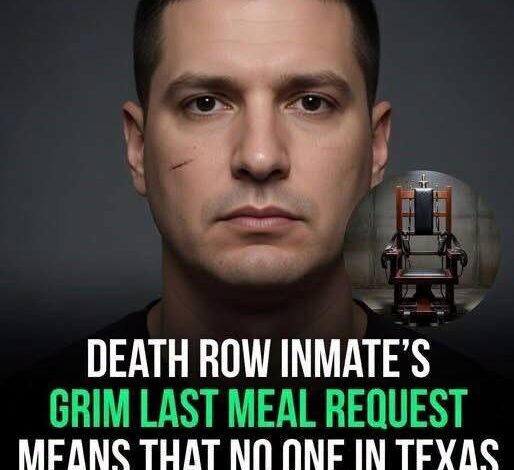
Few final meals have changed public policy.
Lawrence Russell Brewer’s did.
His name is forever associated with one of the most horrific hate crimes in modern American history—the 1998 murder of James Byrd Jr., a crime whose brutality shocked the nation and became a driving force behind stronger federal hate-crime legislation. Years later, however, Brewer would once again make headlines, not because of his crime itself, but because of what happened in the final hours before his execution.
What should have been a long-standing prison tradition instead became the moment Texas decided to end it.
For generations, many states allowed condemned inmates to request a final meal before execution. The custom was never intended as a reward or celebration. Rather, it was viewed by many as a symbolic acknowledgment that, regardless of a person’s crimes, the state would carry out its sentence with a measure of dignity and order.
The practice varied from state to state.
Some requests were simple.
A hamburger.
Fried chicken.
Ice cream.
A favorite homemade meal remembered from childhood.
Others were unusual or extravagant, attracting media attention because they offered one final glimpse into the personality of someone whose life was about to end.
Then came Lawrence Russell Brewer.
Before his execution in September 2011, Brewer submitted an exceptionally large meal request.
According to widely reported accounts, it included multiple chicken-fried steaks covered in gravy, a triple bacon cheeseburger, fried okra, barbecue, a meat-lover’s pizza, ice cream, peanut butter fudge, and several other items.
Prison officials honored the request.
The food was prepared.
The tray was delivered.
Then Brewer refused to eat any of it.
He reportedly stated that he wasn’t hungry.
The untouched meal immediately became the center of national attention.
To many observers, the refusal felt less like a personal decision and more like a deliberate act of defiance.
For the family of James Byrd Jr., whose unimaginable loss remained at the heart of the case, the gesture was painful to witness. Others viewed it as an unnecessary waste of public resources or a final attempt to attract attention before execution.
Whether Brewer intended to provoke that reaction is impossible to know with certainty.
But the reaction itself was swift.
Among those who responded was Texas State Senator John Whitmire, who publicly criticized the practice of providing special last meals.
He argued there was no justification for offering customized requests to inmates facing execution, particularly when those requests could be manipulated or wasted.
His concerns quickly reached the Texas Department of Criminal Justice.
Soon afterward, prison officials announced that the state would discontinue the long-standing tradition altogether.
From that point forward, inmates scheduled for execution would no longer receive special meal requests.
Instead, they would be served the same meal prepared for every other prisoner on that day.
No exceptions.
No personalized menus.
No elaborate requests.
The policy remains in place today.
Supporters of the decision argue that it removed an unnecessary privilege from individuals convicted of the most serious crimes. They contend that taxpayer resources should not be used to fulfill elaborate final requests, especially when victims’ families continue living with the lasting consequences of violent crimes.
Others believe the change represented a broader statement about accountability.
For them, ending special last meals reinforced the idea that executions are legal proceedings, not public spectacles.
Yet critics see the issue differently.
Some argue that the tradition was never about rewarding condemned inmates.
Instead, they believe it reflected something about the justice system itself.
Providing a final meal, however modest, demonstrated that even when the state imposes its most severe punishment, it does so without abandoning every gesture of human dignity.
From this perspective, eliminating the practice says less about the prisoner than it does about society’s willingness to preserve compassion in even the darkest circumstances.
The debate continues because it touches on larger questions that extend well beyond one man.
How should justice balance punishment and humanity?
Can dignity coexist with accountability?
Should traditions rooted in compassion survive even when applied to those who have committed horrific crimes?
There are no easy answers.
What is certain is that Lawrence Russell Brewer’s final meal became far more significant than anyone expected.
An untouched tray of food altered decades of prison practice in one of America’s largest death penalty states.
It transformed a long-standing ritual into a political issue almost overnight.
Today, condemned inmates in Texas receive the standard prison meal served to everyone else.
The elaborate final requests that once captured public curiosity are gone.
For some, that change represents fairness and common sense.
For others, it reflects the loss of a symbolic tradition that acknowledged the humanity of every person, regardless of the crimes they committed.
The debate is unlikely to disappear.
It continues to challenge fundamental ideas about justice, mercy, punishment, and the values society chooses to uphold even in its most difficult moments.
In the end, Brewer’s final meal was never remembered for what was served.
It was remembered for what was left untouched.
And that untouched tray became the unlikely catalyst for a policy that permanently changed the way Texas carries out its final act of justice.