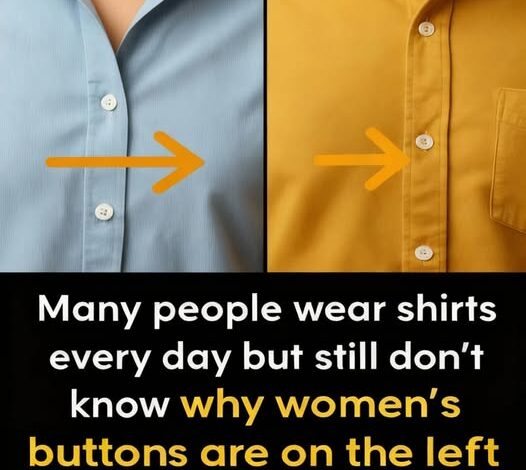
Every morning, millions of people button their shirts without giving the process a second thought.
Yet hidden in that simple routine is a centuries-old design choice that most people never notice.
Take a closer look at a typical men’s shirt and a typical women’s blouse. You’ll find that the buttons are on opposite sides. Men’s shirts usually fasten on the right, while women’s button on the left.
It’s such a familiar detail that it rarely sparks curiosity.
But behind those tiny buttons lies a fascinating story of wealth, fashion, social customs, and practicality—one that stretches back hundreds of years.
The tradition dates to a time when clothing was far more elaborate than it is today.
During the 18th and much of the 19th century, wealthy women often wore dresses layered with petticoats, corsets, bodices, and intricate fabrics. Getting dressed wasn’t a quick morning routine. It could take considerable time and often required another person’s assistance.
For women in affluent households, that helper was usually a maid.
Because the vast majority of people were—and still are—right-handed, dressmakers designed women’s garments with buttons on the wearer’s left side. This placement made fastening the clothing much easier for a maid standing opposite the woman while dressing her.
What seems like an insignificant design choice today was once a practical solution for everyday life among the upper classes.
Over time, that practical arrangement became part of fashion itself.
Even as social customs changed and more women dressed without assistance, clothing manufacturers continued producing garments with left-side buttons simply because that had become the accepted standard.
Fashion often preserves tradition long after its original purpose has disappeared.
Eventually, left-side buttoning became associated with refinement and elegance rather than household convenience.
Men’s clothing evolved along an entirely different path.
Historically, practicality shaped much of men’s attire.
For centuries, many men carried tools, knives, or swords on their left side, allowing them to draw these items quickly with their dominant right hand. Clothing that buttoned on the right naturally overlapped in a way that made movement easier and reduced the chance of fabric interfering while reaching across the body.
Military uniforms reinforced this arrangement.
Soldiers needed clothing that functioned efficiently during demanding physical activity, and right-side buttons became standard across uniforms worn by armies throughout Europe and beyond. As military styles influenced civilian fashion, the right-side button placement remained firmly established.
Function eventually became tradition.
Even after swords disappeared from everyday life and practical concerns changed, manufacturers continued producing men’s clothing in the same way because it had become the expected design.
Today, the difference survives mostly as a historical echo.
Modern men rarely carry swords.
Modern women no longer rely on maids to help them dress.
Yet shirts, jackets, blouses, and coats continue to reflect customs established centuries ago.
Many people wear clothing with this feature their entire lives without ever realizing why it exists.
Of course, not every garment follows these conventions.
Some modern fashion brands intentionally blur traditional distinctions by creating unisex designs or placing buttons according to style rather than historical convention. Children’s clothing may also vary depending on the manufacturer.
Still, the classic arrangement remains remarkably common around the world.
It’s one of countless examples of how history quietly shapes everyday life.
The objects we use often carry stories far older than we imagine.
A staircase may reflect ancient architectural techniques.
A pocket watch may preserve traditions from another century.
Even something as ordinary as a shirt button can reveal the influence of long-forgotten customs.
Fashion isn’t simply about fabric and appearance.
It’s also a record of the societies that created it.
The clothes people wear tell stories about work, class, technology, culture, and the practical challenges of everyday life. Sometimes those stories remain obvious. Other times, they survive in details so small we barely notice them.
A simple row of buttons is one such detail.
What began as a practical solution for wealthy households and working servants evolved into an enduring fashion tradition that continues to shape clothing today.
The original reasons may have faded with time, but the design lives on.
So the next time you button a shirt or blouse, take a second look.
Those tiny buttons aren’t just holding fabric together.
They’re holding onto centuries of history, quietly reminding us that even the smallest details of everyday life can carry remarkable stories from the past.