What began as an ordinary highway patrol call quickly became one of those moments no officer ever forgets.
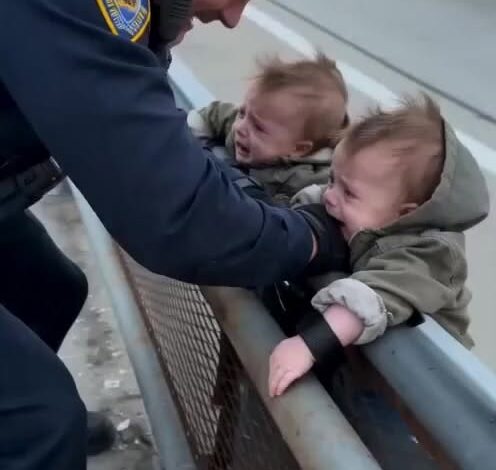
It was a busy afternoon on Route 9 when emergency dispatchers were flooded with frantic calls from motorists reporting an alarming sight. Drivers crossing a busy overpass had spotted two very young children standing dangerously close to the guardrail, only a few feet from a steep drop onto the speeding traffic below.
The callers all described the same scene.
Two toddlers.
Alone.
No adults nearby.
Every passing second increased the danger.
Recognizing the urgency, dispatch immediately classified the call as a high-priority rescue. A highway patrol officer happened to be only minutes away and raced toward the bridge, lights flashing as traffic moved aside.
As he climbed onto the overpass, the situation came into view.
Below him, hundreds of vehicles rushed past at highway speed.
Above, standing near the metal barrier, were two frightened toddlers.
They appeared exhausted, confused, and completely unaware of how dangerous their surroundings truly were.
The officer knew he couldn’t rush toward them.
Any sudden movement might startle the children and send them closer to the edge.
Instead, he slowed his pace, crouched slightly, and began speaking in a calm, gentle voice.
“Hey there… you’re okay,” he called softly. “I’m here to help.”
The children looked toward him but didn’t move.
Their small hands clung tightly to each other as the roar of trucks and cars echoed beneath the bridge.
It was immediately clear that this would require more than one officer.
Without taking his eyes off the children, he radioed for backup and requested emergency medical personnel to respond immediately.
Within minutes, additional patrol units arrived.
Officers quickly secured both ends of the overpass, temporarily restricting traffic in the immediate area to reduce noise and eliminate additional hazards. Paramedics positioned themselves nearby, ready to examine the children the moment they were safely removed.
Working together, the officers slowly closed the distance.
Every movement was deliberate.
Every word was carefully chosen.
Eventually, one officer reached out a reassuring hand.
The older toddler hesitated for a moment before taking it.
The younger child followed immediately afterward.
Within seconds, both children were safely guided away from the guardrail and carried to waiting medical crews.
Only then did everyone allow themselves to breathe.
The toddlers showed signs of exhaustion, dehydration, and emotional distress.
They were frightened and largely unable to answer questions about who they were or how they had reached the overpass.
For investigators, the rescue marked only the beginning.
While paramedics cared for the children, officers began searching the surrounding area for answers.
They carefully examined the bridge, documented nearby items, and interviewed the motorists whose quick calls had likely prevented a tragedy.
Every observation was recorded.
Every clue mattered.
As investigators expanded their search, attention shifted to the surrounding neighborhood.
Not far from the overpass stood an abandoned-looking property that immediately drew investigators’ attention because of its location and unusual condition.
Though it appeared vacant from the outside, officers decided it warranted a closer inspection.
Moving cautiously through the building, they found signs that someone had been there recently.
Rooms showed evidence of recent activity.
Food containers.
Blankets.
Personal belongings.
The discovery prompted an even more thorough search.
Then came another unexpected development.
Inside one of the rooms, officers found a teenage girl who appeared frightened and in need of immediate assistance.
She was safely removed from the building and transported for medical evaluation while investigators secured the property.
As she recovered, the teenager began speaking with investigators.
Although authorities declined to release many details publicly, they later confirmed that her information dramatically changed the direction of the investigation.
Her account helped establish a clearer timeline of events and provided investigators with critical leads that extended well beyond the original missing-children call.
The case rapidly expanded as law enforcement agencies coordinated searches at multiple locations connected to the information she provided.
Investigators worked carefully, collecting evidence while determining whether additional victims or individuals were involved.
Meanwhile, the toddlers remained under medical supervision.
Doctors reported steady improvement over the following days.
After treatment, rest, and observation, both children recovered well physically, though specialists continued monitoring their emotional well-being.
Social workers and child welfare professionals became involved immediately, ensuring the children would receive both medical care and long-term protection while authorities continued their investigation.
Eventually, investigators successfully identified family members connected to the children.
Following careful verification procedures and child-protection reviews, the toddlers were reunited with their relatives in a closely supervised setting.
Officials described the reunion as one of the brightest moments in an otherwise deeply troubling case.
Looking back, investigators emphasized one fact above all others.
None of it would have happened without the people who chose to act.
The drivers who noticed something unusual did not assume someone else had already called.
They trusted their instincts.
They picked up their phones.
They reported what they saw.
Those simple decisions allowed dispatchers to respond immediately, officers to arrive within minutes, and two vulnerable children to be rescued before tragedy could unfold.
Emergency officials also praised the seamless coordination between dispatchers, highway patrol officers, firefighters, paramedics, investigators, and child welfare specialists.
Each agency performed its role quickly and professionally, turning what could have become a devastating story into one of survival.
For the highway patrol officer who first stepped onto that bridge, the memory has never faded.
He began his shift expecting routine traffic enforcement.
Instead, he found himself standing between two frightened toddlers and unimaginable danger.
It was a powerful reminder that no emergency call is ever truly routine.
Sometimes, the smallest detail reported by a stranger can uncover something far larger than anyone first imagined.
And sometimes, one phone call is all that stands between tragedy and hope.