I Walked Into My Mother-in-Law’s Garage and Found My Daughter Eating Alone—The Truth Changed Our Family Forever

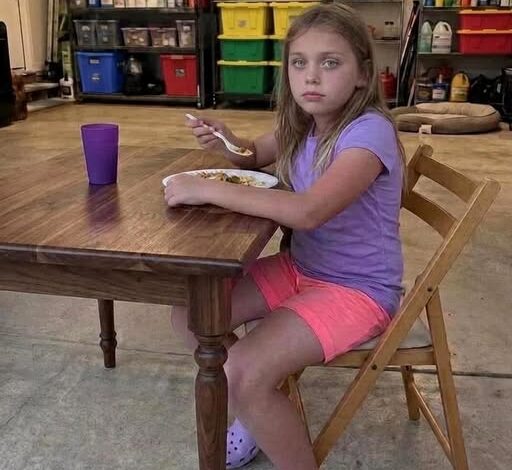
The silence that followed Lily’s disappearance from the dining room was louder than any argument.
Most of the guests had assumed she had simply wandered off to play. They continued chatting over dessert, unaware that an eight-year-old girl had been sent to sit alone in a cold garage because she had accidentally knocked over a glass of juice.
I knew the truth.
So did Daniel.
And before long, everyone else would too.
Among Evelyn’s guests that afternoon was Dr. Margaret Collins, the respected head of one of the city’s most prestigious private academies. Evelyn had been eager to impress her for weeks. She hoped the luncheon would strengthen their friendship and eventually open doors for another grandchild’s future admission while also creating opportunities to discuss charitable contributions and educational partnerships.
Everything had been carefully planned.
The menu.
The flowers.
The seating arrangements.
The polished silverware.
Evelyn wanted every detail to project grace, generosity, and refinement.
Then Dr. Collins noticed something missing.
“Where’s your granddaughter?” she asked, glancing around the table.
“The little blonde girl. Lily, wasn’t it?”
Evelyn smiled stiffly.
“Oh… she’s fine.”
Daniel quietly set down his fork.
“No,” he said.
“She’s sitting alone in the garage.”
Every conversation stopped.
Dr. Collins frowned.
“The garage?”
Daniel nodded.
“She accidentally spilled a drink.”
“Mother decided that meant she shouldn’t eat with the family.”
The room became painfully still.
For a long moment, no one spoke.
Then Dr. Collins slowly placed her napkin beside her plate.
“I’ll excuse myself.”
Her voice remained calm, but disappointment echoed through every word.
Before leaving, she walked directly to the garage.
A minute later, she returned holding Lily’s small hand.
My daughter looked confused more than upset, as though she still believed she’d done something unforgivable.
Dr. Collins knelt beside her.
“Sweetheart,” she said gently, “accidents happen.”
She brushed a strand of hair from Lily’s face.
“They don’t decide whether you deserve a seat at the table.”
Then she looked directly at Evelyn.
“I’ve spent thirty years working with children.”
“I’ve never seen good manners improved through humiliation.”
Without another word, she collected her purse.
One by one, the remaining guests followed.
Some quietly thanked us for inviting them.
Others simply shook their heads.
Within minutes, the beautifully arranged dining room Evelyn had spent days preparing sat nearly empty.
Crystal glasses remained untouched.
Dessert plates were half-finished.
Candles continued burning over conversations that had ended forever.
Evelyn stood alone in the middle of the room, staring at chairs that had emptied faster than she could understand.
For perhaps the first time in her life, reputation could not protect her from the consequences of her own choices.
The following week brought difficult conversations none of us had expected.
Daniel met with an attorney—not because anyone wanted another family conflict, but because we needed to understand how to better protect Lily in the future if similar situations arose.
They discussed practical matters.
Boundaries during family visits.
Responsibilities when children were guests in another person’s home.
Insurance considerations should someone become injured while visiting.
Property issues connected to future gatherings.
Estate planning.
Mortgage obligations tied to Evelyn’s house.
Methods for resolving future disputes if relationships continued deteriorating.
No one wanted courtrooms.
No one wanted legal paperwork.
But pretending everything would somehow fix itself no longer seemed responsible.
For years, uncomfortable conversations had been postponed in the name of keeping peace.
That silence had protected adults.
It had not protected Lily.
So we chose honesty instead.
Months passed without contact.
Then, one rainy Tuesday afternoon, our doorbell rang.
When I opened it, Evelyn stood on the porch.
She carried nothing.
No flowers.
No gifts.
No carefully wrapped peace offering.
Only herself.
“I’d like to speak with Lily,” she said quietly.
“If she’ll allow it.”
I asked Lily privately.
She thought for a moment before nodding.
Evelyn sat at our kitchen table while Lily climbed into the chair across from her.
For several seconds, neither spoke.
Finally, Evelyn looked down.
“I owe you an apology.”
Lily waited.
“I cared too much about what everyone else thought.”
“I worried about appearances.”
“I forgot that you mattered more than a tablecloth.”
Her voice trembled.
“I can’t undo what I did.”
“No,” Lily answered softly.
“You can’t.”
The honesty startled all of us.
Then Lily added something only a child could say.
“But maybe you can do better next time.”
Evelyn’s eyes filled with tears.
“I’d like that.”
“I’d really like that.”
Nothing changed overnight.
Trust rarely returns that easily.
There were no dramatic family reunions.
No instant forgiveness.
Only small decisions made repeatedly.
Short visits.
Honest conversations.
Respect that had to be earned instead of expected.
Nearly eight months later, Lily’s elementary school hosted its annual art fundraiser.
Parents wandered through classrooms filled with paintings, sculptures, and colorful collages created by students.
One canvas immediately caught my attention.
It showed a long wooden dining table stretching across nearly the entire page.
Every chair was occupied.
Children.
Parents.
Grandparents.
Even the family dog sat beneath the table.
Above the painting, written in careful third-grade handwriting, was the title:
Room for Everyone.
When the teacher asked Lily about it, she smiled.
“No one eats alone.”
I had to turn away before anyone noticed the tears in my eyes.
Toward the end of the evening, the artwork was quietly purchased during the fundraiser auction.
The winning bidder was Evelyn.
She didn’t make a speech.
She didn’t ask for recognition.
She simply carried the painting home.
Months later, when we visited for the first time since everything had happened, I noticed it hanging prominently in her dining room.
Not hidden in a hallway.
Not tucked inside a guest bedroom.
Right there above the table where every visitor would see it.
She caught me looking.
“I wanted the reminder where I couldn’t ignore it.”
I nodded.
It was exactly where it belonged.
I don’t believe people transform overnight.
Real change is slower than that.
It asks for humility.
Consistency.
The willingness to confront uncomfortable truths about yourself.
Whether Evelyn became a completely different person is something only time can answer.
But I do know one thing changed forever.
Lily never again questioned whether she belonged.
She grew into the kind of child who noticed the quiet student sitting alone.
The new neighbor without invitations.
The classmate no one picked first.
Whenever there wasn’t enough room, she somehow made space.
Because she remembered exactly how it felt to believe there wasn’t a place waiting for her.
And perhaps that became the greatest lesson our family ever learned.
Children rarely remember perfect dinners or expensive decorations.
They remember how they were treated.
Whether they felt welcomed.
Whether they felt safe.
Whether someone made room for them when it mattered most.
Long after the crystal glasses and polished silverware had been forgotten, one simple painting remained on Evelyn’s wall, reminding everyone who gathered there that the most important tradition a family can ever protect is making sure no one is left behind.
After all, every table is large enough for kindness.