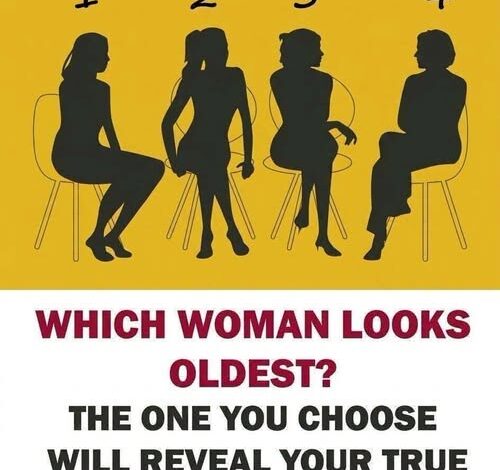
Why do millions of people stop scrolling to answer a question as simple as, “Which woman looks the oldest?” The image itself may take only a few seconds to examine, yet those few seconds often spark lively debates, surprising conversations, and plenty of curiosity. Some people answer immediately, convinced their choice is obvious. Others study every detail before making a decision. Either way, the real intrigue isn’t whether the answer is right or wrong—it’s what the exercise reveals about the way our minds process information.
Visual personality quizzes have exploded in popularity because they offer something that feels both effortless and personal. Instead of completing lengthy questionnaires or rating dozens of statements, participants are presented with a single image and asked to trust their first instinct. It might involve choosing the happiest face, spotting an unusual object, or deciding which person appears oldest. The challenge takes only moments, yet it encourages people to wonder whether those instant reactions say something meaningful about how they see the world.
Part of the appeal comes from the remarkable speed of human perception. Long before we consciously analyze an image, our brains have already begun organizing visual information, recognizing familiar patterns, and drawing quick conclusions. These rapid judgments are influenced by far more than eyesight alone. Memories, life experiences, cultural background, emotional state, and countless unconscious associations all contribute to the impression that forms within seconds.
That is why two people can study the same illustration and confidently reach completely different conclusions.
When participants are asked to identify the oldest-looking woman in a drawing or silhouette, the brain immediately starts searching for clues. It may notice posture, clothing, hairstyle, body language, walking position, or even the overall feeling each figure creates. Although these characteristics cannot reliably reveal a person’s actual age, our minds naturally associate certain visual signals with ideas we’ve developed over many years.
For one viewer, an upright, composed posture may suggest maturity and experience. Another may associate slower movement with age, while someone else focuses on confidence, assuming it reflects years of life experience. None of these interpretations are inherently correct or incorrect—they simply reflect how each person’s mind organizes incomplete information.
This process is known in psychology as perceptual inference.
Perceptual inference describes the brain’s ability to fill in missing details when only limited information is available. Rather than waiting for every fact, the mind builds a complete picture using fragments of visual input combined with previous knowledge and expectations. It is an efficient system that helps people make quick decisions in everyday life, but it also means our conclusions are shaped by assumptions we may not even realize we’re making.
These visual quizzes often reveal more about perception than about personality itself.
Every split-second decision passes through a network of mental shortcuts known as cognitive heuristics. These shortcuts allow the brain to process information rapidly without carefully examining every possibility. They are essential for navigating daily life efficiently, but they are also influenced by personal history.
Someone raised in an environment where older adults were viewed as symbols of wisdom may unconsciously associate calmness and dignity with age. Another person may connect physical energy with youth because of their own experiences. Education, family values, media exposure, and cultural traditions all contribute to these automatic associations.
Because every person’s experiences are unique, no two minds process visual information in exactly the same way.
Emotions also play an important role.
Our mood at the moment we view an image can subtly influence how we interpret what we see. Someone feeling relaxed may perceive a figure as peaceful and experienced, while another person who is excited or energetic might interpret the same posture as confident or self-assured. These emotional influences often operate beneath conscious awareness, quietly shaping perception without us realizing it.
Culture adds another fascinating layer.
Ideas about aging differ widely across societies. In some cultures, older age is closely linked with wisdom, leadership, and respect. In others, youthfulness, physical vitality, or independence may receive greater emphasis. These lifelong cultural influences naturally affect the way people interpret visual cues, making it entirely normal for viewers from different backgrounds to reach different conclusions when looking at the exact same illustration.
This diversity of interpretation is one reason these quizzes remain so engaging.
People enjoy comparing answers because every choice reflects a slightly different perspective. The discussion often becomes more interesting than the image itself, encouraging participants to consider viewpoints they hadn’t previously noticed.
At the same time, it’s important to understand what these quizzes can—and cannot—tell us.
Although they may encourage self-reflection, they are not scientifically validated personality assessments. Unlike standardized psychological tests that undergo extensive research and reliability testing, internet image quizzes are designed primarily for entertainment. They cannot accurately measure personality traits, intelligence, emotional health, or decision-making ability based on a single visual choice.
That doesn’t mean they have no value.
They can still encourage people to think about how quickly first impressions form and how easily assumptions influence everyday judgments. Recognizing that our minds naturally fill in missing information can help us become more thoughtful when evaluating real people and real situations.
After all, first impressions are only beginnings.
Whether you’re meeting someone for the first time, reading a news headline, or interpreting a simple illustration, your brain is constantly drawing conclusions before all the facts are available. Those quick judgments can be useful, but they are not always complete. Taking a moment to question our initial assumptions often leads to a deeper and more accurate understanding.
Ultimately, asking which woman appears oldest is not really about finding one universally correct answer. It is an invitation to explore the remarkable way the human mind constructs meaning from limited information. Every viewer approaches the image carrying a lifetime of memories, beliefs, experiences, emotions, and cultural influences that quietly shape perception.
What one person interprets as maturity, another may see as confidence. What seems like age to one observer may simply reflect composure, authority, or personality to someone else.
That variety of interpretation is exactly what makes these visual challenges so fascinating. They remind us that perception is rarely as straightforward as it seems. The mind is constantly observing, interpreting, filling in gaps, and creating stories from incomplete clues—an extraordinary ability that helps us navigate the world while also reminding us that our first impression is only one small part of a much larger picture.