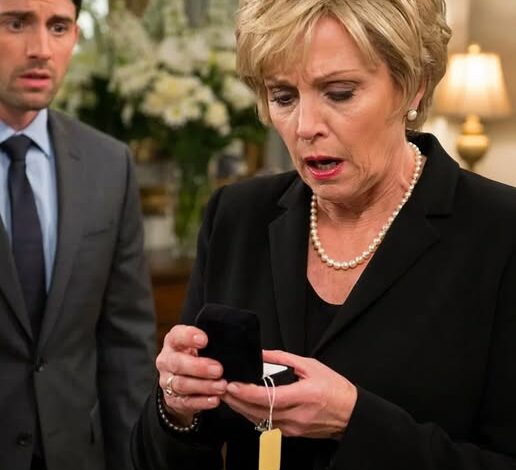
Forty minutes into my husband’s funeral reception, I opened the blue velvet box on our mantel so my grandson could hold his grandfather’s wedding ring.
The ring was gone.
In its place, tucked into the hinge, was a yellow pawn-shop tag marked $895.
I didn’t scream or drop the box. Some exhausted part of me had expected grief to steal my sleep, my appetite, perhaps even my sanity. I simply hadn’t expected anyone to steal from the dead.
My name is Idella Renner. I was sixty-eight then, and Silas and I had been married forty-nine years—one month short of fifty.
He died on a Tuesday morning in the machine shed behind our farmhouse. He had gone out before six to inspect the baler, as he had done for decades. I found him sitting against a tractor tire as though he had paused to rest. The doctor later called it a massive heart attack and said death had probably been immediate.
I held tightly to the word immediate. The alternative was unbearable.
Silas and I had spent our entire marriage on the same quarter section outside Hollis Creek, a small farming town where everyone recognized everyone else’s truck. He raised cattle and grain. I taught fourth grade for thirty-one years. Together, we raised one daughter, Kendra, survived hard seasons, buried beloved dogs, repaired the same roof twice, and wore a permanent groove into the kitchen linoleum.
His wedding ring was a plain gold band purchased in 1977 for eighty dollars. Inside, in tiny letters, it read:
Always, S.
After the funeral home returned his belongings, I placed that ring inside my late mother’s old blue velvet box and set it on the mantel beside Silas’s photograph and folded National Guard flag.
Eventually, I intended to give it to our grandson, Foster.
The five days before the funeral passed in a blur of casseroles, visitors, coffee urns, and unlocked doors. Kendra and her husband, Trace, stayed close. Trace had been my son-in-law for eleven years, and until then, I had genuinely liked him. He repaired farm equipment, called me “Miss Idella,” and had helped us countless times without accepting payment.
On the first evening after Silas died, Trace took my hand and said, “Don’t worry about anything. Whatever needs handling, I’ll handle it.”
At the time, it sounded loving.
Later, it sounded like a confession.
The house remained crowded from morning until night. Anyone could have entered the front room unnoticed. No one guards jewelry during a wake. Grief consumes the attention normally used to notice danger.
We buried Silas on Saturday beneath a painfully ordinary blue sky. Afterward, nearly everyone returned to the farmhouse for sandwiches, cake, and condolences.
Foster found me near the fireplace.
“Grandma,” he said, “can I see Grandpa’s ring? He told me years ago that when I found the right woman, I could use it. I know it’s too soon. I just want to hold it while he still feels close.”
I led him to the mantel and opened the box.
Empty.
Only the curled yellow tag remained.
Foster read it over my shoulder.
“That isn’t Grandpa’s ring.”
“No,” I said. “Someone sold it.”
His hand began trembling, but I closed the box and squeezed his fingers.
“Not today,” I whispered. “Today belongs to your grandfather. This can wait until tomorrow.”
I slipped the tag into my purse and returned the empty box to the mantel.
Then I watched Trace.
He checked his phone repeatedly. He avoided the front room, taking the longer route through the kitchen every time he crossed the house. Four times, I counted him deliberately walking around the mantel.
I had taught nine-year-olds for three decades. I knew the look of someone who had broken a window and blamed the wind.
The next morning, without telling Kendra, I drove forty-three miles to Kirby’s Pawn and Trade.
The owner, Ansel Kirby, listened quietly as I placed the tag on his counter and explained that I had buried my husband the previous day.
He entered the ticket number into his computer.
“Fourteen-karat gold band,” he read. “Engraved ‘Always, S.’ Purchased outright nine days ago.”
Then he turned the screen toward me.
The seller’s name was Trace Allan Iverson.
There was his driver’s license, his signature, and his thumbprint.
Ansel retrieved the ring from the display case. The engraving had faded after forty-nine years against Silas’s hand, but it was still there.
Always, S.
“I can’t legally return it based only on your word,” Ansel explained. “But I paid him three hundred forty dollars. That’s what I’ll charge you. I won’t profit from your loss.”
I wrote the check.
Then I drove home with my dead husband’s ring in the cup holder and cried harder than I had during the funeral.
On Monday, I contacted our old friend Milt Corrigan, the county sheriff and Silas’s hunting partner. I showed him everything.
“What Trace did is theft,” Milt said. “The documentation makes it an easy case. Whether you press charges is your decision, but you need to understand that you hold the full hand.”
I invited him to Sunday dinner.
When Kendra, Trace, and Foster arrived, Milt was already sitting at our kitchen table.
I placed the pawn-shop envelope beside the mashed potatoes.
“Trace,” I said, “I want to show you something.”
I set the ring in front of him.
His face collapsed.
“I found the pawn tag during your father-in-law’s funeral reception,” I told him. “Mr. Kirby showed me your identification, thumbprint, and signature. You sold Silas’s wedding ring nine days after he died for three hundred forty dollars.”
Kendra went white. Foster stared at his father as though seeing a stranger.
Trace confessed.
He owed eighteen thousand dollars in sports-betting debts. His business equipment payments were overdue, and his tow truck was nearing repossession. He had seen the ring during the wake and convinced himself he could pawn it temporarily, solve his problems, and return it before anyone noticed.
“I was going to buy it back,” he said.
It was the oldest lie a thief had ever told.
I did not have him arrested.
Instead, I laid down conditions.
He would reveal every debt to Kendra. She would gain access to every financial account. They would attend financial counseling. He would repay the three hundred forty dollars through two months of Saturday labor helping Foster and me organize and sell Silas’s remaining equipment.
“And never again,” I added, “tell me not to worry because you’ll handle everything.”
He agreed.
Months later, Foster proposed to his girlfriend, Marisol, on our porch. I had Silas’s ring resized, and I watched my grandson slide it onto her finger.
Trace stood nearby, quiet and humbled.
Grief does not make people foolish. It makes them tired, and tired is not the same as blind.
Even shattered, I noticed Trace avoiding the mantel. I recognized his guilty expression. I drove forty-three miles the morning after burying my husband because I refused to let a wrong remain unanswered.
A woman can be heartbroken and still be sharp.
Silas’s ring now belongs to a new marriage, carrying nearly fifty years of wear and one stubborn promise inside:
Always, S.
It was stolen during the darkest week of my life.
But it found its way home.
This story is a dramatization. Names, characters, and details are fictional, and any resemblance to actual people or events is coincidental.