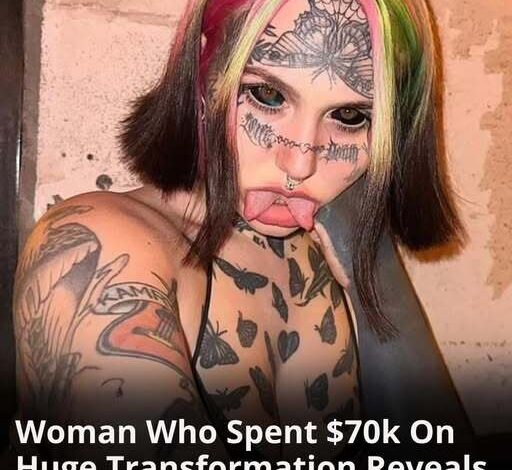
What people notice first is the ink.
Not one tattoo. Not ten. Nearly every visible inch of skin transformed into a canvas of symbols, patterns, and personal expression. Then come the details that make strangers stare a little longer: the jet-black eyeballs, the split tongue, the heart-shaped implant beneath the skin of her hand, the sharpened veneers that resemble fangs.
For many observers, Orylan’s appearance is shocking.
For her, it is familiar.
She often describes her transformation not as becoming someone new, but as revealing someone who was always there. The tattoos and body modifications did not create her identity; they simply made visible what she already felt inside. What began with a single tattoo at fourteen gradually evolved into a years-long journey of self-expression that pushed far beyond conventional beauty standards.
The reaction from the public has been intense.
In everyday life, people stare openly. Some are curious. Others are uncomfortable. Online, the criticism can be relentless. Commenters frequently post old photographs beside newer ones, insisting she was more attractive before, as though beauty were something that could be measured by a universal formula.
But those reactions reveal as much about society as they do about her.
People are often unsettled by individuals who refuse to seek approval. When someone deliberately steps outside accepted norms, it forces others to examine the assumptions they carry about appearance, identity, and belonging. For some, Orylan represents freedom. For others, she represents a challenge to ideas they have never questioned.
The physical transformation has not come without cost.
Body modification requires money, recovery time, and a willingness to endure discomfort. The emotional toll can be even greater. Living with constant scrutiny means accepting that strangers may form opinions before hearing a single word you say.
Yet despite the criticism, Orylan has remained unapologetic.
Through social media, where she has built an audience of more than 143,000 followers, she regularly speaks about self-acceptance and personal choice. Her message is not that everyone should look like her. It is that everyone should have the freedom to decide what feels authentic for themselves.
That distinction matters.
The story is not really about tattoos, implants, or blackened eyes.
It is about ownership.
Ownership of one’s appearance. Ownership of one’s identity. Ownership of the life lived inside a body that belongs to no one else.
Many people look at her and see extremes.
She looks at herself and sees honesty.
Whether others admire her choices or disagree with them, her transformation raises a question that reaches far beyond body art: How much of our appearance is shaped by our own desires, and how much is shaped by the expectations of others?
For Orylan, the answer seems clear.
She chose a path that invited criticism, curiosity, and misunderstanding because it felt true to her. In a culture that often rewards conformity, that decision requires a different kind of courage.
The result is a woman who walks through the world impossible to ignore—not because she demands attention, but because she stopped asking permission to be herself.
And for her, that may be the most meaningful transformation of all.