On Our Wedding Day, My Fiancé’s 5-Year-Old Son Ran to the Altar and Shouted, ‘Dad, You Already Have a Wife!’ and Pointed at a Woman Sitting in the Back Row

Some betrayals arrive loudly.
A slammed door.
A discovered text message.
A screaming argument at two in the morning.
Others arrive dressed as celebration.
Flowers line the aisles.
Music plays softly.
Families smile for photographs.
Champagne waits on silver trays.
And then, in the middle of all that beauty and expectation, reality walks calmly into the room and tears the entire illusion apart in front of everyone.
That was what happened to Claire the moment a five-year-old child ran down the aisle and accidentally told the truth adults had spent years hiding.
At first, her wedding day looked exactly the way hopeful beginnings are supposed to look.
Soft piano music floated through the church.
Guests turned toward the doors when she entered.
Her maid of honor fussed over her hair moments earlier while joking about nervous breathing.
Claire stood in front of the mirror believing she was stepping into the life she had always wanted:
a loving husband,
a warm home,
a little boy she already adored.
Not perfection.
Just ordinary happiness.
Movie nights.
Sunday pancakes.
Shoes kicked off by the front door.
Shared routines built slowly over years.
That vision felt especially real because of Liam.
Andrew’s five-year-old son had quietly become part of Claire’s emotional world long before the wedding itself.
Children create intimacy quickly when they trust someone. Liam trusted her through bedtime stories, sticky fingers wrapped around hers, small moments adults often underestimate.
Claire loved him before she fully realized it herself.
And Andrew understood exactly how powerful that bond had become.
That matters because deception involving children cuts differently than romantic dishonesty alone. Once a child becomes emotionally involved, betrayal expands outward:
future routines imagined,
family identity formed,
attachment already rooted.
Claire believed she was not only marrying Andrew.
She believed she was becoming part of Liam’s life permanently.
Everything supporting that belief rested on one central story:
Liam’s mother had died during childbirth.
Andrew told that story calmly years earlier, and Claire never questioned it because grief narratives discourage interrogation naturally. People rarely ask for proof when someone describes profound loss.
So she trusted him.
That trust shattered publicly in less than thirty seconds.
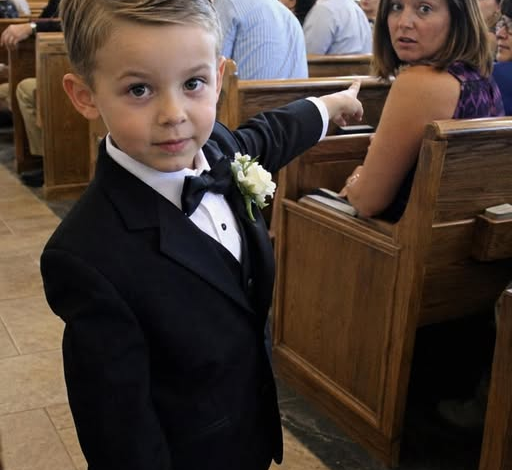
The priest had barely begun the ceremony when Liam suddenly broke free from the pews and ran toward the altar.
At first, guests smiled.
Children interrupt weddings all the time.
People expected something cute:
a forgotten ring,
a funny question,
nervous excitement.
Instead Liam grabbed his father’s jacket with both hands and shouted:
“Dad, you already have a wife.”
There are moments when entire rooms change emotionally all at once.
You can feel it physically:
the silence tightening,
laughter dying halfway through,
people shifting unconsciously toward tension before they fully understand why.
Claire looked at Andrew expecting immediate reassurance.
A laugh.
An explanation.
Anything.
Instead his hand turned cold inside hers.
That detail says everything.
People often reveal truth before speaking through body language first:
freezing,
avoiding eye contact,
losing physical presence entirely.
Andrew did not react like a man facing childish confusion.
He reacted like a man watching a secret collapse.
Claire bent down carefully and asked Liam the obvious question:
“Who is your dad already married to?”
Liam smiled brightly and pointed toward the back pews.
“There she is.”
And suddenly another woman was running for the doors.
Claire followed instinctively, gathering wedding skirts in her fists while guests whispered behind her. She caught the woman at the church entrance just before escape became possible.
Up close, the woman looked exhausted rather than malicious.
That distinction mattered later.
“Who are you?” Claire demanded.
The woman answered quietly:
“You should ask him.”
Then finally:
“My name is Elena.”
The conversation that followed revealed something more emotionally complicated than simple cheating.
Andrew was not legally married to Elena.
But emotionally?
Practically?
Historically?
Yes.
Completely.
Years earlier, Andrew promised Elena a life together beneath a full moon on a beach, slipping a Claddagh ring onto her finger while speaking vows privately.
No legal paperwork.
No public ceremony.
No family approval.
But commitment existed.
So did Liam.
And suddenly the truth rearranged itself into something ugly:
Claire was not replacing a dead woman.
She was replacing a living one hidden carefully outside Andrew’s approved social world.
That distinction transforms betrayal entirely.
Andrew did not merely fail to disclose a complicated past.
He constructed an entirely false emotional reality around Claire’s future.
Worse, he allowed her to bond with Liam while lying about the child’s mother being dead.
That level of deception requires sustained compartmentalization psychologically. People capable of maintaining parallel emotional realities often rely heavily on rationalization:
I’ll fix it later.
Nobody gets hurt if timing works out.
I’m protecting everyone.
It’s complicated.
But “complicated” often means someone benefits from avoiding truth.
Andrew benefited enormously.
He kept Elena privately.
Kept Liam.
Kept family expectations temporarily satisfied.
And simultaneously built a socially approved future with Claire.
Because Claire fit the world his parents wanted publicly.
Elena explained the dynamic painfully simply:
“You are from a good family, and I’m not.”
That sentence exposed the real architecture beneath the deception:
class,
status,
approval,
inheritance.
Andrew’s parents tolerated Elena only in secrecy because she threatened the image and social alignment they envisioned for their son.
Claire represented legitimacy.
Elena represented emotional truth.
And Andrew lacked the courage to choose openly between them.
Instead he attempted to live inside both realities simultaneously.
That emotional cowardice became visible most clearly when confronted publicly. Even then, he struggled to speak plainly.
“It’s complicated.”
“No,” Elena answered. “It isn’t.”
She was right.
Painful situations can still be emotionally simple underneath:
he loved Elena,
wanted Claire’s approval-based future,
and hoped somehow to avoid consequences long enough that reality would organize itself conveniently.
People often mistake indecision for kindness.
They are not the same thing.
Indecision prolonged suffering for everyone involved.
Claire understood that almost immediately once the shock settled into clarity.
The cruelty was not merely romantic betrayal.
It was emotional appropriation.
Andrew let her build dreams using false foundations:
motherhood,
family,
future,
trust.
And because Liam genuinely loved her too, the loss became devastatingly layered.
When she confronted Andrew directly —
“You told me his mother was dead!” —
his responses centered less on remorse and more on damage control.
“I care about you.”
“I never wanted to hurt you.”
Those phrases often appear when people still want moral credit despite destructive behavior.
But caring about someone while deceiving them fundamentally is not emotional integrity.
It is attachment without courage.
Meanwhile, Andrew’s mother revealed herself completely once public image collapsed.
“This is not the place for theatrics,” she snapped during the confrontation.
That sentence reveals something important psychologically:
some families prioritize appearance over truth so intensely that exposure itself becomes treated as the greater offense.
Not the lying.
Not the manipulation.
Not the hidden partner and child.
The public embarrassment.
Image-centered family systems often operate this way. Maintaining social order matters more than emotional honesty until reality becomes impossible to contain.
Even then, the instinct remains:
quiet it,
minimize it,
restore appearances.
But the church had already transformed into something impossible to control:
a room full of witnesses watching years of secrecy collapse in real time.
And at the center of it all stood Liam.
Confused.
Scared.
Still innocent enough to believe honesty simply belonged wherever adults were talking.
Children expose hidden systems accidentally because they have not learned strategic silence yet.
Liam did not intend destruction.
He believed he was correcting a mistake.
His father already had a wife.
That statement contained more moral clarity than anything spoken by the adults around him.
The most heartbreaking moment arrived afterward when Liam asked Claire:
“Did I do bad?”
That question reveals how quickly children internalize adult emotional chaos. The room had turned hostile, tense, judgmental. Liam sensed immediately that his honesty caused disruption even though he did not understand why.
Claire’s response mattered enormously:
“No, sweetheart. You told the truth.”
That line transformed the entire emotional center of the story.
Because despite her humiliation and grief, Claire protected the child from carrying adult shame.
That is emotional maturity many adults never achieve.
She understood instinctively:
the person most responsible for the disaster was not the five-year-old who exposed it.
It was the grown man who built it.
Outside the church afterward, Elena apologized quietly.
And Claire answered with surprising compassion:
“Don’t stay with him just because he finally got caught.”
That sentence revealed another layer of understanding.
Claire recognized something painful in Elena too:
years spent hoping honesty would eventually emerge naturally,
years spent accepting partial love while waiting for public acknowledgment.
Women trapped inside emotionally unequal relationships often convince themselves patience will eventually become reward.
Sometimes exposure simply reveals the relationship was never built to honor them fully in the first place.
Six months later, the emotional aftermath looked very different than anyone expected.
Elena filed for custody and won.
Claire supported her through the process.
And what began as shared betrayal slowly transformed into unexpected friendship.
That development feels emotionally significant because it rejects the narrative many people expect women to follow after romantic betrayal:
competition,
resentment,
mutual destruction.
Instead Claire and Elena recognized a more difficult truth:
they were both manipulated by the same system of cowardice and image management.
One hidden privately.
One displayed publicly.
Neither truly chosen honestly.
And somehow, through all of it, Liam remained the emotional bridge between them.
Claire still visited.
Liam still ran into her arms.
Love survived even though the wedding did not.
That may be the most powerful part of the story.
Not every ending destroys everything attached to it.
Sometimes collapse reveals which connections were real all along.
Claire lost the future she imagined walking into that church.
But she kept something unexpected:
truth,
clarity,
and a child who loved her honestly because children do not care about social approval, strategic marriages, or family status.
They care who shows up,
who listens,
who kneels down gently when they are scared.
And in the middle of public humiliation and heartbreak, Claire still did that for Liam.
Which perhaps says more about her capacity for love than the wedding vows ever could have.