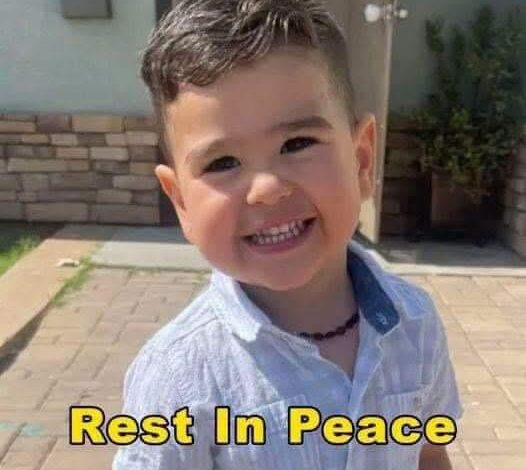
The days following the child’s death have settled over the neighborhood like a heavy silence.
Streets that once echoed with everyday routines now feel subdued, as though the entire community is moving more slowly, struggling to make sense of a loss that has left so many questions unanswered. Familiar faces linger a little longer at the ends of driveways. Conversations begin softly and often end in silence. In moments like these, words rarely feel large enough to carry the weight of grief.
Parents instinctively reach for their children’s hands.
Hugs last a little longer than they did before.
Simple routines—walking to school, riding bicycles, playing in front yards—now carry an awareness that wasn’t there only days earlier. A tragedy involving a child has a way of touching even those with no direct connection to the family, reminding everyone how precious and fragile young lives can be.
Near the place where the child is being remembered, a small memorial continues to grow.
Fresh flowers appear each morning.
Stuffed animals, handwritten notes, candles, and balloons have been carefully placed by neighbors, classmates, and strangers alike. Each item represents a shared desire to honor a life that ended far too soon and to offer comfort, however small, to a grieving family facing unimaginable pain.
Behind the scenes, investigators continue their work with quiet determination.
Cases involving the death of a child require extraordinary care and attention. Detectives are reviewing medical records, interviewing relatives, neighbors, and anyone who may have relevant information, while carefully reconstructing the hours leading up to the emergency call.
Every timeline is examined.
Every statement is compared.
Every piece of evidence is evaluated with the goal of understanding exactly what happened.
Officials have emphasized that the investigation remains active and that conclusions should not be drawn before all available evidence has been thoroughly reviewed. The autopsy, forensic findings, witness interviews, and medical evaluations will all contribute to determining the circumstances surrounding the child’s death.
For investigators, patience is essential.
So is accuracy.
For the family, however, every passing day can feel like an eternity.
Grief rarely waits for official answers.
It arrives immediately, leaving loved ones to face an emptiness that no investigation can erase.
At the same time, conversations online have grown increasingly emotional.
Social media has become a place where sympathy, speculation, and rumor often exist side by side. While many people have shared heartfelt condolences and messages of support, others have rushed to form conclusions before the investigation has been completed.
Community leaders and local residents have urged restraint.
They remind people that behind every headline is a real family experiencing profound loss, and that spreading unverified information can deepen the pain for those already carrying an unbearable burden.
Compassion, they say, is more valuable than speculation.
Patience is more helpful than assumptions.
As the investigation continues, one truth has already become unmistakably clear.
The child’s death has changed this community.
Neighbors who barely knew one another now stop to talk.
Families are checking in on each other more often.
Teachers, counselors, faith leaders, and community organizations have stepped forward to support those struggling to process the tragedy.
Moments of loss often reveal the quiet strength that exists within a community.
They remind people that healing rarely happens alone.
Whatever conclusions investigators eventually reach, they cannot restore what has been taken.
No report.
No courtroom.
No official statement.
None can return a child to the people who loved them.
What they can provide is understanding—an honest account of what occurred and, perhaps, lessons that may help prevent similar tragedies in the future.
In the meantime, many parents are finding themselves paying closer attention to the small moments that once seemed ordinary.
A lingering sadness.
A change in behavior.
An unexplained fear.
A cry for help that might otherwise have been dismissed as a passing phase.
The tragedy has encouraged difficult but important conversations about listening more carefully, asking more questions, and reaching out when something doesn’t seem right.
Sometimes the smallest warning signs deserve the greatest attention.
For now, the flowers continue to gather.
Candles continue to burn.
The memorial grows a little larger each day, standing as a quiet reminder of a young life that touched far more people than anyone could have imagined.
While investigators continue searching for answers, the community has already made one promise to itself.
To care a little more deeply.
To notice a little sooner.
To listen a little more closely.
And to honor the memory of a child gone far too soon by ensuring that compassion, vigilance, and kindness become part of the legacy left behind.