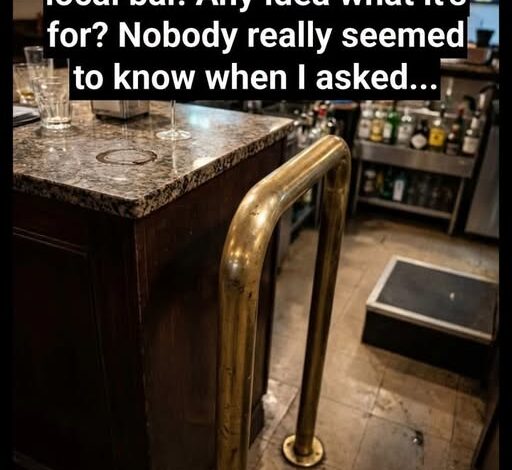
At first glance, it looks like nothing more than a decorative piece of metal.
Running along the front edge of many bars and restaurant counters is a polished rail that most customers barely notice. It doesn’t hold drinks, support stools, or appear to serve any obvious purpose. Yet that simple feature has been carefully included in bar designs for generations because it quietly solves several practical problems.
It’s called a service bar rail, and its job is far more important than it appears.
The primary purpose of the rail is to create a subtle boundary between customers and the staff’s working area.
Unlike a wall or a rope barrier, the rail doesn’t completely block access. Instead, it gently signals where guests should stop, helping preserve a clear workspace for bartenders and servers who often need to move quickly during busy service.
Behind the bar, every second matters.
Bartenders prepare drinks, wash glasses, handle payments, restock supplies, and coordinate orders while servers move in and out collecting beverages for their tables. During peak hours, dozens of people may be sharing the same limited workspace.
Without a clearly defined boundary, customers naturally tend to step closer, lean over the counter, or gather wherever there’s an open space.
Even a small shift into the staff’s path can slow service, create congestion, or increase the risk of accidental spills.
The service bar rail helps prevent that.
Rather than constantly asking guests to move back, staff can rely on the rail as a visual cue that quietly communicates where the customer area ends and the working zone begins.
Many bars also include an opening in the rail.
This gap isn’t an oversight—it’s intentional.
It allows bartenders and servers to enter and exit the workspace efficiently while reminding customers that the opening is reserved for staff access. In many restaurants, this section also serves as the pickup station where servers collect completed drink orders before delivering them to waiting guests.
Keeping that area clear helps maintain a steady flow of service throughout the restaurant.
The material used for these rails has its own history.
Brass has long been the traditional choice.
Part of the reason is practical. Brass is durable, resistant to corrosion, and capable of withstanding years of constant use. It also develops a distinctive patina over time that many establishments consider part of its charm.
But aesthetics play an equally important role.
Many classic bars feature matching brass foot rails beneath the counter. Using brass for both the upper service rail and the lower foot rail creates a cohesive appearance, giving the entire bar a warm, timeless character that has become closely associated with traditional pubs, taverns, and cocktail lounges.
Although brass remains popular, modern bars may also use stainless steel, chrome, powder-coated metals, or other materials chosen to complement contemporary interior designs.
Regardless of the material, the purpose remains the same.
The rail helps organize movement without drawing attention to itself.
Customers benefit as well.
By keeping the service area clear, bartenders can work more efficiently, drinks are prepared and delivered more quickly, and the likelihood of collisions or spilled beverages is reduced.
It’s one of those design features that works best when no one notices it’s doing its job.
Like many successful elements of architecture and interior design, the service bar rail quietly guides behavior rather than enforcing it.
People instinctively understand where to stand.
Servers instinctively know where to pass.
The entire space functions more smoothly because of a feature many patrons never consciously observe.
The next time you visit a restaurant or bar, take a closer look at that polished metal rail running along the counter.
What seems like a simple decorative accent is actually an important part of the bar’s workflow.
It helps separate guest space from staff space, protects busy service areas, creates a safer working environment, and contributes to the classic appearance that many bars are known for.
Sometimes the smartest design solutions aren’t the ones that demand attention.
They’re the ones that quietly shape how people move, interact, and share a space—making everything work a little more smoothly without anyone realizing why.