Thirty minutes after I gave birth, my husband stared at our newborn and whispered, “I want a DNA test. That baby might not be mine.”

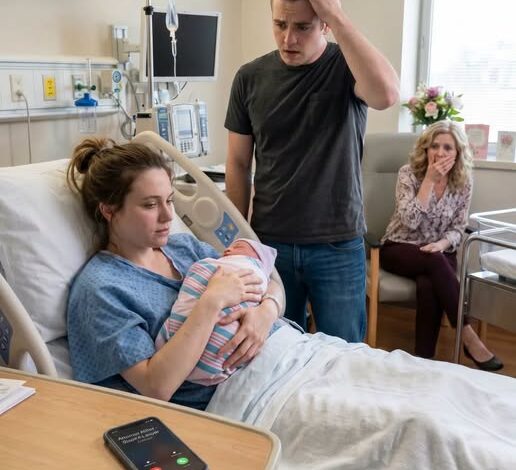
Thirty minutes after giving birth, I thought my husband would stand beside my hospital bed, kiss our daughter’s forehead, and tell me we had finally become a family.
Instead, he stared at her like she was evidence.
“I want a DNA test,” Mark said quietly. “That baby might not be mine.”
For one stunned second, I wondered whether the pain medication had distorted his words.
I was lying in a Nashville hospital room, exhausted, stitched, trembling, and still wearing the plastic bracelet they had fastened around my wrist when I arrived doubled over with contractions. Our daughter, Lily, rested against my chest, her tiny lips moving as if she were already trying to understand the world she had entered.
I had imagined this moment for months.
I thought Mark would cry.
I thought he would touch her miniature fingers and whisper that she was beautiful.
Instead, he stood at the foot of my bed with his arms folded, studying her face with suspicion.
“What did you say?” I asked.
His mother, Carol, sat rigidly in the corner, gripping a paper coffee cup with both hands.
Mark cleared his throat.
“I said I want a paternity test. I deserve to know whether she’s mine.”
The room went so quiet that I could hear Lily’s soft breathing.
My nurse, Dana, stopped adjusting the monitor. The look she gave Mark was the look people reserve for someone who has just committed an act of cruelty so shocking that words feel inadequate.
I stared at the man I had married four years earlier.
The man who had attended every prenatal appointment.
The man who had painted Lily’s nursery pale yellow.
The man who had cried when we first heard her heartbeat.
“You’re accusing me of cheating now?” I whispered.
“I’m asking for proof.”
Something inside me broke.
But it did not collapse.
It hardened.
Carol rose abruptly.
“Mark, stop this.”
He turned toward her.
“No, Mom. I’m not spending my life raising another man’s child.”
I looked down at Lily.
Her fingers curled around mine with complete trust.
I had never felt weaker physically, yet my mind became terrifyingly clear.
“Fine,” I said.
Relief flickered across Mark’s face.
He thought I was agreeing to the test.
I reached for my phone instead.
Rachel Bennett had handled legal matters for my business for years. When she answered, I spoke before Mark could stop me.
“Rachel, prepare divorce papers.”
Mark’s face went blank.
Carol turned white.
Then she whispered, “Oh God. He doesn’t know.”
I slowly looked at her.
“What doesn’t he know?”
Carol pressed a trembling hand to her mouth.
Mark’s anger shifted into alarm.
“Mom, what are you talking about?”
“Not here,” she said.
A bitter laugh escaped me.
“You watched him humiliate me thirty minutes after childbirth. Privacy is over.”
Dana quietly asked whether I wanted hospital security.
“Not yet.”
Carol lowered herself into the chair.
“When Mark was twenty-two, he had surgery,” she began. “There was a serious infection afterward. The doctors warned us that the damage might affect his fertility.”
Mark stared at her.
“What?”
“They said there was a strong possibility you would never father a child naturally.”
His expression changed as if the floor had dropped beneath him.
“You’re lying.”
“I’m not.”
Carol’s eyes filled with tears.
“Your father and I hid it because you were already depressed after the hospitalization. We thought the truth would destroy you.”
My heart pounded.
“You’re saying Mark may not be able to have children?”
Carol nodded weakly.
“The doctor said it was possible, but unlikely.”
Mark stepped backward.
For the first time since accusing me, fear appeared in his eyes.
But my anger did not soften.
“You didn’t know about the diagnosis,” I said. “But you knew me.”
“Emily—”
“You looked at our daughter before she had been alive for an hour, and instead of seeing love, you saw betrayal.”
He dragged both hands down his face.
“I heard things.”
“What things?”
He hesitated.
I waited.
Finally, he said, “My brother texted me. He said Lily didn’t look like me. He said you were too close to Ethan.”
For a moment, I could only stare.
Ethan was sixty-three, happily married, and preparing for retirement. He had helped me organize maternity leave and covered two client meetings when morning sickness became unbearable.
Mark had taken one reckless message from his brother and used it to destroy the most vulnerable moment of my life.
Carol reached into her purse and pulled out an old envelope.
“I kept the medical records.”
She held it toward him.
“Read them.”
Mark opened the papers with shaking hands.
He read the report once.
Then again.
By the third time, the certainty had vanished from his face.
All that remained was shame.
Carol began to cry.
“We thought we were protecting you.”
Mark looked at me.
“Emily, I’m sorry.”
I raised my hand.
“Don’t.”
He stopped.
For years, I had stood beside him without suspicion.
When he worked late, I brought dinner to his office.
When his father died, I handled funeral arrangements, bills, phone calls, and grieving relatives because Mark could barely get out of bed.
When Carol needed surgery, I drove her to appointments while pregnant and nauseous.
After everything I had given, one rumor had been enough to make him believe the worst of me.
“The DNA test will happen,” I said.
Mark nodded quickly.
“Yes. And when it proves Lily is mine—”
“When it proves she is yours,” I interrupted, “it will not erase what you did.”
His eyes filled with tears.
“I was scared.”
“So was I. I was scared during every contraction. I was scared when Lily’s heart rate dropped. I was terrified when extra nurses rushed into the room.”
My voice shook, but I did not look away.
“I was scared, and I still chose love. You chose accusation.”
The test results arrived two weeks later.
Mark was Lily’s biological father.
He came to my mother’s house carrying flowers, diapers, and a handwritten letter. He stood on the porch looking older than he had two weeks earlier.
“I’ll do anything,” he said. “Counseling. Therapy. Whatever you ask. Please don’t end our family.”
Through the window behind me, Lily slept in a bassinet beside my mother’s couch.
“Our family did not break because of a laboratory result,” I said. “It broke when you looked at your newborn daughter and treated her like a threat.”
He cried then.
Real tears.
Perhaps he meant every apology.
Perhaps one day he would become a better man.
But remorse did not immediately restore safety.
I filed for separation.
Not as revenge.
As protection.
Mark received supervised visits while we attended separate counseling. I told him that trust would not return because he delivered flowers or found the right words. It would have to be rebuilt through patience, accountability, and consistent action.
Carol apologized again and again. I eventually forgave her enough to let her be part of Lily’s life, but I never forgot what her silence had done. She had hidden the truth to protect her son, yet that secret had fed the fear that nearly destroyed his marriage.
Months later, I sat alone in Lily’s nursery, rocking her beneath the yellow walls I had finished decorating by myself.
She smiled in her sleep.
I kissed her forehead.
“You were never a question,” I whispered. “You were always wanted.”
The DNA test proved Mark was her father.
But biology was the easiest truth.
The harder question was whether he could become the kind of father—and husband—who deserved the family he had doubted at its most fragile moment.
That answer could not be printed on a medical report.
He would have to live it.