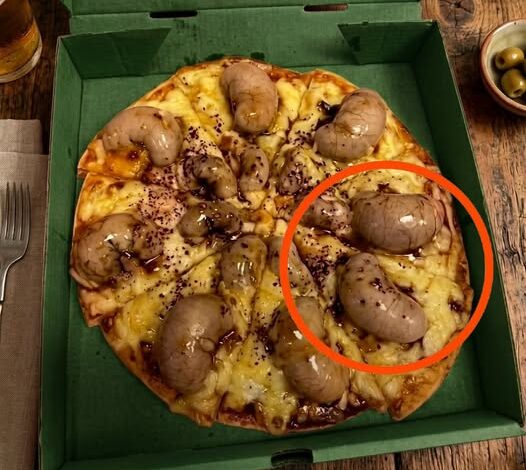
The moment I opened the pizza box, my excitement disappeared.
Instead of seeing the perfectly melted cheese I had been craving, I was greeted by several large, swollen bubbles rising from the surface. They weren’t the golden, crispy blisters you sometimes expect from a hot pizza. These were smooth, round, and oddly inflated, almost as if something had been trapped beneath the cheese. The way they reflected the light made them look strangely out of place, and the longer I stared, the less appetizing they became.
For several long seconds, I simply stood there, pizza slice in hand, trying to decide what I was looking at.
Part of me wanted to shrug it off and start eating.
The other part couldn’t ignore the growing feeling that something wasn’t right.
My imagination quickly took over.
Had the restaurant used some unusual ingredient?
Had something gone wrong while it was baking?
Could the cheese have spoiled somehow?
The possibilities became more dramatic with every passing moment. What had started as an ordinary meal suddenly felt like a mystery waiting to be solved. The strange bubbles looked almost organic, making it easy to convince myself they were something they definitely weren’t.
The more I examined them, the more unsettled I became.
It was one of those moments when your brain struggles with something that looks almost familiar but just different enough to trigger suspicion. Everything about the pizza seemed normal except for those unusual domes, and that tiny difference was enough to make me question the entire meal.
I even considered throwing it away.
Better safe than sorry, I thought.
Still, curiosity refused to let me give up so easily.
Instead of taking a bite, I reached for my phone and started searching online. Surely someone else had encountered the same strange-looking pizza. Within minutes, I found dozens of photos that looked almost identical to mine. Even more reassuring were the countless comments from people who admitted they had reacted exactly the same way.
Many had assumed the bubbles meant something had gone terribly wrong.
Others thought they were signs of contamination or poor-quality ingredients.
Some confessed they had thrown away perfectly good slices before learning what had actually caused them.
As I kept reading, the explanation turned out to be surprisingly simple.
Those strange-looking domes weren’t mysterious ingredients at all.
They were nothing more than pockets of air and melted cheese that had expanded during baking. As the pizza cooked in the intense heat of the oven, steam and air became trapped beneath the layer of cheese. Combined with the natural oils and fat released as the cheese melted, those pockets puffed upward, creating the smooth, balloon-like bubbles that had looked so alarming.
In other words, nothing was wrong with the pizza.
It was simply doing what pizza sometimes does.
Some pizzerias even consider those bubbles a completely normal part of the baking process, especially when pizzas are cooked at very high temperatures. Depending on how the cheese melts and how the dough releases steam, certain areas naturally inflate before settling back down as the pizza cools.
The discovery instantly changed my perspective.
Just moments earlier, I had been convinced I was looking at something suspicious.
Now I couldn’t stop laughing at how quickly my imagination had run wild.
All that worry…
All those ridiculous theories…
And the answer had been nothing more than ordinary cooking science.
Feeling more than a little embarrassed, I closed my phone, picked up a slice, and took a generous bite.
It tasted exactly as it should.
The crust was crisp.
The cheese was rich and perfectly melted.
The sauce was flavorful.
There was absolutely nothing unusual about it except the appearance that had fooled me so completely.
By the end of the meal, the strange bubbles that had seemed so intimidating were nothing more than a funny story to tell. It reminded me how easily appearances can shape our assumptions, especially when we encounter something we don’t immediately understand.
Sometimes our minds rush to the worst possible conclusion simply because something looks unfamiliar. But with a little curiosity—and a quick search for the facts—we often discover that what seemed alarming is completely harmless.
That pizza taught me an unexpected lesson.
The strangest-looking things aren’t always dangerous.
Sometimes they’re simply the result of ordinary science, a little heat, and melted cheese doing exactly what it’s supposed to do.
And in this case, the only real mistake would have been missing out on a perfectly delicious slice because I let appearances convince me otherwise.