The strangest thing about losing Dolly Parton is imagining silence where her laughter used to be.
For decades, she seemed to exist everywhere at once. On country radio and movie screens. Beneath the lights of Nashville and inside family living rooms. In battered record collections, children’s books, roadside billboards and the memories of people who could remember exactly where they were the first time they heard “Jolene.”
Now, at 80, Dolly Parton’s passing has left behind the kind of absence that feels almost too large to measure.
Yet the farewell her family is preparing is deliberately small.
According to the family’s wishes, there will be no enormous public funeral built around the spectacle of celebrity. No attempt to turn grief into one final performance. Instead, those closest to Dolly intend to honor what she wanted: an intimate ceremony centered on family, faith, stories and music.
It might sound surprising for a woman who spent most of her life in front of millions.
But perhaps it shouldn’t.
Dolly Parton understood the difference between being public and belonging to the public.
She gave audiences an extraordinary amount of herself. She shared stories of childhood poverty, heartbreak, ambition and faith. She laughed about her appearance before anyone else could. She turned deeply personal emotions into songs strangers used to understand their own lives.
But some things remained hers.
Her marriage to Carl Dean was perhaps the clearest example.
While Dolly became one of the most recognizable women in the world, Carl largely stayed away from cameras. Their relationship survived precisely because they refused to make every part of it available for public consumption.
That same instinct appears to shape her goodbye.
The rhinestones belonged to everybody.
The funeral belongs to the people who loved the woman underneath them.
And Dolly reportedly wanted those who wished to honor her to look beyond flowers and grand gestures.
Books mattered.
Stories mattered.
Music mattered.
Children mattered.
That is why one of the most fitting ways to remember her is through the work she spent decades building beyond the stage.
Her Imagination Library became one of the defining achievements of her life.
The idea was beautifully simple: put books into children’s hands.
Not only children whose parents could afford overflowing shelves. Not only children living near excellent libraries. Children everywhere the program could reach, including those growing up in circumstances Dolly understood personally.
She knew what poverty looked like because she had lived it.
She knew that talent did not arrive according to income.
She knew imagination could bloom inside a one-room cabin just as easily as inside a mansion.
What children often lacked wasn’t ability.
It was access.
So Dolly helped provide it.
Millions of books eventually traveled into homes because a country singer from Tennessee believed reading could expand the borders of a child’s world.
That work now feels inseparable from the global mourning surrounding her death.
Fans have been returning to her songs, certainly.
But many are also returning to the lessons behind them.
They are sharing photographs.
Repeating favorite quotes.
Reading old interviews.
Playing albums they haven’t heard in years.
Some are donating books.
Others are supporting literacy programs.
Parents are pulling Dolly’s books from shelves and explaining to children why the smiling blond woman associated with them mattered so much.
It is grief translated into action.
And Dolly probably would have appreciated that.
She never seemed especially interested in being mourned as a monument.
She wanted to be useful.
Even her songs worked that way.
“I Will Always Love You” became something people borrowed when their own language failed them.
“Coat of Many Colors” gave dignity to children who understood what it meant to have less than everyone around them.
“9 to 5” transformed workplace frustration into a chorus millions could sing together.
“Jolene” made insecurity sound simultaneously vulnerable and powerful.
Her music wasn’t merely admired.
It was used.
For breakups.
Weddings.
Funerals.
Road trips.
Hard mornings.
Lonely nights.
Fresh starts.
That is why the response to her death stretches so far beyond Tennessee.
In Nashville, the city that transformed an ambitious young songwriter into a star, fans have gathered around the places connected to her career. Her lyrics have appeared in tributes and handwritten notes, familiar words suddenly carrying the weight of prayers.
Elsewhere, landmarks and communities have found their own language for goodbye.
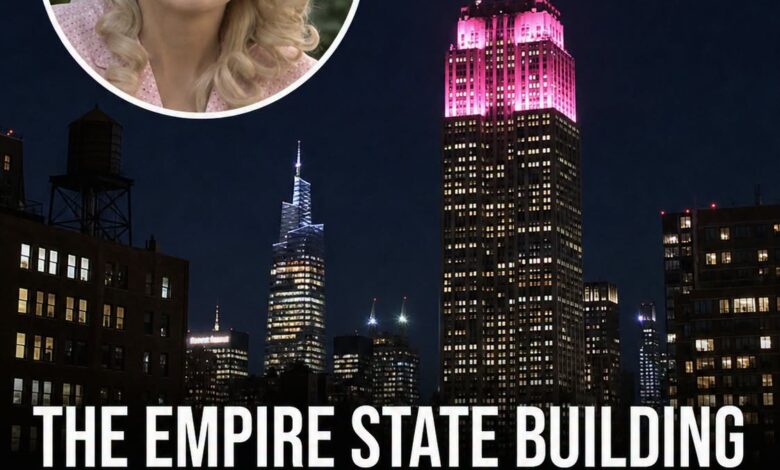
In Manhattan, the Empire State Building’s “pink sparkle” tribute offered a particularly fitting image.
The timing—9:25—was an unmistakable nod to “9 to 5.”
For a few moments, one of the most famous buildings in America became something Dolly would have appreciated: enormous, glamorous, slightly playful and impossible to ignore.
Pink light shimmered over New York.
Thousands of miles from the Tennessee mountains where her story began, the skyline sparkled for a woman who once had almost nothing.
There is poetry in that.
Dolly was born into circumstances that gave her no obvious path toward global fame.
She grew up in a large family where money was scarce but music wasn’t.
Those beginnings never became something she tried to erase.
Instead, she carried them everywhere.
The mountains stayed in her voice.
Her family’s stories entered her songwriting.
The poverty became material, but never something she exploited with contempt.
She could look back at hardship without romanticizing hunger and still find beauty inside what her family had given her.
Then she turned that beginning into something astonishing.
Records.
Movies.
Businesses.
Awards.
Dollywood.
A publishing legacy.
Philanthropy.
An international identity so recognizable that a silhouette of blond hair and rhinestones could practically function as a signature.
Yet what made Dolly unusual wasn’t simply that she became successful.
It was that success never seemed to embarrass her into pretending she had started somewhere else.
She could move between Hollywood and the Smoky Mountains without behaving as though one world made the other less important.
That authenticity helped people trust her.
So did her humor.
Dolly understood that people were going to talk about her appearance, so she joined the conversation before they could weaponize it.
She joked about the wigs.
The clothes.
The cosmetic work.
The exaggerated femininity.
But beneath the jokes was control.
Nobody had accidentally created Dolly Parton.
She had built that woman deliberately.
She understood branding before celebrities were expected to describe themselves as brands.
She knew exactly what the audience saw.
And she also knew there was considerably more underneath it.
A formidable songwriter.
A disciplined businesswoman.
A philanthropist.
A woman who understood ownership and fought to maintain control over her work.
A person whose apparent softness never prevented her from knowing when to say no.
That is part of why her private funeral feels so appropriate.
After a lifetime of being looked at, Dolly’s final intimate moments do not need an audience.
Her family deserves to cry without performing grief.
They deserve to tell stories that never become headlines.
They deserve to sing songs badly if they want to.
They deserve laughter.
They deserve silence.
They deserve to remember their Dolly rather than ours.
Because theirs was different.
The public knew the woman walking onto a stage.
They knew the voice booming through speakers.
They knew the perfectly timed punch lines.
Her family knew the person who existed when the show was finished.
Those are not competing versions.
They are simply different rooms in the same life.
The public farewell, meanwhile, doesn’t need a single location.
It is already happening everywhere.
Every time somebody plays one of her records, part of it happens.
Every time a child receives a book through the Imagination Library, part of it happens.
Every time an aspiring songwriter looks at where Dolly started and thinks, “Maybe I can do this too,” part of it happens.
Every time someone chooses generosity over applause, part of it happens.
That may ultimately be the most extraordinary thing about Dolly Parton’s legacy.
She left behind mechanisms that continue working without her.
The recordings still play.
The songs still belong to people experiencing feelings she understood decades earlier.
The books still arrive.
The businesses still employ people.
The stories still travel.
The encouragement remains.
Death can stop a voice from creating something new.
It cannot easily stop a voice that has already traveled this far.
And Dolly’s traveled everywhere.
Perhaps that is why a giant public funeral would almost feel unnecessary.
How could one building contain her memorial?
How could one congregation represent everybody who felt they knew her?
How could one eulogy explain what she meant to a child receiving their first book, a songwriter chasing an impossible career, a woman leaving a relationship while listening to “I Will Always Love You,” or a worker turning up “9 to 5” before another exhausting shift?
There is no single Dolly Parton story.
There are millions of them.
Her family can keep the ceremony small.
The world will handle the rest.
Somewhere tonight, somebody will put on “Jolene.”
Somebody else will laugh at an old interview.
A child will open a book and see Dolly’s name.
A tourist will look toward the Tennessee mountains and remember the girl who dreamed beyond them.
Someone struggling with failure will repeat one of her reminders about getting back up.
And somewhere, perhaps, a young songwriter with very little money will sit alone with a guitar and believe that where you begin doesn’t have to determine where you finish.
Those moments are the real procession.
They require no cameras.
No velvet ropes.
No enormous floral arrangements.
No final television special.
Dolly Parton’s funeral may belong to a small circle of people who knew her most intimately.
But her memorial belongs to everyone she reached.
It stretches from Tennessee to Manhattan and far beyond, through radio speakers, glowing skylines, library shelves and memories.
The woman who spent her life covered in sparkle ultimately left behind something brighter than rhinestones.
Possibility.
The possibility that poverty doesn’t get the final word.
That heartbreak can become art.
That ambition and kindness can occupy the same heart.
That enormous success can be turned outward.
That a book can change a childhood.
That a song can outlive the person who wrote it.
And that sometimes the best way to honor someone isn’t to build a larger monument.
It’s to continue what they started.
So let the family have its quiet goodbye.
Let the rest of us sing.
Let the buildings glow pink.
Let the stories be told.
And most of all, let the books keep arriving.
Because somewhere a child who never knew Dolly Parton is about to open one.
And without realizing it, that child will become part of her story too.