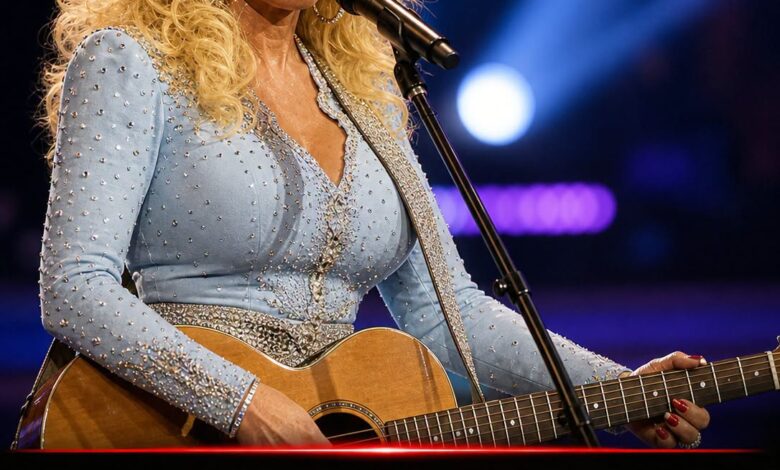
Dolly Parton gave the world thousands of pieces of herself.
Her heartbreak became lyrics. Her childhood became stories. Her humor filled interviews. Her faith appeared between the lines of songs that millions of people carried through marriages, funerals, long drives, lonely nights, and new beginnings.
For most of her life, if Dolly created something she loved, she wanted people to hear it.
But one song was different.
She deliberately took it away from us.
Not forever.
Just until 2045.
The recording sits sealed inside a wooden box at Dollywood’s DreamMore Resort in Tennessee, waiting for a generation Dolly knew she might never meet.
And perhaps that is what makes the idea so haunting.
It isn’t merely an unreleased track.
It’s an appointment with the future.
Years earlier, while developing Dollywood’s DreamMore Resort, Dolly created what became known as the Dream Box—a time capsule containing memories and objects intended to preserve part of her story.
But Dolly being Dolly, photographs and memorabilia weren’t enough.
She wanted to leave something alive inside it.
A song.
Not an old recording everyone already knew.
Not a forgotten demo pulled from an archive.
She wrote and recorded something specifically for the box.
Then she locked it away.
The instructions were clear: the song was not to be released until 2045, marking the resort’s 30th anniversary.
That meant Dolly had created music for listeners decades in the future.
Think about the strangeness of that for a moment.
A songwriter normally writes for the present.
She sits with a melody, wrestles with lyrics, walks into a studio and eventually releases the finished piece into the world. Then comes the frightening part: people respond.
They love it.
Ignore it.
Criticize it.
Make it their wedding song.
Play it after a breakup.
Turn it into something the songwriter could never have predicted.
Dolly’s mystery song was denied that immediate life.
She recorded it knowing that once it disappeared into the box, she would have to surrender control.
No audience reaction.
No radio play.
No applause.
No one approaching her backstage to say, “That song got me through something.”
Only silence.
And Dolly apparently found that silence almost unbearable.
Years after sealing the recording away, she admitted that she sometimes wished she could retrieve it.
She joked about wanting to dig the thing up.
That reaction feels perfectly Dolly.
She had willingly created the mystery and then became one of the people most tormented by it.
She knew what everyone else wanted to know.
Was the song good?
What did it sound like?
What had she written to people living decades beyond the moment in which she recorded it?
She knew.
And she wasn’t telling.
The temptation must have been enormous.
Dolly Parton spent her career understanding audiences almost instinctively. She knew how to deliver a punchline, when to reveal vulnerability and when a simple melody could carry more emotional weight than a complicated arrangement.
Imagine possessing a song you believe matters and knowing that the entire purpose of the song depends upon refusing to let anyone hear it.
That requires an unusual kind of restraint.
The box itself adds to the mythology.
This isn’t a digital file sitting anonymously on a forgotten server.
The song was preserved physically, reportedly on a CD with a player so that whoever eventually opens the capsule has the means to hear it.
There is something wonderfully old-fashioned about that.
Technology changes brutally fast.
Formats disappear.
Machines become obsolete.
Entire music libraries that once required shelves can now fit inside a device smaller than a hand.
Dolly understood that the people of 2045 might inhabit a technological world dramatically different from hers.
So she left instructions with the music.
In essence:
Here is my voice.
And here is how you make it speak.
The chestnut wood used for the Dream Box also connects the object to Tennessee, the place that shaped nearly everything about Dolly’s imagination.
She could have chosen something sleek and futuristic.
Instead, the song was surrounded by something rooted.
Wood.
Home.
Memory.
The mountains.
It feels appropriate for a woman who spent her career moving between two worlds.
Dolly was always looking forward without pretending she came from nowhere.
She could build businesses, embrace new audiences and reinvent herself while continuing to speak about the one-room cabin and Smoky Mountain childhood that formed her.
She became global without becoming geographically anonymous.
Tennessee remained inside the story.
And now, symbolically, Tennessee surrounds the song too.
For years, the mystery was playful.
Fans could speculate knowing that Dolly herself was somewhere laughing about their impatience.
What could she possibly have written?
Was it funny?
Spiritual?
A love song?
A farewell?
Was there some message hidden inside the lyrics?
Did she imagine flying cars and robots?
Did she address the listeners directly?
Nobody outside the small circle involved could say.
And that uncertainty was part of the fun.
But time changes the emotional weight of objects.
A sealed recording from a living artist is a curiosity.
A sealed voice waiting beyond goodbye becomes something else entirely.
Suddenly 2045 does not feel like a release date.
It feels like a reunion.
That is the extraordinary power of recorded sound.
Photographs preserve appearance.
Letters preserve thoughts.
Objects preserve touch.
But voices preserve presence in a uniquely unsettling way.
A familiar voice can collapse decades in seconds.
Anyone who has unexpectedly heard a recording of someone they lost understands this.
For one instant, the logical part of the mind knows the truth while another part reacts as though the person has simply entered the room.
There they are.
Breathing between sentences.
Laughing.
Pausing.
Existing again in sound.
Imagine that experience multiplied across millions of listeners.
When the box is eventually opened, people will know the Dolly Parton of history.
They will know “Jolene.”
They will know “9 to 5.”
They will know “Coat of Many Colors.”
They will know the songwriter who wrote “I Will Always Love You.”
They will know the businesswoman, philanthropist, performer and larger-than-life personality.
Some listeners will remember her personally from their own lifetimes.
Others may know her the way today’s young people know performers from generations before them—through recordings, photographs and stories handed down by parents or grandparents.
Then someone will press play.
And for a few minutes, history will become present tense.
A new Dolly Parton song will exist.
Not newly written.
Newly heard.
That distinction makes the entire experiment remarkable.
The woman singing will belong to another moment in time.
But the audience will be hearing her for the first time.
Dolly essentially sent music forward through history without knowing who would receive it.
She could not know what country music would sound like in 2045.
She could not know how people would listen to songs.
She could not know what Dollywood would become.
She could not know what Tennessee, America or the world would look like.
She could not even know which words and worries would still feel familiar.
Yet she trusted something.
Human beings would still listen.
That faith may be the real message inside the box.
Technology changes.
Fashion changes.
Fame changes.
But someone still falls in love.
Someone still loses a parent.
Someone still leaves home.
Someone still misses childhood.
Someone still needs encouragement.
Someone still needs a song.
Dolly built an extraordinary career by understanding that emotional continuity.
Her songs often worked because beneath the wigs, jokes and instantly recognizable voice were feelings that required no particular decade.
Poverty.
Ambition.
Jealousy.
Devotion.
Grief.
Dignity.
Home.
Hope.
Those things survived every musical trend she encountered.
Perhaps they will survive until 2045 too.
There is also something deeply generous about creating art without expecting to witness its reception.
Artists naturally want feedback.
They want applause.
They want to know their work mattered.
Dolly intentionally denied herself that reward.
She planted a seed knowing someone else would stand beneath the tree.
That may be why her jokes about wanting to retrieve the song are so revealing.
Of course she wanted to hear it released.
Of course she wanted people to know.
She was human.
She had made something and wanted to share it.
But she resisted.
Because the waiting was part of the gift.
And Dolly understood gifts.
Her greatest acts of generosity were rarely about simply handing someone something valuable.
They were about possibility.
A book placed in a child’s hands creates possibilities the giver will never witness.
A scholarship creates a future the donor cannot predict.
An encouraging word can alter a decision without the speaker ever discovering what happened afterward.
The secret song operates in much the same way.
Dolly created something for strangers.
People who may have been children when she recorded it.
People who may not yet have been born.
People whose lives she could not possibly imagine.
She asked nothing from them except that they wait.
Until 2045.
Then open the box.
Follow the instructions.
Press play.
And listen.
There is an irresistible temptation to imagine that moment.
Perhaps a crowd will gather.
Perhaps cameras will broadcast the opening around the world.
Perhaps musicians will stand nearby.
Maybe longtime fans will arrive wearing rhinestones and carrying photographs from concerts held decades earlier.
Somebody will carefully lift the contents.
The recording will be prepared.
There may be nervous laughter while everyone wonders whether technology preserved it properly.
Then silence.
A button will be pressed.
And somewhere inside a speaker, after decades of waiting, Dolly will breathe in.
That first sound may matter almost as much as the song itself.
Because for the people listening, it will briefly defeat time.
The voice will not know what happened after it was recorded.
It will not know who is listening.
It will not know what the world became.
But it will have arrived exactly where Dolly intended it to arrive.
In the future.
That is the beauty of the Dream Box.
Dolly Parton spent her life giving herself away in songs.
Yet one time, she did something different.
She withheld one.
She wrapped it in mystery.
Placed it inside Tennessee wood.
Left instructions.
And trusted tomorrow to keep the appointment.
Most artists leave behind unreleased recordings by accident.
Dolly left one behind deliberately.
That’s why the song already means something before anyone hears a single note.
It represents her peculiar combination of humor, sentimentality, showmanship and hope.
Only Dolly could turn not releasing a song into a performance lasting thirty years.
And when 2045 finally arrives, the mystery will end.
The box will open.
The silence will break.
A voice from another time will fill the room.
For those few minutes, people will not simply be listening to an archival recording.
They will be receiving something addressed to them.
A gift mailed across decades.
A promise finally kept.
And somewhere between the first note and the last, listeners may realize that Dolly Parton managed one final piece of stagecraft.
She made the world wait for an encore.
Then arranged for the music to begin long after everyone thought the show was over.