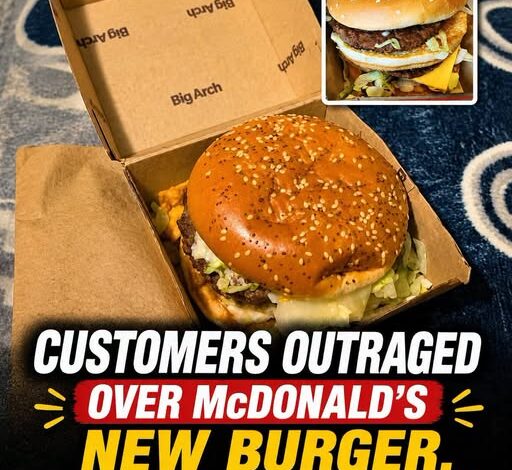
The arrival of the Double Big Mac in the United States is about more than adding another item to a fast-food menu. It has sparked a broader conversation about taste, tradition, portion sizes, and the role that iconic brands continue to play in American culture. For some customers, the oversized burger is a welcome return to familiar comfort food, offering a larger version of one of McDonald’s most recognizable creations. For others, it raises questions about nutrition and the direction of an industry already known for serving increasingly generous portions.
For many people, the appeal is rooted in nostalgia.
The Big Mac has been a fixture of American fast food for decades, becoming more than just a hamburger. It represents childhood road trips, family meals, late-night stops, and memories tied to a brand recognized around the world. The Double Big Mac builds on that familiarity by offering the same signature ingredients—special sauce, lettuce, cheese, pickles, onions, and sesame-seed bun—but with twice the beef patties, creating an experience designed to feel both familiar and bigger than before.
That sense of indulgence is exactly what many customers are looking for.
Fast food has long occupied a unique place in everyday life. For some, it is an occasional treat rather than a daily habit—a chance to enjoy something rich, flavorful, and unapologetically satisfying. The Double Big Mac embraces that idea completely, inviting customers to enjoy a larger, more filling version of a classic sandwich without pretending to be anything else.
At the same time, its arrival has naturally generated debate.
Nutrition experts and health advocates have long expressed concerns about portion sizes, calorie consumption, and the relationship between highly processed foods and long-term health outcomes. Against that backdrop, an even larger version of an already substantial burger inevitably becomes part of a wider discussion about dietary habits and public health. Some critics view products like the Double Big Mac as examples of a continuing trend toward oversized meals, while others argue that occasional indulgences can fit within a balanced lifestyle when enjoyed in moderation.
These differing perspectives highlight a broader reality.
Food is rarely just about nutrition alone. It is shaped by culture, personal preference, family traditions, convenience, affordability, and individual choice. What one person sees as a fun, limited-time treat, another may view as an unnecessary example of excess. Neither perspective completely defines the product itself, but together they explain why new menu items from major restaurant chains often receive attention far beyond the dining table.
The Double Big Mac has also developed a reputation internationally before reaching American customers. In countries where it has previously appeared as a limited-time offering, reactions have ranged from enthusiastic praise among fans seeking a heartier meal to criticism from those who found it overly large or difficult to eat comfortably. Like many highly anticipated menu releases, its reception has reflected the wide variety of tastes and expectations among consumers.
Pricing has become another point of conversation.
Depending on location, restaurant pricing, and promotional offers, customers may find noticeable differences in what they pay, adding another dimension to discussions about value. Some see the larger sandwich as worthwhile for its increased portion, while others question whether the additional cost justifies the extra size. As with many restaurant purchases, perceptions of value often depend as much on personal priorities as on the menu itself.
Perhaps that is why the Double Big Mac has attracted so much attention despite being, at its core, a variation of an existing product.
It sits at the intersection of several ongoing conversations: changing eating habits, consumer expectations, nostalgia, health awareness, and the continuing evolution of fast-food culture. A single sandwich becomes a topic of debate because it reflects larger questions about how people choose to eat, what they expect from familiar brands, and how companies respond to shifting consumer preferences.
Ultimately, McDonald’s is introducing more than a limited-time burger. It is offering customers a choice—whether to revisit a beloved classic in a larger form, to pass on it altogether, or simply to join the conversation surrounding its return. The Double Big Mac may satisfy some appetites while leaving others unconvinced, but its biggest impact may be the discussion it inspires about balance, moderation, and the many different ways people define enjoyment when it comes to food.
In the end, the sandwich itself is only part of the story. The greater conversation lies in what it represents: a familiar favorite reimagined on a larger scale, inviting each customer to decide for themselves where indulgence ends, moderation begins, and whether bigger truly means better.