Pope Leo XIV’s One-Word Message to the United States Sparks Global Debate: What It Really Means

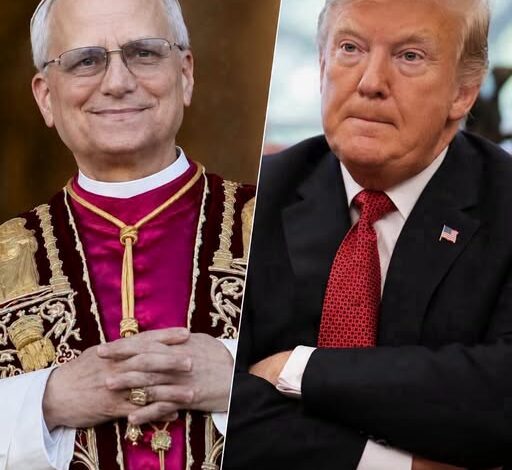
It lasted only a moment, but for many who watched, it carried the weight of something much larger.
As Pope Leo XIV moved through a crowd of reporters, one journalist asked a deceptively simple question: “Holy Father, your thoughts on the United States?” Rather than offering a lengthy reflection or carefully crafted diplomatic statement, the Pope paused briefly before answering with a single word.
“Wounded.”
There was no immediate explanation.
No elaboration.
No attempt to soften the impact of the remark.
For a brief instant, the press corps seemed almost frozen, uncertain whether to ask a follow-up question or simply let the silence speak for itself. The exchange ended as quickly as it had begun, yet that one-word response immediately became the focus of discussion far beyond the Vatican.
What exactly did he mean?
That question has fueled days of debate among journalists, religious scholars, political commentators, and ordinary readers alike. Because the Pope offered no further clarification in that moment, people have naturally interpreted the remark through the lens of their own experiences and concerns.
Some hear a lament over the deep political divisions that have increasingly shaped American public life. They see “wounded” as a reflection of growing polarization, declining trust in institutions, public anger, and the difficulty many communities face in finding common ground despite profound disagreements.
Others hear something less like criticism and more like compassion.
After all, describing someone as wounded does not necessarily imply condemnation. It acknowledges pain. It recognizes that suffering exists while leaving open the possibility of healing. In that interpretation, the Pope’s answer sounds less like a verdict against the nation than an expression of concern for people struggling through difficult social, political, and cultural challenges.
For many theologians, that distinction is significant.
Throughout the Bible, wounds are rarely presented as the end of the story. They often become places where mercy, restoration, and transformation begin. Physical wounds heal. Emotional wounds require compassion. Spiritual wounds call people toward reconciliation rather than despair.
Seen through that perspective, the Pope’s choice of words carries a sense of hope alongside its obvious gravity.
A wound is painful.
But unlike something declared beyond saving, a wound also suggests the possibility of recovery.
That theological symbolism has led many observers to view the comment as both an honest assessment and an invitation. Rather than labeling America by its achievements or failures alone, the word “wounded” encourages reflection on what has caused those injuries—and what might be required to heal them.
The remarkable power of the exchange lies in its simplicity.
Long speeches often provide enough detail to guide interpretation.
One carefully chosen word does the opposite.
It invites listeners to complete the thought themselves.
Some immediately think about violence.
Others consider loneliness, economic hardship, addiction, declining trust, political hostility, or social isolation.
Still others hear a broader reflection on humanity itself, recognizing that every nation carries its own visible and invisible wounds.
That openness explains why the response has resonated so widely.
It functions almost like a mirror.
Each person brings their own concerns to the conversation and, in doing so, discovers what the word “wounded” means to them personally.
Of course, without additional explanation from Pope Leo XIV, no single interpretation can be presented as definitive. His brief answer leaves room for multiple readings, and responsible observers should be cautious about claiming certainty where none has been provided.
Perhaps that is precisely why the moment has endured.
The Pope did not offer a political platform.
He did not identify specific leaders or policies.
He did not assign blame.
Instead, he chose a word that invites examination rather than argument.
Whether people understand it as a gentle rebuke, a pastoral expression of compassion, or a call to national reflection, the response continues to spark conversations that extend well beyond the few seconds it took to deliver.
In the end, the significance of that exchange may lie less in the word itself than in the questions it leaves behind.
If a nation is wounded, what caused those wounds?
Who bears responsibility for healing them?
Can disagreement coexist with compassion?
Can truth be spoken without abandoning hope?
Those are questions no single sentence can answer.
Yet sometimes a single word is enough to begin asking them.
And perhaps that is why the moment has remained so memorable. In a world overflowing with speeches, statements, and endless commentary, one brief response managed to accomplish something surprisingly rare: it encouraged people to pause, reflect, and consider not only what their country has become, but what it still has the capacity to become.