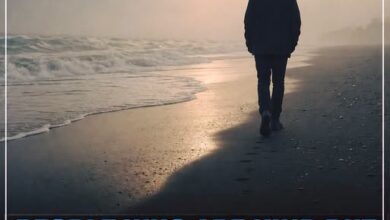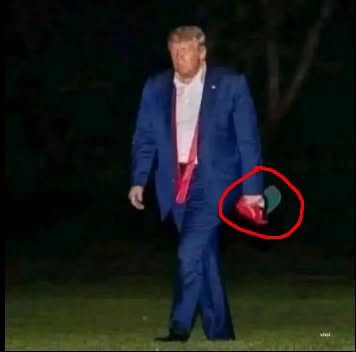
Long after the photograph disappears from news headlines and social media timelines, the real story is no longer about the man in the picture or the object he happened to be carrying. Instead, it becomes a story about us—about the assumptions we make, the narratives we create, and the remarkable speed with which ordinary moments can be transformed into something they were never meant to be.
What should have remained an unremarkable late-night walk quickly became something much larger.
Within hours, strangers across the internet had begun examining every pixel of the image, convinced that hidden answers were waiting to be uncovered. Some zoomed in on his hands, others debated his expression, while countless viewers confidently claimed to know what the photograph truly revealed. The absence of clear information didn’t slow the speculation—it accelerated it.
Every unanswered question became an invitation to invent an answer.
Before long, a single image had evolved into a national inkblot test, reflecting far more about the people interpreting it than about the person who appeared in the frame. Some viewers projected fear onto the scene, seeing signs of danger where none had been confirmed. Others interpreted it through hope, frustration, admiration, or political loyalty. The same photograph produced entirely different stories depending on who happened to be looking at it.
That is the remarkable power—and the danger—of ambiguity.
Human beings are naturally uncomfortable with unanswered questions. Our minds are wired to search for patterns, connect loose pieces of information, and build complete stories from incomplete evidence. When details are missing, imagination often rushes in to fill the gaps, creating explanations that feel emotionally satisfying even when they have little connection to reality.
Social media magnifies that instinct.
A theory shared with confidence can spread across thousands of screens in minutes. Repetition gives speculation the appearance of certainty, and before long, opinions begin masquerading as established facts. The original image remains unchanged, yet the stories attached to it multiply with astonishing speed.
In that environment, curiosity can quietly transform into something else.
Wanting to understand a public figure is natural. Public interest has always accompanied people who live their lives in the spotlight. But there is an important difference between curiosity and entitlement. At some point, the desire to know more can become the belief that every private moment deserves explanation, every unexplained action demands interpretation, and every ordinary event must conceal extraordinary meaning.
That expectation places an impossible burden on public life.
Not every photograph carries a hidden message.
Not every quiet moment signals a dramatic turning point.
And not every unanswered question points toward secrecy or deception.
Sometimes a person is simply walking.
Sometimes an object is exactly what it appears to be.
Sometimes a photograph captures nothing more complicated than a brief, ordinary moment that happened to be witnessed by the wrong camera at the right time.
Yet our collective appetite for meaning often refuses to accept simplicity.
We have become accustomed to believing that every image contains clues waiting to be decoded, every pause conceals a larger narrative, and every silence is evidence of something intentionally withheld. In doing so, we risk overlooking the possibility that life is often far less theatrical than the stories we build around it.
The late-night sighting ultimately reveals something more enduring than the questions surrounding the individual in the photograph.
It exposes the way modern audiences interact with uncertainty.
A single image becomes a blank canvas onto which millions of people project their own experiences, anxieties, hopes, and beliefs. Political frustrations, personal fears, and emotional expectations all find their way into interpretations that say as much about the observer as they do about the subject.
The mystery, then, is not simply what happened that evening.
The greater mystery is why we feel compelled to transform every unknown into a carefully constructed narrative.
Perhaps the hardest lesson is learning to live with unanswered questions.
Not every story arrives with a satisfying conclusion.
Not every moment requires an explanation.
And not every shadow hides a secret waiting to be uncovered.
Sometimes life simply unfolds beyond the reach of cameras, captions, and speculation.
As the image gradually fades from public attention, what deserves to remain is not another unverified theory but a quieter reminder about the way we consume information. Curiosity is valuable. Asking questions is healthy. But there is wisdom in recognizing the limits of what a single photograph can honestly tell us.
In the end, the most revealing part of that late-night image may never have been the person walking through it.
It was the reflection it offered of ourselves.
It showed how easily we turn strangers into symbols, ordinary moments into grand narratives, and unanswered questions into stories that feel complete simply because we want them to be.
Sometimes the truth is not hidden behind the image.
Sometimes the only thing waiting there is an ordinary moment, still incomplete, still uncaptioned, and entirely comfortable remaining just that.