A Hostess Refused to Seat My Elderly Mother, Assuming We Couldn’t Pay—But the Owner Soon Stepped In

My mother wanted only one thing for her seventy-eighth birthday.
Not a party.
Not gifts.
Not a room full of people singing loudly while she smiled politely and pretended not to be overwhelmed.
She wanted dinner at a small Italian bistro her church friends kept talking about.
For weeks, she had mentioned it in little pieces.
“They say the pasta is handmade.”
“Evelyn said the sauce tastes like someone’s grandmother made it.”
“Apparently the tiramisu is wonderful.”
She never asked directly at first. That was my mother’s way. She had spent most of her life making herself easy to overlook, smoothing out her own wants so everyone else could have theirs. So when she finally said, “Maybe we could go there for my birthday,” I said yes before she finished the sentence.
On the evening of her birthday, she came out of her bedroom wearing a navy vintage dress covered in tiny pale flowers.
I recognized it instantly.
She had worn it in old photographs from before I was born, back when her hair was darker and my father still looked at her as though the world made sense because she was in it.
“You look beautiful,” I told her.
She touched the sleeve, shy as a girl. “At seventy-eight, beautiful is generous.”
“At seventy-eight, beautiful is accurate.”
She smiled then, small and luminous.
The drive into the city was quiet in the best way. She hummed along with the radio, hands folded over her purse, watching the buildings slide by. Every so often, she pointed out something that had changed.
“That bakery used to be a pharmacy.”
“Your father got a parking ticket on this street once.”
“There was a toy store near here. You cried because I wouldn’t buy you a stuffed giraffe.”
“I remember that giraffe,” I said.
“You named it Sebastian before you even owned it.”
We laughed, and for a while the evening felt exactly as I had hoped it would: ordinary, tender, safe.
When we reached the bistro, warm golden light spilled through the windows. Inside, candles flickered on small tables. Waiters moved between guests with plates of pasta and glasses of wine. The air smelled like garlic, bread, tomatoes, and something buttery enough to make my stomach ache with hunger.
My mother paused at the entrance.
“This is it,” she whispered, almost reverently.
I offered my arm. “Then let’s go have your birthday dinner.”
The hostess stood behind a polished wooden stand, dressed in black, her hair pulled into a sleek knot. She looked up at us briefly, and in that single glance, something changed.
Her eyes moved over my mother’s dress.
Her shoes.
Her worn purse.
Then me.
“Reservation?” she asked.
“Yes,” I said. “Two under Margaret Ellis.”
She tapped at the screen. Once. Twice.
“I don’t see it.”
I blinked. “I confirmed yesterday.”
“We’re fully booked.”
Behind her, at least five tables sat empty.
I glanced past her. “There seem to be tables available.”
“They’re reserved.”
“For later?”
“They’re reserved,” she repeated, colder this time.
My mother’s hand tightened around my arm.
“It’s all right,” she murmured. “We can go somewhere else.”
But I heard the change in her voice.
The brightness had faded.
“Could you check again?” I asked. “It’s her birthday.”
The hostess gave a small smile that had no kindness in it.
“I’m sure there are other places nearby that might be more comfortable for you.”
The words were soft.
The meaning was not.
My mother lowered her eyes immediately, as though she had done something wrong simply by walking through the door.
That was what broke my heart.
Not the reservation.
Not the empty tables.
The way my mother, who had raised three children on a nurse’s salary, who had buried a husband, cared for neighbors, organized church meals, sat beside dying friends, and never once asked life for special treatment, suddenly looked embarrassed for wanting dinner.
“Mom,” I said gently, “you don’t need to apologize.”
“I don’t want trouble,” she whispered.
“You are not trouble.”
Before I could say more, a sharp crash rang out from the kitchen.
A plate, maybe two.
Conversations paused.
The hostess turned, irritated.
Then a man in a chef’s coat appeared in the kitchen doorway.
He was older, tall, with silver hair and flour on one sleeve. His expression was stern at first, focused on whatever had happened behind him.
Then his eyes landed on my mother.
The color drained from his face.
He took one step forward.
Then another.
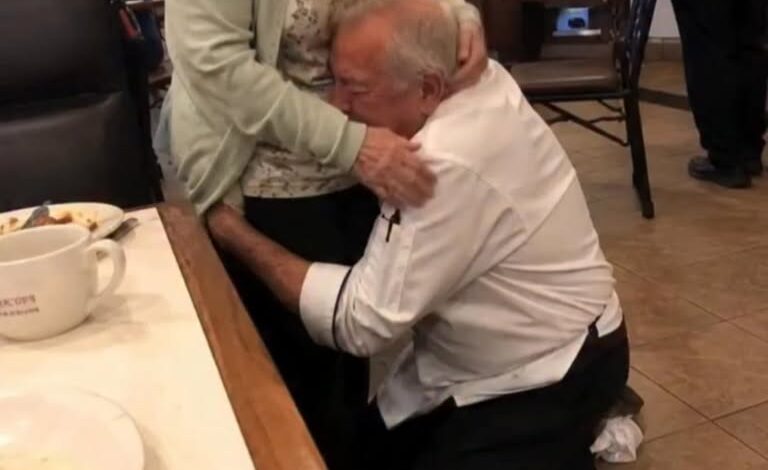
“Margaret?”
My mother lifted her head.
The room seemed to go quiet all at once.
The chef walked toward us slowly, as if approaching a memory he was afraid might disappear.
“Margaret Hale?”
My mother stared at him.
Her lips parted.
“Antonio?”
The hostess looked between them, suddenly pale.
The chef stopped in front of my mother, and for a moment he looked no longer like a man who owned a restaurant, but like a young boy seeing a ghost.
“I thought I’d never see you again,” he said.
My mother pressed one hand to her chest. “I didn’t know this was yours.”
He laughed once, shakily. “It is because of you that it is mine.”
I looked at my mother. “Mom?”
Antonio turned to me.
“Your mother fed me when I first came to this country,” he said. “I was nineteen. I had no family here, barely any English, and no money. She worked nights at the hospital, and every morning she brought me leftovers in a paper bag.”
My mother’s cheeks flushed. “It was nothing.”
“It was not nothing,” he said sharply, then softened. “To you, maybe. To me, it was survival.”
The whole restaurant had gone silent.
Antonio looked at the hostess.
“Who told this woman we had no table?”
The hostess swallowed. “I thought—”
“No,” he said. “You did not think. That was the problem.”
My mother reached out. “Please, don’t be harsh.”
Antonio looked at her with such tenderness that I nearly cried.
“Still defending people,” he said. “After all these years.”
Then he turned to the staff. His voice became firm enough to cut through the room.
“No guest is measured by clothing, age, purse, accent, or anything else you think you see at the door. If you cannot understand that, you cannot work here.”
The hostess lowered her head.
Antonio looked back at my mother. “Margaret, please. Allow me the honor.”
He led us to the best table in the restaurant.
Not hidden in the corner.
Not squeezed near the door.
A table by the window, beneath a small painting of the Italian coast.
My mother sat as if she were still unsure she deserved it.
Antonio pulled out her chair himself.
“You once told me food should make people feel less alone,” he said. “Tonight, I cook for you.”
And he did.
Course after course arrived.
Warm bread with olive oil.
Handmade pasta in a rich tomato sauce.
Roasted vegetables.
Chicken with lemon and herbs.
Tiramisu with a single candle placed gently in the center.
When the candle was lit, the entire restaurant sang.
My mother covered her mouth, tears shining in her eyes.
Not because everyone was looking at her.
Because for once, they were seeing her.
After dinner, Antonio came back carrying an old photograph.
In it, my mother stood outside a hospital entrance, younger and laughing, handing a paper bag to a skinny teenage boy with dark curls.
“You kept this?” she whispered.
“Every kitchen I ever worked in,” he said. “It reminded me what feeding people means.”
My mother held the photo as though someone had handed her a piece of her own life she had forgotten.
On the ride home, she was quiet for a long time.
Then she said, “I almost let that girl make me leave.”
“I know.”
“I’m glad you didn’t.”
I reached over and squeezed her hand.
“Me too.”
She looked out at the city lights, the navy flowers of her dress soft in the dashboard glow.
“I suppose kindness comes back sometimes,” she said.
I smiled. “Sometimes it owns the restaurant.”
She laughed then, full and bright.
And I realized her birthday dinner had become far more than a meal.
It had become proof.
Proof that dignity does not fade with age.
Proof that small acts of kindness can outlive decades.
And proof that some people may judge you at the door, but others will remember exactly who you were when it mattered most.