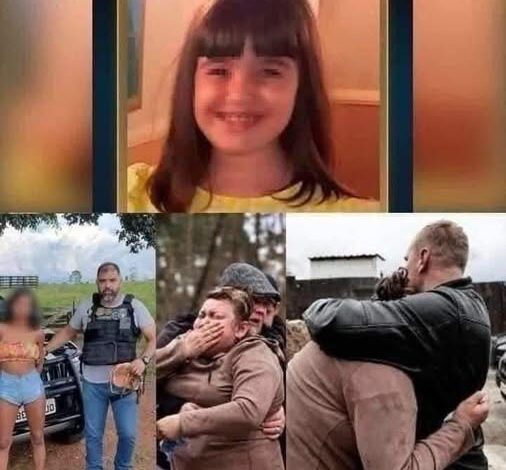
The moment officers reached her, the search ended—but the real journey was only beginning.
For years, her name had lived on missing-person posters, social media campaigns, and in the hearts of people who refused to stop hoping. To the public, she had become a mystery. To investigators, she was an open case. To her family, she remained the child they had never stopped waiting for.
But when she was finally found, none of those labels mattered.
She was simply a frightened young girl.
The child standing before investigators was not the same one who had disappeared. The years in between had changed her in ways no one could yet measure. Whatever circumstances had kept her hidden had also separated her from the ordinary experiences most children take for granted—school, friendships, birthdays, routines, and the reassuring rhythm of everyday family life.
Those losses cannot be counted on a calendar alone.
Trauma has a way of reshaping childhood, often leaving effects that remain long after physical safety has been restored. That is why the first priority was never interviews or headlines.
It was care.
Doctors began evaluating her physical health.
Mental health professionals worked patiently to create an environment where she could begin feeling safe again.
Specialists prepared for what they knew would not be a quick recovery, understanding that trust, confidence, and emotional security are rebuilt slowly, one step at a time.
No one expected immediate answers.
Children who have endured prolonged trauma often need time before they are able—or willing—to talk about what they have experienced. Pressuring them for details can sometimes do more harm than good. Instead, professionals focus first on restoring stability, helping them rediscover routines, establish a sense of safety, and regain control over their own lives.
Meanwhile, investigators turned their attention elsewhere.
While the child began the difficult process of healing, law enforcement continued gathering evidence, interviewing those involved, reviewing records, and examining every decision that had contributed to the years she remained missing. Each new lead helped piece together a timeline that investigators hoped would explain not only how she disappeared, but also how she remained hidden for so long.
Every answer uncovered brought new questions.
Were warning signs overlooked?
Could someone have intervened sooner?
Did others know more than they admitted?
Those questions would take time to resolve.
For her family, however, another challenge unfolded quietly behind closed doors.
For years, they had lived suspended between hope and heartbreak. Every phone call carried possibility. Every reported sighting revived emotions they had learned to manage but never truly silence. They imagined countless reunions, yet no amount of imagining could prepare them for the reality of welcoming home someone who had lived through experiences they could scarcely comprehend.
Love alone could not erase the years apart.
It could, however, provide a place to begin.
Family members learned to move gently, allowing conversations to happen naturally instead of demanding explanations. They understood that healing rarely follows a schedule. Some memories might emerge slowly. Others might remain difficult to discuss for a long time. What mattered most was making sure she knew she no longer had to face those memories alone.
Sometimes the greatest gift a family can offer is patience.
Not every silence needs to be filled.
Not every question requires an immediate answer.
Sometimes simply being present speaks louder than words.
Beyond the family, an entire community found itself reflecting on the years that had passed.
Neighbors remembered the missing-person flyers that had once appeared in shop windows.
Volunteers recalled long days spent searching fields, neighborhoods, and wooded trails.
People who had shared photographs online, followed news updates, or reported possible sightings realized that every effort—no matter how small it seemed at the time—had been part of a larger chain of hope.
Most tips lead nowhere.
Most searches end without resolution.
Yet those who continue looking understand something important: every case remains unsolved until the one lead that matters finally arrives.
Her recovery will not be measured by the day she was found.
It will be measured by the months and years that follow.
By every night she sleeps without fear.
By every friendship she builds.
By every milestone reclaimed.
By every moment she rediscovers what it means to make her own choices and live without constant uncertainty.
Finding a missing child is often described as the ending of a story.
In truth, it is usually the beginning of another.
One focused not on survival, but on healing.
Not on headlines, but on ordinary days slowly returning.
Not on what was taken, but on what can still be rebuilt.
The search brought her home.
Now comes the quieter, more demanding work of helping her believe that home is a place where she is safe, valued, and free to become whoever she chooses to be.
Because being found is an extraordinary moment.
Feeling found—truly, deeply, and completely—is a journey built one day, one act of compassion, and one restored piece of trust at a time.