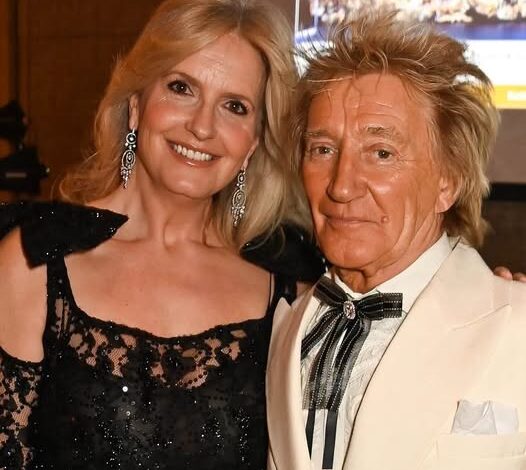
What began as an ordinary family getaway quickly became the center of an online debate that reached far beyond one celebrity or a handful of photographs.
Penny Lancaster was enjoying a relaxing day aboard a yacht with her loved ones, soaking up the sunshine and spending time away from the demands of public life. There were no red carpets, television interviews, or carefully orchestrated photo shoots—just a woman enjoying precious moments with her family.
Then the photographs appeared online.
Within hours, social media users were commenting not on the holiday itself, but on Penny’s appearance.
Some praised her confidence and natural beauty.
Others focused on every visible sign of aging, dissecting her body with the kind of scrutiny that has become all too familiar for women in the public eye.
Wrinkles.
Skin texture.
Natural changes that come with time.
The comments arrived one after another, many suggesting she should have dressed differently, posed differently, or somehow hidden the reality of getting older.
The criticism spread quickly.
As often happens online, strangers who had never met Penny felt entitled to judge her appearance based on a few photographs captured in a single moment.
Yet something remarkable happened.
She didn’t respond with anger.
She didn’t rush to defend herself.
She didn’t issue lengthy statements explaining why her body looked exactly the way a real person’s body naturally does.
Most importantly, she didn’t apologize.
That quiet refusal became far more powerful than any argument could have been.
For decades, women—particularly those in the public eye—have faced extraordinary pressure to appear untouched by time. Magazine covers, social media filters, cosmetic procedures, and unrealistic beauty standards have created an environment where aging is often treated as something to hide rather than something every human being inevitably experiences.
While men are frequently praised for looking “distinguished” or “aging gracefully,” women often encounter a very different standard.
Gray hair becomes controversial.
Natural skin changes become headlines.
A vacation photograph somehow becomes public property, inviting thousands of opinions from people who believe aging should remain invisible.
Penny Lancaster’s photographs unexpectedly became part of that larger conversation.
Many supporters quickly came to her defense.
They pointed out the obvious contradiction in modern beauty culture.
Women are encouraged to embrace confidence and authenticity, yet are often criticized the moment they appear without perfect lighting, professional styling, or digital editing.
Others praised Penny for simply existing without trying to erase every visible reminder of the years she has lived.
Her confidence resonated because it felt genuine.
There were no elaborate attempts to create an impossible illusion of perfection.
No carefully staged effort to convince the world that time had somehow stopped.
Just a woman enjoying life with the people she loves.
That authenticity struck a chord with countless people who are growing increasingly tired of unrealistic beauty expectations.
Many women shared their own experiences.
Some admitted they had become anxious about wearing swimsuits because of comments made by strangers.
Others spoke about avoiding photographs altogether after becoming overly self-conscious about normal signs of aging.
Many described feeling as though society had quietly decided there was an expiration date on being seen.
Reading those stories revealed something important.
The conversation had long since stopped being about Penny Lancaster.
It had become about millions of women who recognized pieces of their own lives in the criticism directed toward her.
Why, so many asked, has growing older become something people feel obligated to apologize for?
After all, every wrinkle tells a story.
Every line reflects years spent laughing, worrying, raising families, working hard, overcoming challenges, and simply living.
These changes are not evidence of failure.
They are evidence of life itself.
Experts in psychology often note that constant exposure to unrealistic beauty standards can have profound effects on self-esteem and mental well-being. Social media, where edited images frequently dominate attention, can create impossible comparisons that leave many people feeling they are somehow falling short of an ideal that doesn’t actually exist.
The result is a culture where ordinary human aging is sometimes viewed as a flaw requiring correction.
Yet moments like Penny’s vacation photographs offer a different perspective.
They remind us that authenticity carries its own kind of beauty.
Confidence does not require perfection.
Joy does not depend on flawless skin.
And meaningful moments with family lose none of their value because a camera happened to capture someone exactly as they are.
Perhaps that is why so many people ultimately admired her response.
Rather than disappearing from public view or attempting to satisfy impossible expectations, she continued living her life.
She smiled.
She spent time with her loved ones.
She remained present in moments that truly mattered instead of allowing criticism from strangers to dictate how she should experience them.
That quiet confidence sent a message far more powerful than any carefully crafted statement ever could.
It suggested that self-worth cannot be measured by online approval.
That growing older is not something to hide.
And that existing naturally in one’s own body should never require permission.
The debate surrounding those photographs also highlights a broader cultural shift.
Increasingly, people are questioning whether beauty standards built around impossible perfection truly serve anyone. More public figures have begun sharing unedited photographs, speaking openly about aging, and rejecting the expectation that they must constantly appear flawless.
These choices may seem small individually.
Together, they gradually reshape conversations about confidence, appearance, and self-acceptance.
In the end, the most memorable part of Penny Lancaster’s yacht day wasn’t the criticism.
It was what followed.
A reminder that confidence doesn’t come from looking perfect.
It comes from refusing to let other people’s expectations determine your value.
The photographs captured more than a relaxing day on the water.
They captured something quietly courageous.
A woman choosing to be fully present in her own life, exactly as she is.
And perhaps the greatest lesson wasn’t about celebrity at all.
It was about the freedom that comes when people stop treating aging as something to fear and start recognizing it for what it truly is—a privilege that not everyone is fortunate enough to experience.