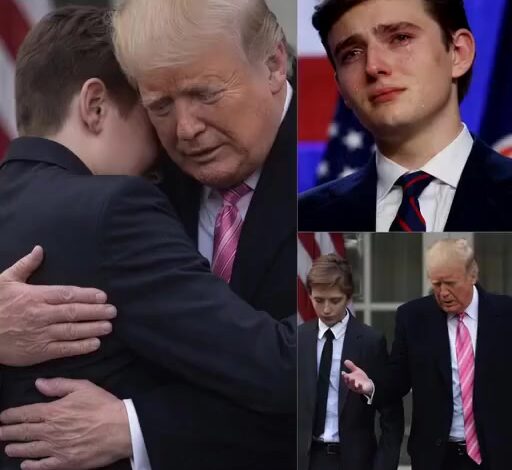
He did not choose the storm, but he learned to live in its eye. As his father turned every room into a battleground and every moment into a broadcast, Barron Trump moved like a ghost at the edge of the frame, present but unreachable. Melania’s shield was not affection displayed for approval, but a refusal to let the crowd devour what little innocence he had left.
That decision carved out a rare space in a culture obsessed with access. It allowed him to grow without constantly performing, to observe without being forced to react. While others his age built brands from their childhoods, he was allowed to keep his. Whatever he becomes—public figure, private citizen, or something in between—he carries an unusual power: he knows how to exist without needing to be seen. In this era, that might be the loudest rebellion of all.
Barron Trump entered public life before he could possibly understand what public life meant.
Most children discover attention gradually:
a classroom,
a neighborhood,
a sports team,
a small circle of peers shaping identity slowly over time.
Barron was born into something entirely different.
Before he formed lasting memories, cameras already followed his family. Before he understood politics, his surname had become one of the most polarizing brands in modern American culture. By the time he was old enough to recognize faces in crowds, strangers already believed they knew something about him simply because they recognized his father.
That kind of visibility alters childhood fundamentally.
Especially when the father at the center of it all is Donald Trump.
Donald Trump does not merely occupy rooms; he dominates them. His personality reshapes environments around him through sheer force of attention. Conversations become performances. Conflict becomes spectacle. Public life becomes permanent theater. Supporters experience that charisma as strength. Critics experience it as exhaustion. Either way, the gravitational pull remains undeniable.
Inside that atmosphere, Barron often appeared almost spectral by contrast.
Tall,
silent,
carefully composed,
hovering near the edges of photographs without fully entering them emotionally.
The contrast fascinated people because modern political families usually operate differently. Children of powerful figures are often introduced strategically into public narratives:
campaign appearances,
interviews,
carefully staged family moments designed to humanize authority.
But Barron remained unusually protected from that machinery.
Much of that protection came through Melania Trump.
Her public image often appeared reserved, even distant, but distance itself became part of the shield she built around her son. She seemed to understand instinctively what relentless exposure does to children psychologically. Fame already distorts identity under ordinary circumstances. Political fame magnifies that distortion exponentially because every gesture becomes symbolic and every appearance becomes commentary fuel.
So she withheld him.
Not completely.
That would have been impossible.
But strategically.
While the Trump family often embraced visibility aggressively, Barron’s appearances remained comparatively rare and controlled. He attended necessary public events yet seldom became emotionally accessible to the public itself. Americans watched him grow physically taller over the years while learning remarkably little about who he actually was privately.
That privacy mattered.
Especially during adolescence.
Teenage years are already psychologically fragile under normal conditions. Identity forms unevenly through embarrassment, experimentation, insecurity, friendship, rebellion, and mistakes people hopefully outgrow quietly. Imagine navigating all of that while millions of strangers discuss your appearance, your body language, your clothes, your silence, or your family every time you step outside.
Barron largely escaped the worst versions of that scrutiny precisely because he was allowed to remain undefined publicly.
In a culture obsessed with constant self-exposure, that restraint feels almost radical now.
Modern celebrity culture encourages children toward visibility immediately. Young people build audiences before identities fully stabilize. Entire childhoods become content:
birthday parties,
family arguments,
private grief,
awkward adolescence,
relationships,
mistakes.
Attention becomes currency early.
Privacy becomes weakness.
Performance becomes survival.
Barron’s upbringing moved strangely against that current.
While countless young public figures learned to monetize visibility, he learned how to endure it without participating fully. That distinction may shape him more profoundly than people realize.
Because there is power in observing without constantly presenting yourself for consumption.
Barron rarely speaks publicly.
Rarely explains himself.
Rarely feeds the endless appetite modern media possesses for personal access.
That silence frustrates some observers precisely because contemporary culture increasingly treats public curiosity as entitlement. People believe visibility creates ownership:
if someone belongs to public life, the public deserves emotional access too.
Melania consistently resisted that assumption regarding her son.
Her protection often appeared less emotional than strategic, but strategy can itself become a form of love. She understood that preserving fragments of ordinary development mattered more than satisfying public fascination.
And Barron, intentionally or not, became one of the few recognizable political children of his era whose identity was not fully consumed by branding before adulthood.
That absence of overexposure shaped public perception strangely.
People projected onto him constantly because projection fills informational gaps naturally. Some imagined him shy. Others imagined him observant, isolated, privileged, lonely, detached, intelligent, awkward, or quietly rebellious. The less he revealed, the more symbolic he became.
But symbols rarely capture actual people accurately.
The truth is likely simpler and more complicated simultaneously:
a young man growing up inside extraordinary circumstances while trying to maintain enough internal privacy to become himself independently of national obsession surrounding his family.
That task cannot be easy.
Especially because Donald Trump’s public life generates perpetual emotional weather around everyone connected to him. Every election cycle, indictment, rally, controversy, or media battle creates renewed scrutiny extending outward toward family members automatically.
Most people attached to that orbit either join the performance actively or become consumed by it unwillingly.
Barron seemed to choose a third option:
minimal participation.
That choice may reflect temperament.
It may reflect maternal influence.
It may simply reflect survival instinct.
Whatever the cause, it created distance between him and the emotional frenzy surrounding his father’s public existence.
And distance creates perspective.
Children raised around enormous power often absorb strange lessons about visibility. Some become addicted to attention because they mistake it for love or relevance. Others recoil from it entirely after witnessing its corrosive effects firsthand.
Barron’s silence suggests someone who learned early that attention extracts a price.
Not necessarily through dramatic trauma.
Through observation.
Watching every family interaction analyzed publicly.
Watching strangers debate private dynamics confidently.
Watching ordinary moments transformed into political symbolism instantly.
That environment teaches caution quickly.
It also teaches performance.
Yet paradoxically, Barron’s most striking quality publicly has often been his refusal to perform emotionally for audiences. He appears neither eager for approval nor desperate to reshape public perception constantly.
That restraint feels increasingly unusual.
Especially among younger generations raised online, where identity itself often becomes inseparable from presentation. Many people now experience existence through continuous audience awareness:
posting,
reacting,
branding,
documenting.
Barron emerged from perhaps the most media-saturated political environment imaginable while remaining comparatively opaque psychologically.
In another era, that might not seem remarkable.
Today, it does.
Because withholding yourself from constant visibility has become culturally counterintuitive. Silence now reads almost rebellious in environments demanding endless disclosure.
And perhaps that is why public fascination with Barron persists despite knowing relatively little about him personally. People sense absence where they expect exposure. Mystery where they expect branding.
He exists publicly without fully surrendering himself publicly.
That balance may prove increasingly valuable as he moves further into adulthood.
Whether he eventually embraces public life, enters business, avoids politics entirely, or constructs something completely separate from the Trump legacy remains unclear. But whatever path he chooses, he carries an unusual kind of education:
he has witnessed the machinery of fame, politics, media obsession, and public projection from inside while remaining partially untouched by it emotionally.
That perspective is rare.
He knows what visibility costs because he grew up watching its consequences unfold around his family constantly. He also knows privacy possesses value precisely because so little of it survived within the political world surrounding him.
Perhaps that is the deeper significance of Melania’s protection.
She did not merely shield him from tabloids or gossip temporarily. She preserved his ability to become a person before becoming a symbol entirely. In public life, that distinction often disappears quickly.
Children become narratives.
Images.
Extensions of ideology.
Barron remained stubbornly human partly because so much about him stayed unknowable.
And in a culture increasingly addicted to exposure, unknowability itself becomes a kind of freedom.
People cannot fully consume what they cannot fully access.
So while the Trump name generated endless noise—rallies, scandals, headlines, commentary, applause, outrage—Barron often moved quietly beside it all like someone learning how to survive proximity to spectacle without becoming spectacle himself.
That may ultimately become his defining strength.
Not wealth.
Not power.
Not influence inherited through family.
Distance.
The ability to exist without constantly demanding recognition.
The ability to remain partially intact despite living near machinery designed to flatten private identity into public product.
In another age, such restraint might have seemed insignificant.
Now it feels almost radical.
Because in a world where everyone is expected to broadcast themselves endlessly, the person who can remain quiet,
private,
observant,
and emotionally self-contained
holds a form of power many louder people no longer even understand how to recognize.