In families that live constantly beneath public attention, even absence becomes a form of language.
An empty chair at an ordinary wedding might pass unnoticed in most households, explained away later through scheduling conflicts, travel delays, illness, or simple personal choice. But inside families whose lives have become inseparable from politics, celebrity, and media mythology, absence rarely remains private for long. It acquires symbolism almost immediately.
That was what happened after Donald Trump Jr.’s wedding celebration in the Bahamas.
The ceremony itself appeared intentionally restrained by the standards usually associated with the Trump family image. Held on a private island in the Bahamas, the gathering reportedly included roughly forty close friends and relatives, creating an atmosphere far more intimate than the massive gold-toned spectacle outsiders might have expected from one of America’s most publicly visible political families.
Donald Trump Jr. and Palm Beach socialite Bettina Anderson were celebrating what many reports described as a quieter personal milestone rather than a highly orchestrated public event. Several members of the Trump family attended, including Ivanka Trump, Eric Trump, Tiffany Trump, and Donald Jr.’s children. Photographs from the event reflected warmth, celebration, and the polished informality often associated with wealthy private gatherings designed to feel effortless despite careful planning behind the scenes.
Yet almost immediately, public attention shifted away from who was present toward who was not.
The missing seats became the story.
Donald Trump himself did not attend.
Neither did Melania Trump.
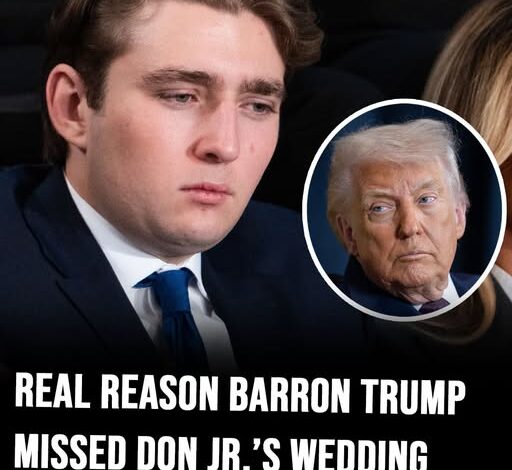
And perhaps most notably to public observers, Barron Trump was absent as well.
Under ordinary circumstances, the explanation offered for Donald Trump’s absence might have ended the conversation quickly. Reports indicated that presidential responsibilities and ongoing international matters prevented him from traveling to the Bahamas for the celebration. Given the demands attached to modern political leadership, such scheduling conflicts are hardly unusual.
But the Trump family has never existed inside ordinary political optics.
For years, their public image has depended heavily on visual unity:
campaign stages,
family photographs,
holiday appearances,
debate-night entrances,
carefully choreographed moments where presence itself communicated loyalty and solidarity.
Within that environment, absence naturally attracts interpretation.
The Trump family long functioned not only as relatives connected biologically, but as a kind of political and cultural institution. Public appearances often carried symbolic weight extending beyond personal relationships. During campaign years especially, visual cohesion reinforced broader narratives surrounding power, succession, branding, and family continuity.
That is why the Bahamas wedding generated so much discussion despite being relatively small by celebrity standards.
People no longer observe the Trump family casually.
They decode it.
Every seating arrangement,
every public embrace,
every visible tension,
every missing figure becomes potential evidence for larger theories about loyalty, distance, influence, or internal division.
And in modern media culture, speculation spreads faster than clarification ever can.
Barron Trump’s absence drew especially intense attention because he occupies an unusual position inside the Trump family structure. Unlike Donald Jr., Ivanka, and Eric Trump — who grew up closely connected to the Trump Organization, tabloid culture, reality television, and later political branding — Barron’s upbringing unfolded under far more controlled visibility.
Melania Trump consistently maintained unusually strong boundaries around his exposure to public life. While his older half-siblings became deeply integrated into business operations, campaign appearances, interviews, and media narratives, Barron largely remained outside the daily machinery of public performance surrounding the Trump name.
That difference matters.
Generational gaps inside large blended families often create naturally different emotional dynamics even without conflict. Donald Jr., Ivanka, and Eric came of age during the aggressive expansion of the Trump business identity in New York social and media culture. Barron, by contrast, grew up during a period where the family existed under constant political scrutiny and global visibility.
The environments shaping them were fundamentally different.
One generation was trained publicly.
The other was protected privately.
That distinction may explain some of the emotional and symbolic separation people now perceive between the younger and older branches of the family.
Still, perception itself can become misleading.
Public families are often interpreted through fragments:
photographs,
brief statements,
attendance lists,
body language analyses,
social media activity.
Entire narratives emerge from incomplete information because modern audiences increasingly consume celebrity and political life through symbolic storytelling rather than direct knowledge. The public rarely sees ordinary family dynamics — missed flights, scheduling complications, personal preferences, emotional exhaustion, or quiet boundaries that exist naturally inside every family regardless of status.
Instead, absence becomes dramatic almost automatically.
And perhaps nowhere is that more true than within the Trump family ecosystem, where image has long functioned as both political strategy and cultural currency.
Donald Trump himself built much of his public identity around projection:
strength,
visibility,
success,
dominance,
presence.
His children became extensions of that image during both business and political eras. Family appearances reinforced continuity and amplified messaging. During campaigns, the family often operated almost like parallel surrogates, each representing slightly different versions of the broader Trump brand:
corporate success,
traditional family identity,
wealth,
patriotism,
media confidence,
next-generation influence.
For years, the image remained remarkably coordinated despite external controversy.
But families evolve.
Children marry.
Grandchildren grow older.
Careers diverge.
Priorities shift.
Emotional distances emerge naturally over time.
And maintaining a perfectly unified public image becomes increasingly difficult once individual lives begin pulling in different directions.
The Bahamas wedding may represent part of that transition.
Not necessarily collapse.
Not necessarily feud.
But evolution.
Donald Trump Jr. himself has developed a public identity increasingly separate from the centralized family structure surrounding his father. His media presence, political commentary, and social relationships often position him as both participant in and independent extension of the broader Trump world.
His marriage to Bettina Anderson also reflects entry into a somewhat different social environment — one rooted heavily in Palm Beach society and elite private networks that intersect with but do not fully mirror traditional Trump political branding.
The wedding’s reported intimacy may have been intentional partly for that reason.
Smaller gatherings create emotional control.
Fewer cameras.
Fewer obligations.
Fewer symbolic performances required.
Yet paradoxically, reducing spectacle often intensifies scrutiny for public families because observers begin examining details more closely.
Who attended?
Who did not?
Who stood beside whom?
Who appeared relaxed?
Who looked distant?
Modern celebrity-political culture transforms ordinary family logistics into symbolic theater almost instantly.
The missing seats therefore carried emotional power regardless of whether deeper conflict existed behind them.
Because absence leaves interpretive space.
And humans instinctively fill interpretive space with narrative.
Some commentators framed the absences as signs of possible generational distance within the family. Others suggested practical explanations mattered far more than internet speculation acknowledged. Still others interpreted the moment as evidence that the Trump family’s carefully unified public image may naturally be becoming harder to maintain as individual branches develop separate lives and priorities.
All those possibilities can coexist simultaneously.
Families rarely fracture through one dramatic event alone.
More often, they drift gradually through accumulated distance:
different schedules,
different emotional needs,
different identities forming over time.
Public families simply experience that process beneath national observation instead of private silence.
And perhaps that is what makes these moments feel so strangely compelling to outsiders.
People project broader cultural questions onto famous families:
What does loyalty look like?
Can power preserve closeness?
Do public brands survive private complexity?
How much of family unity is authentic connection, and how much is performance maintained for cameras and expectations?
The Trump family occupies a uniquely American intersection of politics, celebrity culture, wealth, branding, and media mythology. Their personal milestones therefore become public symbols almost automatically, whether anyone involved intends that transformation or not.
A wedding becomes commentary about succession.
An absence becomes commentary about loyalty.
A photograph becomes commentary about influence.
Even silence becomes narrative material.
Yet beneath all the speculation, the simplest explanation may also contain truth:
families are complicated.
Even famous ones.
Especially famous ones.
And perhaps the Bahamas ceremony ultimately revealed less about dramatic rupture than about something quieter and more inevitable:
the gradual decentralization of a family long defined by coordinated visibility.
The Trump children are no longer merely extensions of one household.
They are building separate marriages,
separate identities,
separate social worlds,
separate public roles.
That process changes optics naturally.
The unified family image that once appeared tightly controlled during campaign years may become increasingly fragmented simply because adulthood itself fragments families over time, regardless of wealth or influence.
Still, the symbolism remains powerful.
Because in the Trump world, presence has always communicated something larger than attendance alone.
Showing up means alignment.
Visibility means support.
Shared photographs become public declarations.
And when certain figures are missing from those photographs, people inevitably begin asking what the absence means.
Perhaps the truth is mundane.
Perhaps it is personal.
Perhaps it reflects nothing deeper than conflicting obligations and evolving family rhythms.
Or perhaps it reflects subtle emotional distances impossible for outsiders to fully understand.
The public may never know.
But the attention surrounding the wedding revealed something undeniable:
the Trump family is still being watched not simply as relatives, but as symbols.
And symbols are interpreted constantly, even in silence.
For now, the empty seats do not prove collapse.
They do not confirm feud.
They do not automatically signal hidden division.
But they do suggest something quieter:
the family image that once appeared almost perfectly synchronized is becoming more complicated, more decentralized, and perhaps more human than the mythology surrounding it has long allowed people to admit.
And as future weddings, campaigns, celebrations, and crises unfold, the public will likely continue studying not only who stands in the photographs —
but who remains just outside the frame.