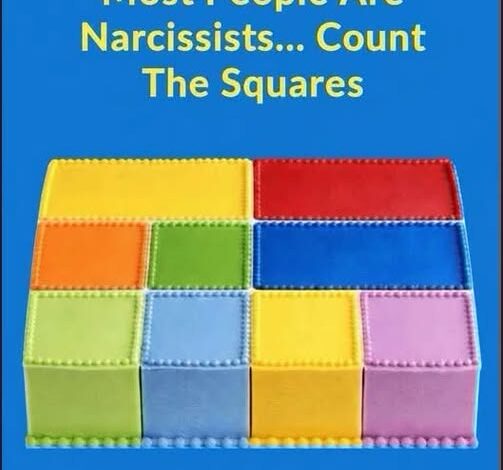
At first glance, it looks like one of the simplest puzzles imaginable. A collection of squares arranged in a familiar pattern and a single question: How many squares do you see? Most people answer within seconds, convinced the solution is obvious.
Then the comments begin.
One person confidently counts only the squares visible on the surface. Another insists there are larger combinations hidden within the design. Someone else argues that implied or partially obscured shapes should also be included. Before long, what started as a harmless brain teaser has transformed into a heated debate, with each participant convinced their answer is the only reasonable one.
The fascinating part isn’t the puzzle itself.
It’s what the puzzle reveals about us.
These visual challenges expose a truth that many people rarely consider: we don’t experience the world as objective observers. Instead, our brains constantly interpret what we see, filling in gaps, filtering information, and making assumptions long before we’re consciously aware of the process.
In other words, we often believe we’re seeing reality exactly as it is when we’re actually seeing reality through the lens of our own expectations.
That becomes especially apparent with puzzles involving hidden shapes or ambiguous images.
One person immediately notices the most obvious squares because their brain focuses on clearly defined boundaries. Another naturally begins combining smaller shapes into larger patterns. Neither approach is necessarily wrong unless the puzzle specifies exactly what should or shouldn’t be counted.
Yet that’s the detail people often overlook.
Very few stop to ask an important question before answering:
What are the rules?
Are we counting only complete, visible squares?
Do larger squares formed by smaller ones count?
Should overlapping shapes be included?
What about implied three-dimensional structures?
Without agreeing on those assumptions first, two intelligent people can arrive at entirely different answers while both following perfectly logical reasoning.
The disagreement, then, isn’t always about mathematics.
It’s about interpretation.
Unfortunately, many social media posts intentionally blur those boundaries.
Captions promising that “only geniuses get this right” or claiming that “most people fail this test” are designed to provoke strong reactions. Some go even further, attaching labels such as “narcissists always answer this way” or suggesting that a particular response reveals hidden personality traits.
These claims have little basis in psychology.
Instead, they exploit something much more predictable: our desire to be correct.
Once people publicly commit to an answer, many feel an unconscious need to defend it. Changing their mind can feel less like solving a puzzle and more like admitting defeat.
Psychologists have long studied this tendency.
One common cognitive bias, known as confirmation bias, encourages us to notice information that supports our initial belief while overlooking evidence that contradicts it. Once we’ve decided on an answer, our attention naturally gravitates toward details that reinforce our conclusion.
Another factor is selective attention.
The human brain cannot process every visual detail simultaneously, so it prioritizes certain patterns over others. Two people looking at the exact same image may genuinely notice different features first, not because one is smarter than the other, but because their attention has been drawn in different directions.
That’s why these puzzles can generate so much disagreement despite appearing so simple.
Everyone believes they’re observing the same picture.
In reality, they’re often focusing on different aspects of it.
Perhaps the greatest lesson hidden inside these visual riddles has nothing to do with counting squares at all.
It’s about intellectual humility.
Instead of rushing to defend an answer, there’s value in slowing down and asking questions.
“What assumptions am I making?”
“Could someone else be using a different—but equally reasonable—method?”
“Have the rules actually been defined?”
Those questions transform the experience from a contest into an opportunity for learning.
Interestingly, that habit extends far beyond puzzles.
Many disagreements in everyday life follow the same pattern.
People argue over statistics without agreeing on definitions.
They debate solutions without first agreeing on the problem.
They defend conclusions built upon assumptions that were never openly discussed.
The result is often frustration rather than understanding.
A simple visual puzzle offers a chance to practice a different approach.
Pause before reacting.
Clarify the rules.
Consider alternative perspectives.
Remain open to the possibility that another interpretation might reveal something you initially overlooked.
None of that requires abandoning your own reasoning.
It simply means recognizing that thoughtful people can reach different conclusions when they begin from different assumptions.
In the end, the most valuable part of the puzzle isn’t discovering whether the correct answer is sixteen, twenty, thirty, or some other number.
It’s discovering how quickly certainty can emerge—and how easily that certainty can be challenged.
What begins as a handful of squares on a screen becomes a quiet lesson about perception, communication, and the remarkable ways the human mind constructs reality.
Perhaps that’s why these puzzles continue to fascinate millions of people.
They’re never really about geometry.
They’re about us.
And every time we choose curiosity over certainty, we sharpen a skill that’s far more important than counting shapes—the ability to think carefully, question our assumptions, and listen before insisting we’re right.