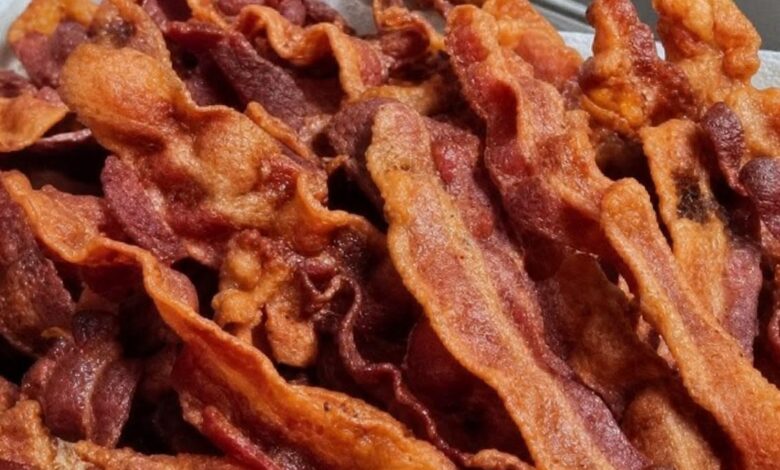
If you’re still standing over a skillet getting attacked by flying bacon grease every weekend, there’s a much easier way.
And once you try it, you may never cook bacon in a frying pan again.
For years, the traditional method seemed obvious: heat a skillet, lay down a few strips, flip them repeatedly, dodge the splattering grease, and hope every piece finishes at roughly the same time.
The problem is that bacon rarely cooperates.
One end burns while the other stays soft. The strips curl into awkward shapes. The stove ends up coated in grease, and if you’re feeding several people, you have to cook batch after batch while everyone else waits.
There’s a simpler method hiding in plain sight.
Use your oven.
The trick begins before you even turn it on.
Line a rimmed baking sheet with aluminum foil. This isn’t absolutely necessary, but it can make cleanup dramatically easier because most of the rendered fat stays on the foil instead of baking onto the pan.
Next, arrange the bacon in a single layer.
Try not to overlap the strips. Giving each piece its own space helps it cook more evenly.
Now comes the part that surprises many people.
Put the tray into a cold oven.
Then set the oven to 400°F (about 205°C).
Starting cold allows the bacon to warm gradually as the oven heats. The fat begins rendering slowly instead of being shocked immediately by a scorching-hot pan.
That’s what helps produce those beautifully browned strips with crisp edges and less dramatic curling.
Then you can mostly leave it alone.
No standing over the stove.
No constant flipping.
No grease popping toward your hands.
Depending on the thickness of your bacon and how crisp you like it, begin checking it around the 18-minute mark. Many batches will take roughly 18–25 minutes, though especially thick bacon may need longer.
And keep a close eye on it near the end.
Bacon can go from perfectly crisp to overdone surprisingly quickly.
When it reaches the texture you like, carefully remove the baking sheet and transfer the strips to a paper-towel-lined plate or cooling rack.
The difference is impressive.
Instead of curled-up pieces cooked unevenly in a crowded skillet, you get an entire tray of bacon ready at approximately the same time.
The strips tend to stay flatter.
The browning is more consistent.
And perhaps best of all, your stovetop hasn’t become a grease-covered disaster zone.
There’s another bonus sitting right on that baking sheet.
Bacon fat.
If you cook regularly, don’t automatically throw it away. Once it has cooled enough to handle safely, the rendered fat can be strained into a heat-safe container and refrigerated for later use.
A spoonful can add tremendous flavor to roasted potatoes, eggs, vegetables, beans, or cornbread.
If you don’t want to save it, allow the grease to cool and solidify before disposing of it appropriately. Don’t pour bacon grease down the sink, where cooled fat can contribute to clogged pipes.
But what if you’re only making two slices?
Heating an entire oven can feel excessive.
That’s where the microwave becomes surprisingly useful.
Place a few sheets of paper towel on a microwave-safe plate.
Lay the bacon on top without overlapping it, then cover it with another layer of paper towel.
Microwave it in short intervals, checking frequently as it approaches your preferred level of crispness.
Because microwave wattages and bacon thickness vary considerably, there’s no perfect universal cooking time. Short bursts toward the end give you more control and reduce the chance of turning breakfast into charcoal.
The paper towels absorb much of the rendered grease while also helping contain splatter.
For one or two people, it’s difficult to beat the convenience.
So which method is better?
It depends on what you’re making.
If you’re feeding a family, preparing brunch, or need enough bacon for sandwiches, burgers, or meal prep, the oven is hard to beat.
You can cook an entire tray while preparing everything else.
If you’re making a couple of strips for breakfast, the microwave is fast and requires almost no cleanup.
Either way, you’re free from hovering over a sputtering frying pan.
And there is one more reason the oven method is worth remembering.
It makes bacon useful far beyond breakfast.
Bake a large batch and suddenly you have crispy strips ready for BLTs.
Chop them over baked potatoes.
Crumble them into salads.
Add them to scrambled eggs.
Scatter pieces over macaroni and cheese.
Or do what inevitably happens in many kitchens:
Stand beside the baking sheet and eat a piece before anyone else realizes the bacon is finished.
Because somehow, regardless of how many strips you make, there’s always one that mysteriously disappears before reaching the table.
Call it the cook’s tax.
And after discovering that crisp bacon can come from a foil-lined tray instead of twenty minutes spent dodging hot grease at the stove, you may start wondering why you ever cooked it any other way.