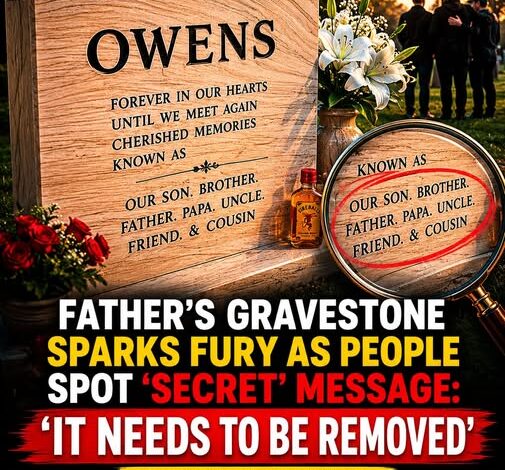
At first glance, the headstone looks ordinary.
Gray granite.
Polished edges.
A pair of engraved roses curling softly around the base.
Nothing about it immediately signals controversy.
Visitors walking through Greenlawn Memorial Cemetery usually pass it without hesitation, pausing only briefly to read the name carved across the front:
Steven Owens.
1964–2017.
Beloved husband.
Father.
Friend.
Like thousands of other stones spread across quiet acres of grass and memory, it appears to exist for one purpose only:
to help the living continue loving someone after death has made touching impossible.
But if you walk around to the back and read carefully, something changes.
The inscription begins innocently enough.
Forever in our hearts.
Until we meet again.
Cherished beyond words.
Kindness never forgotten.
Each sentence sounds gentle.
Traditional.
Tender.
Until someone notices the pattern.
The first letter of every line forms an acrostic:
F.
U.
C.
K.
And suddenly the quiet little headstone becomes something else entirely.
A joke.
A protest.
An offense.
A love letter.
Depending on who is standing in front of it.
To Steven Owens’s family, the hidden message is neither vulgarity nor rebellion.
It is recognition.
The phrase spelled secretly into granite was something Steven said constantly throughout his life — not with cruelty, but with theatrical exaggeration and mock frustration. He used it when the football team lost, when someone burned toast, when his children tracked mud through the kitchen after rainstorms.
His wife, Denise, once described it as “his version of punctuation.”
Not anger.
Not aggression.
Personality.
“He’d say it,” Denise explained years later, “then grin two seconds afterward because he never actually stayed mad at anything.”
Their children remember it too.
The sound of him pretending outrage while secretly laughing.
The exaggerated sigh before the profanity.
The way he’d soften halfway through the sentence whenever one of them started laughing first.
To outsiders, the acrostic looks crude.
To them, it sounds like home.
That distinction became the center of a debate nobody expected when the stone was installed six months after Steven’s death.
The cemetery groundsman noticed it first.
At first, he thought he was imagining things.
Then he reread the inscription twice more before quietly contacting township officials.
Soon trustees stood beside the grave awkwardly discussing whether a hidden profanity violated cemetery standards. Lawyers reviewed regulations. Administrators debated intent versus interpretation.
Technically, no explicit profanity appeared visibly on the stone itself.
Only complete sentences.
Respectful sentences.
The offense existed only once someone assembled the hidden pattern intentionally.
Which raised a strange and unexpectedly emotional question:
Can grief break rules if love is the reason?
Township trustee Harold Baines argued no.
“Cemeteries are public spaces,” he insisted during one tense community meeting. “Families visit here with children. People come searching for peace. They shouldn’t encounter profanity hidden in memorials.”
Others agreed.
One woman described bringing flowers to her late husband’s grave before noticing the acrostic accidentally.
“Once you see it,” she said quietly, “you can’t unsee it.”
Another resident called the stone disrespectful to surrounding families mourning nearby.
But Steven’s children heard those complaints differently.
To them, strangers were asking their family to sanitize their father after death.
As though mourning only counted if performed politely enough for public approval.
Steven’s oldest daughter, Rachel, eventually spoke during the final township hearing.
She carried herself calmly despite cameras and crowded folding chairs filling the municipal building.
“You see a swear word,” she said softly. “We see our dad.”
The room fell silent.
Because grief complicates morality in uncomfortable ways.
Most people accept memorials when they look solemn enough:
crosses,
flowers,
Bible verses,
military symbols.
But what happens when remembrance includes humor?
Imperfection?
Language considered inappropriate by strangers but emotionally sacred by family?
Who decides which versions of the dead deserve preservation?
Rachel described childhood dinners where Steven mocked burnt meat dramatically while everyone laughed around the kitchen table. She described his habit of muttering the same phrase affectionately whenever his children beat him at cards or interrupted football games.
“He wasn’t polished,” she admitted. “He was funny. Loud. Human.”
Then she looked directly toward the trustees.
“If grief means remembering someone honestly,” she asked quietly, “why should death force us to pretend he spoke differently than he did?”
No one answered immediately.
Because beneath the argument about profanity sat something much larger:
the tension between public decorum and private love.
Cemeteries occupy strange emotional territory.
They are public spaces built from intensely personal pain.
Every grave represents a private universe of memories strangers cannot fully understand:
inside jokes,
arguments,
favorite songs,
annoying habits suddenly transformed precious by loss.
Most of those memories remain invisible.
Steven Owens’s family accidentally made theirs visible.
That visibility unsettled people.
Especially because the acrostic required participation.
No giant obscenity carved boldly across granite.
No deliberate confrontation.
Only a hidden message waiting quietly for observant eyes.
Which somehow made it feel more intimate —
and more intrusive.
In the end, township officials reached an uncomfortable compromise.
The stone remained.
Legally, it violated no written cemetery policy. The inscription itself contained no direct profanity visible in ordinary reading. Forcing removal risked constitutional challenges surrounding speech, memorial rights, and religious expression.
Still, administrators privately worried the decision would encourage copycats.
It didn’t.
Perhaps because most families understood something important:
the power of the Owens headstone came not from rebellion, but specificity.
It mattered because it belonged unmistakably to one particular man.
Years passed.
Grass grew.
Seasons changed.
Other funerals filled nearby plots.
And still the stone remained there quietly among rows of polished granite and fading flowers.
Some visitors notice the acrostic immediately.
Others never see it at all.
But for those who do notice, the reaction usually unfolds in stages.
Confusion first.
Then surprise.
Then either discomfort or reluctant laughter.
Sometimes both.
Children occasionally ask questions.
Older visitors shake their heads.
Teenagers secretly photograph it.
Meanwhile Denise still visits every Sunday morning carrying fresh flowers and a folding chair.
She talks to Steven softly while trimming weeds around the base of the stone.
Once, a woman approached her cautiously and admitted she found the inscription offensive.
Denise listened politely.
Then asked a simple question.
“Did it make you think about him?”
The woman hesitated.
“Yes.”
Denise nodded toward the stone.
“Then it worked.”
That answer spread quietly through town afterward because people couldn’t stop thinking about it.
What is a memorial actually for?
To comfort strangers?
Or to preserve someone truthfully enough that the people who loved them still recognize the soul beneath the name?
Steven’s family never claimed the stone was tasteful.
Tasteful wasn’t the point.
The point was hearing him again somehow.
Hearing the mock annoyance in his voice.
Seeing him grin across the kitchen.
Remembering the ridiculous phrase that always ended in laughter instead of anger.
Grief does not erase personality.
Sometimes it sharpens it.
And perhaps that is why the headstone still unsettles people years later.
Not because profanity appears hidden inside it —
but because it refuses to separate mourning from humanity.
Too often, society expects the dead to become polished versions of themselves:
gentler,
cleaner,
easier to display publicly.
But real love remembers imperfections too.
The irritating habits.
The embarrassing jokes.
The phrases that would sound terrible outside the family but somehow became affection inside it.
Steven Owens’s grave forces strangers to confront that discomfort directly.
To ask themselves whether respect means silence and decorum —
or honesty complicated enough to include laughter beside loss.
Even now, years after the controversy faded from local headlines, visitors still occasionally stop before the stone longer than expected.
Some walk away offended.
Others smiling despite themselves.
And somewhere beneath the gray granite and careful lettering rests a man whose final joke continues dividing strangers while quietly comforting the people who miss him most.
The acrostic remains there hidden in plain sight.
Waiting.
Not for approval.
Not for forgiveness.
Only recognition.
Because to Steven’s family, the message carved into stone was never really profanity at all.
It was the sound of a husband and father still refusing, even in death, to leave quietly.