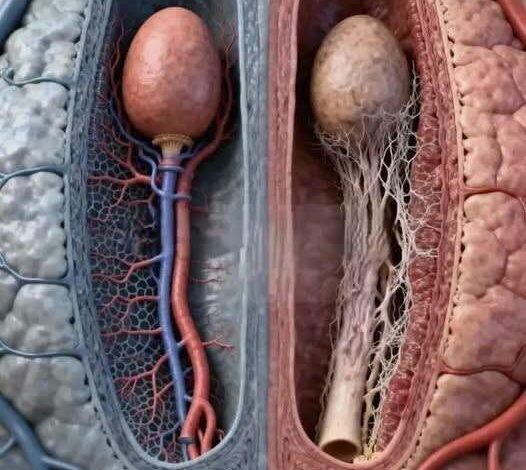
One of the most misunderstood parts of male aging happens quietly.
There may be no dramatic moment when a man suddenly realizes his body has changed. Instead, the differences often arrive gradually.
An erection may take longer to develop.
Firmness may not feel exactly the same.
Recovery after sex may take more time.
Sensitivity or sexual desire may shift.
What once happened almost automatically may begin requiring more stimulation, more time, or a different approach.
For some men, these changes immediately trigger one frightening thought:
Something is wrong with me.
But aging doesn’t mean the male body suddenly stops functioning.
It means the systems responsible for sexual function are aging along with everything else.
And understanding what’s happening can make the changes far less mysterious.
An erection, for example, depends heavily on blood flow.
When sexual stimulation occurs, a complex interaction between the brain, nerves, hormones, and blood vessels allows more blood to enter erectile tissue.
That means cardiovascular health and sexual health are closely connected.
When you’re young, healthy blood vessels generally expand efficiently.
As decades pass, arteries can become less flexible. Conditions such as high blood pressure, high cholesterol, diabetes, and atherosclerosis can further affect circulation.
If blood cannot enter and remain in erectile tissue as efficiently as before, erections may become slower to develop or less firm.
That’s not simply an issue “down there.”
It can reflect what’s happening throughout the vascular system.
This is one reason persistent erectile dysfunction shouldn’t automatically be dismissed as an inevitable inconvenience of getting older.
Sometimes it can be associated with underlying cardiovascular or metabolic problems.
A conversation with a healthcare professional may therefore reveal information that matters well beyond sexual performance.
Nerves change with age too.
Sexual response depends on communication between the nervous system and reproductive tissues.
Over time, sensation and response can change, and certain medical conditions can accelerate that process.
Diabetes, for example, can affect both nerves and blood vessels.
Some surgeries, neurological disorders, medications, and other health conditions can also influence sexual function.
Then there are hormones.
Testosterone levels often decline gradually as men age, although the pattern varies considerably between individuals.
Testosterone plays roles in libido, muscle mass, bone health, energy, mood, and sexual function.
But there’s an important distinction:
Getting older doesn’t automatically mean a man has clinically low testosterone.
And symptoms such as fatigue, reduced libido, or erectile difficulties don’t prove that testosterone is the cause.
Those symptoms can have many explanations.
That’s why testosterone therapy shouldn’t be treated as a universal anti-aging solution.
If low testosterone is suspected, proper medical evaluation and appropriate testing matter.
The physical tissues themselves also change.
Connective tissue can become less elastic with age.
Skin changes.
Muscle mass may decline.
Blood vessels become less flexible.
Recovery takes longer.
The same biological aging visible in knees, backs, skin, and muscles is occurring in tissues we rarely discuss openly.
Yet silence creates unnecessary anxiety.
A man may notice that his sexual response at 60 isn’t identical to what it was at 25 and assume something catastrophic has happened.
Often, the more useful question is not:
“Why doesn’t my body work exactly as it used to?”
It’s:
“What does healthy sexual function look like for me now?”
That change in perspective matters.
Aging may mean spontaneous erections happen less frequently.
It may mean more direct stimulation is needed.
The refractory period—the recovery time before another erection is possible—may become longer.
Sexual desire may fluctuate differently.
None of those changes automatically marks the end of a satisfying sex life.
Sexuality can adapt.
Unfortunately, many men receive almost no education about this.
They hear jokes.
They see advertisements promising to restore youth.
They encounter exaggerated claims about supplements, hormones, and miracle treatments.
What they rarely hear is a calm explanation of what aging actually does.
That information can prevent men from interpreting every normal change as personal failure.
But there’s another side to the story.
Not every sexual problem should be blamed on age.
A sudden or persistent change deserves attention, particularly when it appears alongside other symptoms.
Erectile difficulties can be influenced by heart and blood-vessel disease, diabetes, medication side effects, hormonal problems, neurological conditions, depression, anxiety, stress, sleep problems, alcohol use, smoking, and other factors.
Sometimes several causes overlap.
Even relationship dynamics can influence sexual response.
The body and mind aren’t separate machines.
Worry itself can become part of the problem.
A man experiences difficulty once.
The next time, he remembers it.
Now he’s monitoring himself instead of enjoying the moment.
Will it happen again?
Am I losing it?
What will my partner think?
That anxiety activates precisely the kind of stress response that can interfere with sexual arousal.
One difficult experience becomes anticipation.
Anticipation becomes pressure.
Pressure creates another difficult experience.
Soon, what began as an occasional physical change has become a psychological cycle.
Breaking that cycle often begins with removing shame.
Sexual function isn’t a measure of masculinity.
An erection isn’t a character test.
And needing medical help isn’t evidence of weakness.
It is healthcare.
There are also practical ways to support sexual health as the body ages.
Perhaps surprisingly, many of them are the same habits recommended for protecting the heart.
Regular physical activity supports cardiovascular health and circulation.
Managing blood pressure, cholesterol, and blood sugar can protect blood vessels.
Avoiding smoking matters because tobacco damages the vascular system.
Maintaining a balanced diet and a healthy weight can support metabolic and cardiovascular health.
Sleep matters too.
So does moderating alcohol consumption.
None of these habits guarantees perfect sexual function forever.
Aging cannot be “hacked” out of existence.
But protecting overall health can help preserve many of the systems sexual function depends upon.
Medication also deserves consideration.
Certain drugs used for blood pressure, depression, prostate conditions, and other health problems can affect libido, erections, ejaculation, or orgasm.
That doesn’t mean someone should stop prescribed medication on their own.
Doing so can be dangerous.
Instead, if sexual changes begin after starting or changing a medication, bring it up with the prescribing clinician.
There may be alternatives or adjustments worth discussing.
And yes, effective treatments for erectile dysfunction exist.
Depending on the cause and individual health situation, clinicians may consider oral medications, counseling, lifestyle changes, treatment of underlying medical conditions, vacuum devices, injections, or other therapies.
The right option depends on the person.
That’s another reason random online supplements can be a poor substitute for medical evaluation.
Products promising immediate increases in testosterone, blood flow, size, stamina, or “male vitality” are marketed aggressively.
Their claims may be much stronger than the evidence supporting them, and some products can interact with medications or contain undisclosed ingredients.
When something affects cardiovascular function or hormones, “natural” does not automatically mean harmless.
A clinician can help separate treatments supported by evidence from expensive promises.
Men should also pay attention to changes that aren’t simply about erections.
A new lump.
Persistent pain.
Blood in urine or semen.
Significant changes in urination.
A noticeable new curvature accompanied by pain.
Unexplained swelling.
These aren’t things to silently tolerate because discussing them feels embarrassing.
They deserve appropriate medical evaluation.
The same applies to a major unexplained loss of sexual desire, particularly when accompanied by fatigue, mood changes, or other symptoms.
Sometimes the explanation is straightforward.
Sometimes testing is needed.
Either way, information is better than months of private worry.
Partners can help too.
Sexual changes become much harder when both people interpret them personally.
One person thinks:
“My body is failing.”
The other thinks:
“They aren’t attracted to me anymore.”
Neither may be true.
A simple conversation can prevent physical changes from becoming emotional distance.
Sex may need to become less rushed.
More communication may be necessary.
Different forms of intimacy may become more important.
Expectations developed decades earlier may need to evolve.
That’s not necessarily deterioration.
It’s adaptation.
We accept adaptation almost everywhere else in aging.
Someone who exercised at 25 may train differently at 65.
A person may need reading glasses.
Recovery after physical activity takes longer.
Sleep patterns change.
Dietary needs evolve.
Yet when sexual function changes, many people suddenly expect the body to remain frozen in youth.
That expectation creates suffering biology never asked for.
Healthy aging isn’t about pretending nothing changes.
It’s about understanding what changes, protecting what can be protected, treating what can be treated, and adapting without shame.
For men, that means paying attention to cardiovascular health.
Staying physically active.
Avoiding tobacco.
Managing chronic conditions.
Reviewing medications when appropriate.
Getting recommended medical care.
And speaking up when something changes significantly.
Most importantly, it means abandoning the idea that sexual function determines personal worth.
The body at 70 isn’t supposed to behave exactly like the body at 20.
Different doesn’t automatically mean damaged.
Slower doesn’t mean finished.
And asking for help certainly doesn’t mean failure.
Sometimes a sexual change is simply part of aging.
Sometimes it’s a clue pointing toward a treatable medical condition.
Knowing the difference requires something many men have historically been discouraged from doing:
Talking about it.
So if you’ve noticed persistent changes, don’t rely solely on embarrassment, advertisements, or internet reassurance.
Talk with a qualified healthcare professional.
Ask questions.
Understand your cardiovascular health.
Discuss medications and other symptoms.
Get evaluated when appropriate.
Because aging doesn’t erase sexuality.
It changes the body in which sexuality exists.
And learning how that body works now—rather than demanding that it behave exactly as it did decades ago—can turn fear into understanding and uncertainty into something far more useful:
A plan for staying healthy.