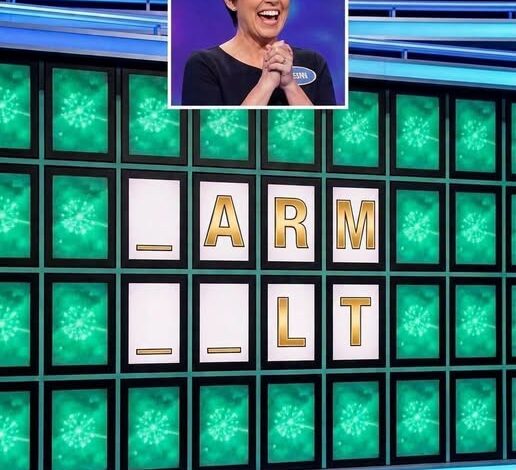
For a few seconds, nobody understood what they had just witnessed.
The cameras kept rolling.
The audience waited.
And the woman standing at the center of it all barely seemed to move.
She didn’t frantically search for clues.
She didn’t whisper possibilities under her breath.
She didn’t stare desperately at the letters, hoping something would suddenly make sense.
Instead, she became completely still.
Then she gave the answer.
Almost instantly.
The room erupted.
What should have been a difficult puzzle—one designed to force hesitation, mistakes, and nervous guessing—had apparently been solved as casually as recognizing an old friend’s face.
Even the host seemed momentarily stunned.
People watching at home had the same reaction.
Wait.
How did she know that?
Within hours, recordings of the moment began spreading online.
People slowed the footage down.
They replayed it.
They watched her eyes.
They studied her expression.
Some tried to determine exactly when she had recognized the answer.
Others searched for some overlooked clue that might explain how she had reached the solution so quickly.
But replaying the footage only made the moment stranger.
There was no visible breakthrough.
No dramatic widening of the eyes.
No sudden smile announcing that she’d figured it out.
One moment she was looking at the problem.
The next, she seemed to know.
That difference fascinated viewers.
We’re accustomed to watching people struggle.
Especially on game shows.
Contestants pace mentally through possibilities.
They guess.
They correct themselves.
They panic as the clock runs down.
Their faces reveal the battle happening inside their heads.
But this contestant appeared to skip the battle entirely.
She simply looked.
Paused.
And answered.
It didn’t look like calculation.
It looked like recognition.
That’s why some viewers began describing the moment as almost impossible.
But there may be a surprisingly human explanation.
The brain doesn’t always solve problems consciously.
Sometimes it recognizes patterns before we’re capable of explaining how we recognized them.
Think about reading.
An experienced reader doesn’t consciously inspect every individual letter in a familiar word.
The brain sees the arrangement and recognizes the whole.
The same thing happens with faces.
You can recognize someone across a crowded room without consciously measuring their nose, eyes, jawline, and distance between their eyebrows.
You simply know them.
Expertise can work similarly.
A chess master may glance at a board and immediately sense danger that would take a beginner several minutes to discover.
An experienced musician can hear that something is wrong before identifying the exact note.
A mechanic may hear an engine for three seconds and know where to start looking.
Years of exposure create enormous libraries of patterns.
Eventually, the brain becomes capable of matching new situations against those patterns at astonishing speed.
What looks like magic from the outside may actually be compressed experience.
That doesn’t make the moment less impressive.
It arguably makes it more impressive.
Because mastery often becomes invisible.
Beginners show their work.
Experts sometimes don’t need to.
They have already performed thousands of versions of the work in the past.
Practice slowly converts deliberate thinking into instinct.
That’s why the contestant’s stillness became almost as fascinating as the answer itself.
There was no wasted motion.
No theatrical struggle.
No attempt to prove how hard she was thinking.
She simply gave herself enough space to see what was already there.
And perhaps that’s why the clip resonated far beyond the game itself.
Modern culture worships visible effort.
We celebrate grinding.
Hustling.
Working longer.
Trying harder.
Pushing through exhaustion.
If someone succeeds without appearing to struggle, we’re almost suspicious.
Surely there must be a trick.
Surely they had an unfair advantage.
Surely something happened that we didn’t see.
We have become so accustomed to associating difficulty with legitimacy that effortless performance can feel unnatural.
But effort doesn’t always appear at the moment of success.
Sometimes the effort happened years earlier.
In repetition.
In mistakes.
In thousands of small experiences nobody watched.
The concert pianist’s fingers appear effortless because the difficult work happened during countless lonely hours of practice.
The athlete reacts in a fraction of a second because the movement has been rehearsed thousands of times.
The experienced emergency worker remains calm because panic has gradually been replaced by procedure.
What audiences witness is the final layer.
The quiet part.
The moment preparation becomes intuition.
Perhaps something similar happened here.
The contestant didn’t necessarily calculate every possibility.
She may have recognized the structure before consciously articulating why it worked.
Her brain saw the pattern.
Everything else disappeared.
And then came the answer.
There’s another reason moments like this captivate us.
Most people know the opposite feeling extremely well.
We’ve stared at a problem until frustration made it harder.
We’ve reread the same sentence without understanding it.
We’ve searched desperately for something sitting directly in front of us.
We’ve tried to remember a name only to have it vanish further away the harder we chased it.
Then we stop trying.
We take a shower.
Go for a walk.
Think about something else.
And suddenly:
There it is.
The answer arrives.
Not because the brain stopped working, but because conscious effort stopped interfering with whatever was happening underneath.
Sometimes stepping back isn’t abandoning the problem.
It’s changing how the problem is being processed.
That may explain why the contestant’s tiny shift in attention looked so important.
She didn’t attack the puzzle.
She allowed herself to see it differently.
And suddenly, what appeared complicated became obvious.
Afterward, analysts could talk about probability.
Fans could debate intuition.
Others could insist she had simply gotten lucky.
Perhaps several explanations contained pieces of the truth.
But none fully captured what made the footage so satisfying to watch.
It was the expression.
Or rather, the absence of one.
There was no panic.
No desperation.
No visible doubt.
Just recognition.
For one fleeting moment, a human being seemed perfectly synchronized with the problem in front of her.
We’ve all experienced smaller versions of that sensation.
A sentence suddenly writes itself.
A difficult calculation clicks.
A forgotten memory returns.
A puzzle rearranges itself in the mind.
Something that seemed impossibly tangled becomes simple.
And afterward, it’s difficult to understand why it ever looked complicated.
The maze disappears.
You see the path.
That is what viewers were watching.
Not necessarily genius.
Not necessarily luck.
But one of those rare moments when preparation, attention, instinct, and timing seem to converge.
The recording can be slowed down.
Her eyes can be studied frame by frame.
Every movement can be analyzed.
But the most important part happened somewhere cameras couldn’t reach.
Inside the mind.
A pattern formed.
A connection appeared.
And before everyone else had finished wondering where to begin, she was already at the end.
Maybe that’s why millions kept replaying it.
They weren’t simply watching someone win.
They were watching the strange beauty of knowing.
No struggle.
No performance.
No dramatic journey through the maze.
Just a quiet pause.
Then the realization that perhaps, for her, there had never been a maze at all.