Patrick Hardison never expected an ordinary day of service to become the beginning of one of the most extraordinary medical journeys in modern history.
A volunteer firefighter from Mississippi, Patrick had built his life around helping others. Known for stepping forward when people needed assistance, he responded to emergencies without hesitation. In September 2001, that commitment led him to a house fire that would change his life forever.
What began as a routine rescue quickly turned into a nightmare.
While battling the blaze, the structure suddenly collapsed. Trapped amid intense heat and flames, Patrick was engulfed by the fire before he could escape. Although he survived, the injuries he suffered were catastrophic.
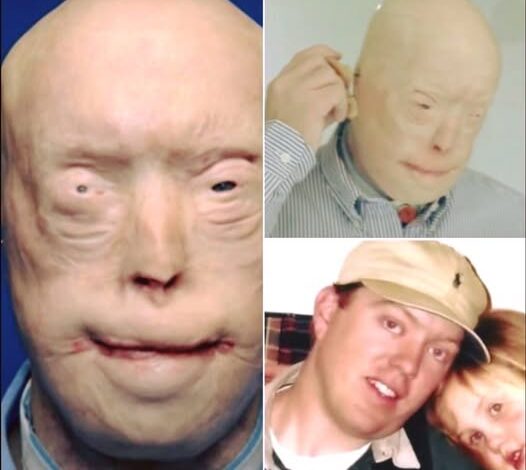
Third-degree burns covered much of his face, scalp, neck, and upper body. The fire destroyed critical facial features, including his eyelids, ears, lips, and nose. The damage was so severe that even seasoned first responders later described the injuries as almost impossible to comprehend.
In the days that followed, doctors focused first on keeping him alive.
Then came the long road of reconstruction.
Over the next several years, Patrick endured more than 70 surgeries. Each procedure aimed to restore function, reduce pain, and preserve what remained of his quality of life. Despite remarkable efforts by medical teams, many basic human actions remained difficult or impossible.
He could not blink normally.
Smiling was painful.
Simple facial expressions most people never think about became daily challenges.
Protecting his eyesight required constant vigilance, and he lived with the ongoing risk of losing his vision altogether. To shield his face and eyes, he often wore prosthetics, sunglasses, and a baseball cap whenever he ventured into public.
Yet the emotional wounds proved just as difficult as the physical ones.
Every trip outside became a reminder of how dramatically his life had changed. Strangers stared. Children sometimes reacted with fear or confusion. Casual interactions that once felt effortless became emotionally exhausting.
Gradually, Patrick withdrew from the world around him.
Even with the support of family and friends, accepting his new reality was an immense struggle.
As the years passed, however, medical science continued to advance.
What once sounded impossible slowly became a legitimate possibility.
Face transplantation—a concept that had long belonged to science fiction—was becoming a reality.
Following the first successful facial transplant procedures in the mid-2000s, Patrick began exploring whether he might qualify for such a groundbreaking operation. The process was complex and uncertain. Finding a suitable donor required an extraordinarily precise match involving tissue compatibility, blood type, and numerous medical factors.
Years passed before a breakthrough finally arrived.
A young man named David Rodebaugh became Patrick’s donor after his family made the courageous decision to donate multiple organs following his death. Their generosity opened the door to a procedure that would become one of the most ambitious reconstructive surgeries ever attempted.
The operation took place at NYU Langone Medical Center under the leadership of renowned reconstructive surgeon Dr. Eduardo D. Rodriguez.
It would require an entire team of specialists working in perfect coordination.
For approximately 26 hours, surgeons performed a highly complex facial transplant involving skin, muscles, nerves, bones, eyelids, and other critical structures. The procedure carried enormous risks, with survival estimates reportedly around fifty percent because of its unprecedented complexity.
Despite those odds, the surgery succeeded.
It became a landmark achievement in the field of reconstructive medicine.
The months that followed brought new challenges.
Patrick had to relearn many of the functions most people perform automatically. Speaking, swallowing, and controlling facial movements required extensive rehabilitation. Powerful medications were necessary to prevent his immune system from rejecting the transplanted tissue.
Progress came slowly.
But it came.
Day by day, small improvements accumulated into meaningful victories.
Gradually, Patrick regained abilities that had once seemed permanently lost. More importantly, he began reclaiming a sense of independence and confidence that the fire had taken from him years earlier.
His story became about far more than surgery.
It became a testament to resilience.
It also highlighted the extraordinary bond that can form between donor families and recipients. Patrick eventually met members of David Rodebaugh’s family, creating a connection built on gratitude, generosity, and shared humanity.
Those encounters underscored the profound impact of organ donation.
In moments of unimaginable loss, one family’s decision had given another family hope.
Today, Patrick continues to live with the lifelong responsibilities that come with a facial transplant. Regular medical monitoring and ongoing treatment remain part of his reality. Yet he has regained much of the independence and quality of life that once seemed beyond reach.
His journey stands as one of the most remarkable examples of what modern medicine can achieve when combined with determination, courage, and compassion.
More than a story about survival, it is a story about possibility.
It is a reminder that even after devastating trauma, recovery can emerge from the combined efforts of skilled doctors, selfless donors, supportive families, and individuals who refuse to give up.
Patrick Hardison’s life was forever changed by a single moment inside a burning building.
But his story did not end there.
Through science, perseverance, and the kindness of others, he found a second chance—and became living proof that hope can survive even the most unimaginable circumstances.